A shopper finds the right jacket, the right color and almost the right size. The website says the missing size is sold out. Across town, 20 of them are hanging in a store. The retailer has the merchandise and the customer, yet still loses the sale because its systems cannot introduce the two. This is the small, maddening gap where Pow* has built a business.
The Buenos Aires company works on ecommerce’s visible surface - the store design, product pages and checkout - but its more revealing work happens behind the screen. It joins warehouse stock to store stock, decides where an order should be fulfilled, connects an online shop to an ERP, automates returns and studies which combination of traffic and interface changes might lift conversion. Pow* calls itself a technology company specializing in ecommerce. In practice, it is a hybrid: consultant, development agency, systems integrator, growth shop and increasingly, software maker.
That combination is aimed at established Latin American retailers whose problem is no longer getting a store online. Their problem is getting a digital business to behave like one coherent business. Founded in 2014 by Guido Ginesi, now CEO, and Felipe Saguier, its CMO, Pow* says it works with more than 25 brands and fields a squad of more than 50 people. Fashion is its clearest specialty. Its public roster includes Cheeky, Como Quieres, 47 Street, Markova, Oggi, Paula Cahen D’Anvers, Equus, FARM Rio Argentina, Awada and Yagmour.
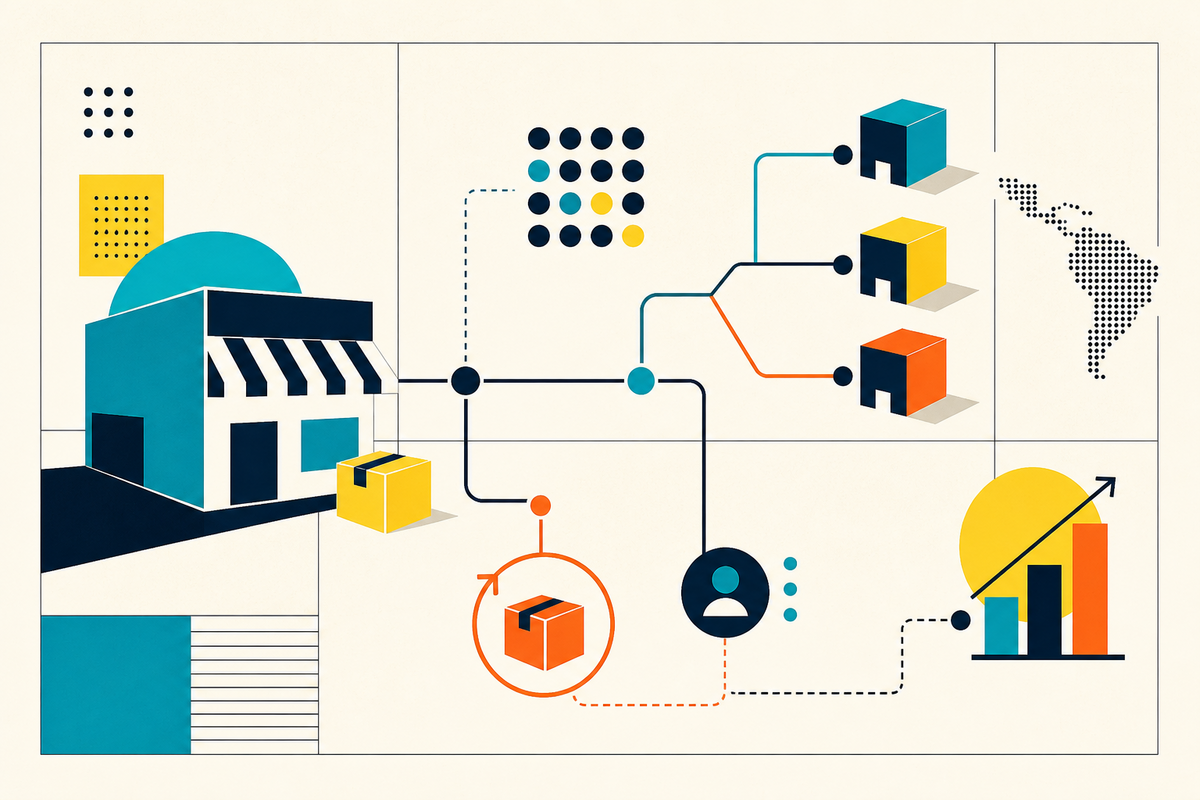
The storefront is only the lobby
Pow* implements and migrates stores on VTEX and Shopify, and offers its own Hermes commerce technology. Its designers and developers customize the front and back ends rather than treating launch day as a finish line. The company describes “evolutive development” - an ongoing stream of improvements after the store opens - and packages the work into multidisciplinary squads. A client can have product, UX/UI, engineering, growth and account strategy working from the same roadmap.
That structure answers a familiar organizational flaw. A retailer may have an agency buying traffic, another building pages, a platform vendor maintaining infrastructure and internal teams protecting the ERP. Each can hit its own target while the customer still encounters a broken journey. Pow*’s pitch is that one partner should see the chain. Its homepage puts the proposition bluntly: access talent and technology that are difficult to find in a single provider.
“A website can be beautifully on-brand and still lose the sale because the stock is stranded in the wrong system.”The operational thesis behind Pow*’s model
The business model follows that breadth. Implementation and migration produce project revenue. Consulting, growth marketing and continuing development can support longer engagements. Proprietary tools add a software layer. Pow* does not publish pricing, revenue or the balance between those streams, but its case studies repeatedly emphasize multi-year relationships. Markova, for example, is presented as an eight-year technology and growth client. The product is not simply a new website. It is accumulated knowledge of how the retailer operates.
Software born from awkward handoffs
The proprietary portfolio reads like a list of headaches discovered during client work. OMNITEX is Pow*’s order management system. It centralizes orders from different platforms, unifies inventory across a retail network and lets a brand set rules for where each parcel should leave from. Stock sitting in a store can become available to the website. Orders can be routed according to the retailer’s own priorities instead of a generic workflow.
Undo handles exchanges and returns, the unglamorous part of commerce that can consume customer-service time and leave usable inventory in limbo. Pow* frames reverse logistics as both an efficiency problem and a retention problem: a customer should be able to manage the process without waiting for an agent, while the business should know what is coming back. Link-Up connects ecommerce to ERP systems. Together, the tools cover the moments when a shiny commerce platform meets an older, messier operating reality.
The differentiation is not that no competitor can provide these pieces. VTEX and Shopify have large partner ecosystems. Specialist agencies can design sharper interfaces. Enterprise integrators can tackle complex plumbing. Marketing firms can buy media, and standalone vendors sell order and returns software. Pow*’s claim is narrower and more credible: for a certain kind of Latin American retailer, it can assemble more of the required pieces under one accountable team.
Fashion makes the test harder
Apparel is a useful proving ground because its inventory is fragile. One shirt may exist in several colors and sizes, spread across a warehouse and a dozen shops. Collections turn over. Promotions create short, violent spikes in demand. Exchanges are common. A “sold out” message can mean no units exist, or merely that the ecommerce system cannot see the unit on a shelf. Omnichannel retail sounds abstract until one missing size costs a basket.
Pow*’s published results should be read as company case-study figures rather than audited comparisons, but they show what the firm chooses to optimize. After unifying stock for Cheeky through Hermes, Pow* reports an 18 percent increase in revenue, 19 percent more items and 26 percent more tickets. A migration of 47 Street to VTEX IO, with features including Dark Mode and Shop the Look, is credited with 155 percent higher revenue, 15 percent more tickets and 33 percent more sessions.
+18% revenue · +19% items · +26% tickets, according to Pow*’s case study.
+155% revenue · +15% tickets · +33% sessions after migration and new features.
+40% repeat purchase · +10% frequency · +29% conversion after redesign and integrations.
+33% units · +27% orders · +22% revenue across two newly independent stores.
For Mexican footwear brand Oggi, a Shopify redesign and integrations are associated with a 40 percent rise in repeat purchase, a 10 percent increase in purchase frequency and 29 percent higher conversion. Separating two Paula Cahen D’Anvers sites is linked to 33 percent more units, 27 percent more orders and 22 percent higher revenue. The common thread is not a favorite platform. It is the use of design, operations and growth as connected levers.
Regional knowledge as a product
Pow* says it has a presence in Argentina, Mexico, Colombia, Chile, Uruguay and Peru, while its delivery model can serve clients elsewhere in Latin America. That geography matters. Global commerce platforms supply powerful primitives; regional retailers still have to connect local payments, carriers, marketplaces, tax systems, ERPs and store practices. The final mile of implementation is often less like installing software and more like translating between institutions.
Its official relationships with VTEX and Shopify give Pow* access to the platforms on which it builds. The company also participates in the surrounding industry: it has worked with Tiendanube’s agency ecosystem, co-organized a post-Hot Sale discussion with Data4Sales and fashion ecommerce leaders, and helped organize GlamDays alongside a group that includes Mercado Libre and other commerce agencies. In July 2026, it appeared at VTEX’s Ecommerce Hub in Santiago.
The company’s culture is marketed in the same practical register. Job materials describe flexible hours, hybrid work, work-from-anywhere periods, extended parental leave, a pet-friendly office, annual training support and “Pow Week” gatherings. Its own team page prizes curiosity and continuous improvement. Those benefits also serve an operating need: a business promising hard-to-find multidisciplinary talent has to keep that talent engaged.
The most defensible part of Pow* may be neither code nor creative. It is the memory of what breaks when a regional retailer tries to make every channel agree.Ten years of integrations become a kind of institutional map
A crowded market, a precise position
Pow* sits between a software vendor and a digital consultancy. That position has tradeoffs. Services can adapt to the client but are harder to scale than pure software. Products can scale but must compete with specialist tools. Supporting multiple platforms expands the addressable market while increasing technical surface area. And the all-in-one promise only works if the squads truly share context rather than reproducing the silos they are meant to remove.
Yet the model has a clear logic. Start with implementation, stay for continuing development and growth, then use proprietary software when the client’s operational gaps demand it. Each layer makes the others more informed. Campaign data can influence the interface; interface behavior can shape the roadmap; order and stock data can expose where a conversion problem is not a marketing problem at all.
For customers, that means Pow* is most useful when the ecommerce challenge crosses departmental borders. A young merchant that needs a template and a payment button has cheaper choices. A larger fashion group juggling stores, warehouses, multiple storefronts and a packed promotional calendar may value one team that understands the entire knot. Pow* has spent a decade making that knot its subject. The online shop is merely where shoppers notice whether the work held together.
Keep exploring