A product page is a confidence trick. The shopper sees a photograph, a price, a few dimensions, perhaps a line about recycled material. Behind that tidy rectangle sits a loud committee: engineering owns the specifications, marketing owns the prose, legal owns the warnings, a supplier owns the images, and every retailer insists on a different template. Change the voltage in one system and the old number may continue wandering through three marketplaces and a printed catalog.
Inriver makes the software that keeps this committee from contradicting itself in public. Its product information management platform, usually shortened to PIM, gathers raw facts from systems such as ERP and PLM, models the relationships among products, lets teams enrich and approve the content, and distributes the finished information to commerce sites, dealers, marketplaces, print, and apps. Then it watches those destinations for missing images, weak search placement, stock problems, pricing changes, and other signs that the story did not arrive intact.
This is not glamorous software, which is part of its importance. New Balance, Michelin, John Deere, Prysmian, Atlas Copco, Pandora, Fluidra, Bacardi, and Carhartt are among the names shown in Inriver's customer material. Their catalogs range from sneakers to cables to industrial machinery. The common problem is not a lack of data. It is too much data, owned by too many people, headed toward too many places.
A conveyor belt for product truth
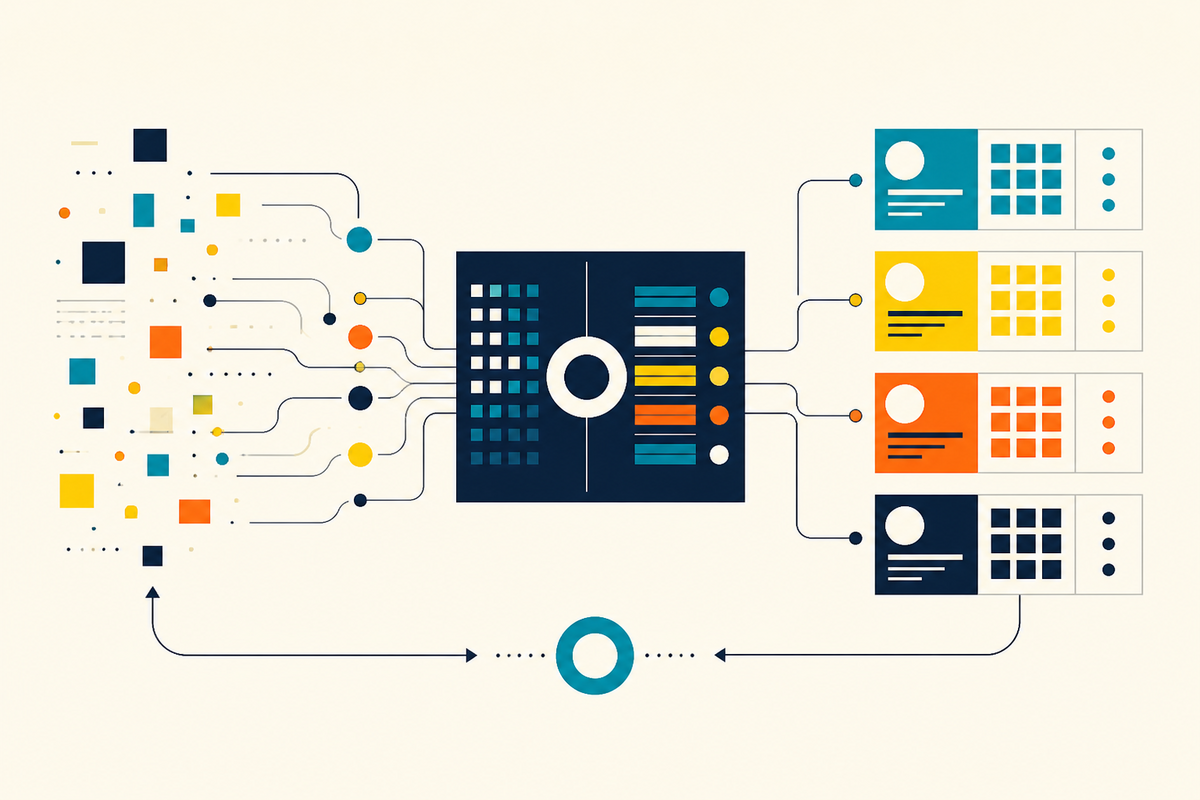
Inriver's most useful explanation of itself is a loop with four verbs: onboard, enrich, distribute, evaluate. Onboarding pulls data from internal systems, suppliers, spreadsheets, and increasingly from unstructured material such as PDFs. Enrichment turns raw attributes into complete descriptions, translations, media sets, relationships, and compliant claims. Distribution reformats that information for each destination. Evaluation inspects the digital shelf and returns evidence to the team.
The arrow bends back to the beginning. A listing is never really finished.
The last verb is the unusual one. Traditional PIM can resemble a library: carefully organize the books, then hand them out. Inriver became more like a library with field reporters after it acquired Swedish digital-shelf specialist Detail Online in 2020 and introduced Evaluate the following year. Evaluate uses automated monitoring and analytics to see whether listings are visible, accurate, available, and competitively presented. The feedback creates a practical distinction: content performance can become another input to the content process.
“No one is as smart as all of us.”One of Inriver's three culture principles, under “inclusive”
That loop is especially relevant to manufacturers. Their product data often begins as an engineering fact rather than a marketing sentence. A pump may have hundreds of attributes, regional certifications, compatible accessories, replacement parts, and installation documents. Its structure can matter more than its adjective. Inriver's flexible entity model is meant to preserve those relationships while still giving business users a place to create a convincing, channel-specific product experience.
The AI is useful when it stays in the plumbing
Generative AI has given PIM vendors a tempting new promise: press a button and fill every empty product field. Inriver's approach is more operational. Inspire can generate and translate descriptions, but its newer agents also enhance existing text, apply brand or regional tone, extract context from documents and images, and participate in governed workflows with human review. An Expression Assistant helps construct data transformations. A Query Assistant lets users search product information in ordinary language. A conversational Enrich Assistant can propose changes across several fields at once.
The important word is governed. A free-standing chatbot can write fifty descriptions quickly; it can also produce fifty fresh liabilities. In a PIM, generated material can be tied to source attributes, rules, permissions, approvals, and a defined data model. That is a less theatrical use of AI, and probably a more valuable one for a business deciding whether “water resistant” is supported by evidence in six markets.
In 2025, Inriver also released a Model Context Protocol server. MCP is a standard way for AI applications to connect with outside tools and information. The strategic idea is simple: as shopping agents begin to compare and recommend products, brands need those agents to read current, structured, authorized facts rather than stale scraps found around the web. Inriver wants the PIM to become the source that both commerce systems and AI systems ask.
How the company makes money
Inriver sells enterprise subscriptions rather than posting a simple per-seat price. The bill depends on the catalog, the modules, connections, usage, and the work required to fit the platform into a company's technology stack. Professional services, training, support, and a large implementation-partner network surround the software. SAP, Salesforce, Microsoft, Shopify, and ChannelEngine connections help product information travel between core systems and the places where buyers encounter it.
This model makes Inriver a considered purchase. A PIM implementation forces a company to decide who owns each attribute, which source wins when records conflict, how completeness is measured, and what approval means. Reviewers of enterprise PIM products regularly note the tradeoff: flexible governance and complex modeling bring implementation effort. Inriver is built for organizations whose catalog problem is expensive enough to justify that work, not for a merchant with thirty products and one storefront.
The company was founded in Malmö in 2007, when Nordic telecom growth and early ecommerce were exposing the need for scalable product information. Institutional capital followed. Verdane, Industrifonden, Zobito, the European Investment Bank, Lugard Road Capital, and RoosGruppen backed stages of expansion. Thomas H. Lee Partners took a majority stake in 2022 in an undisclosed transaction; Verdane retained a significant interest. Inriver's 2025 sustainability report described a global team of more than 300 people and a subscription platform serving over 1,600 brands.
Its stated culture fits the work. The three current values are invested, inclusive, and ingenious: take responsibility, keep promises, listen across disciplines, stay curious, and favor useful progress over perfection. Those phrases could decorate any software office, but PIM gives them a concrete test. A catalog only works when engineers, marketers, compliance teams, suppliers, and developers agree on shared definitions. Product truth is collaborative labor before it is a technical architecture.
A crowded market, a specific lane
PIM is not an empty category. Akeneo emphasizes product experience and an extensive app ecosystem. Salsify combines PIM with syndication and digital-shelf capabilities. Stibo Systems brings broader master-data depth. Syndigo, Pimcore, Pimberly, Informatica, Contentserv, and others offer different balances of governance, openness, speed, analytics, and channel reach. Buyers can also stretch an ERP, commerce platform, or homegrown database until the seams become visible.
Best fit
Enterprise manufacturers, distributors, retailers, and brands with many SKUs, markets, relationships, and technical attributes.
The wager
Product information creates more value when onboarding, enrichment, syndication, and shelf feedback live in one operating loop.
The friction
Governance requires decisions, integrations, and organizational discipline. Powerful modeling does not remove implementation work.
The new customer
AI agents need the same accurate, structured, current product truth as websites and marketplaces - delivered in machine-readable form.
Inriver's lane is the complicated middle of the product journey, particularly for B2B and manufacturing organizations that also sell directly to consumers. It connects upstream systems, supports a changeable product model, enriches content, pushes it outward through native and partner syndication, and pulls shelf observations back in. IDC placed the company in the Leader category of its 2024-2025 assessment of PIM applications for commerce, citing its B2B and direct-to-consumer strength, AI direction, and composable architecture.
For a user, the payoff is measured in ordinary moments. A product manager can see which fields are incomplete before a launch. A regional marketer can translate and adapt a description without severing it from approved facts. A channel team can test a retailer submission before it goes live. A distributor can receive the same revision as the brand's own site. None of these tasks makes a memorable advertisement. Together they reduce the expensive distance between knowing something about a product and saying it correctly everywhere.
The next test is whether PIM becomes more central as AI changes shopping. If product discovery moves from a page of blue links to an agent giving one answer, a missing attribute no longer makes a listing look shabby. It may make the product disappear from consideration. The vendor that can keep facts structured, traceable, and available at the moment of decision occupies valuable ground.
That makes Inriver's work easy to overlook and hard to dismiss. The company does not make the shoe, the cable, or the pump. It makes the description, relationships, evidence, and route by which those products become understandable. The internet is full of labels. Inriver is building the machinery that keeps them honest.