The first Posha looked like it might reach across the room and help itself to the onions. Built in 2016, when the company was called Nymble, it was a six-axis robotic arm assembled with laser-cut acrylic and about $1,000 of its founders' student savings. It could pick up ingredients, drop them into a pan and stir. As proof that a machine could cook, it had charm. As something to live beside in an ordinary kitchen, it had a problem: ordinary kitchens are full of people who have to clean things.
Raghav Gupta and Rohin Malhotra had set out to spare households a familiar bargain. A fresh dinner usually costs time; delivery saves time but takes control of ingredients and often costs more. Their eventual answer, Posha, sits on a counter. The customer chooses a recipe, preps and loads ingredients, and the machine manages the active cooking: timed dispensing, stirring, heat and a camera's view of the food. That division of labor is less theatrical than a robotic arm. It is also the point.
At a glance
- Posha sells a countertop cooker to US households; the customer still shops, chops and loads.
- A camera watches the pan while the device dispenses ingredients, stirs and changes heat.
- The listed device is $1,750, with a $1,500 limited-time offer; the full recipe library has an optional paid membership.
- The first arm gave way to a contained appliance after real kitchen feedback.
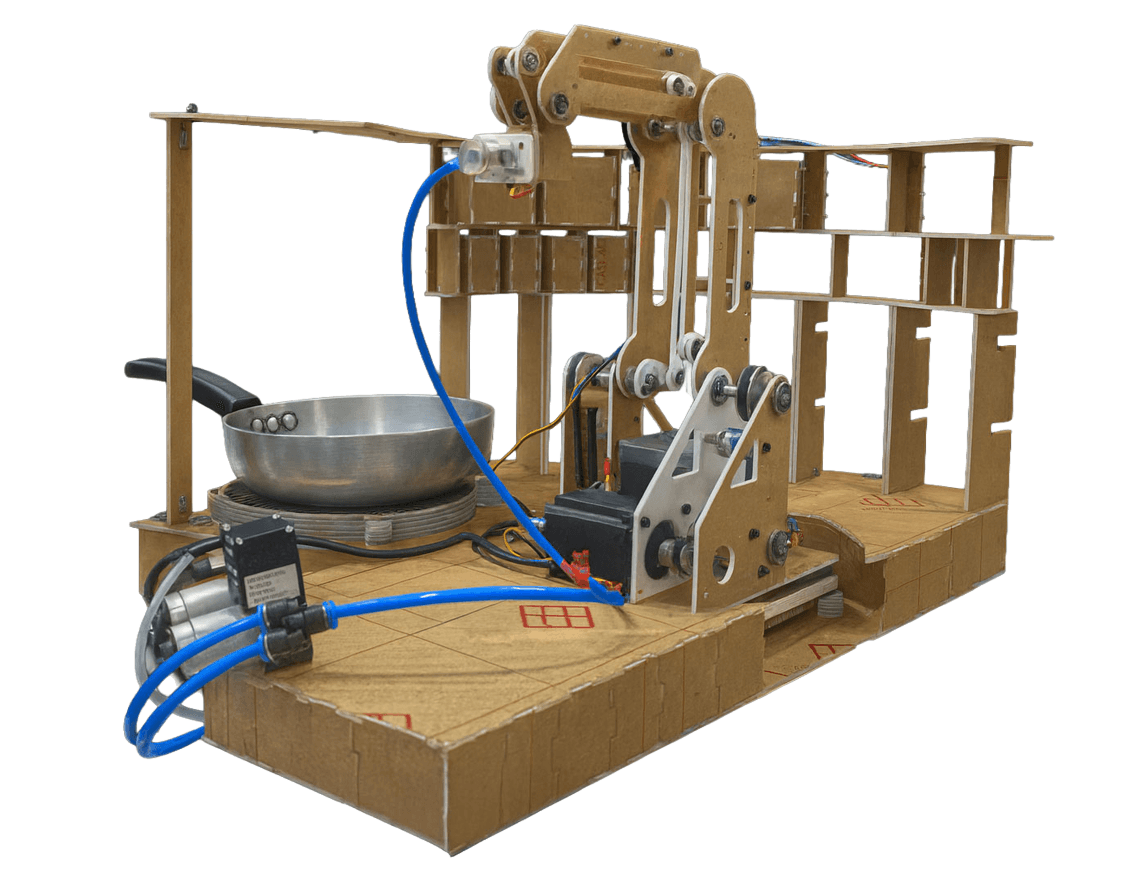
The arm was impressive. The cleanup was persuasive.
The founders joined a Bosch accelerator, where consumer feedback helped overturn the open-arm idea. People did not want a machine roaming across the kitchen or presenting a puzzle of parts after dinner. Posha's later testing moved closer to the truth of domestic hardware: the countertop is contested territory. An appliance must earn its square inches every night, and every detachable part earns a place in the sink.
In 2022, according to a company account, 50 early machines went into homes. A hardware engineer became the entire service team, visiting when units broke. Posha also describes 18 months of testing with families. Gupta told TechCrunch that he kept WhatsApp conversations with more than 100 customers and that many knew him personally. That is an unusual support system for a company trying to sell a household appliance at scale. It is also how a founder learns what an instruction manual has failed to say.
The resulting machine is closer to a small oven in footprint than to a mechanical housemate. It has a cooking pan, containers for ingredients, spice pods and a stirring mechanism. The removable food-contact parts can go in the dishwasher; the main body gets wiped down. Posha says it needs a clear patch of counter at least 27 inches wide, 22 deep and 17 high. Those numbers matter more to a buyer than the poetry of an autonomous kitchen. Measure the counter before believing the dream.
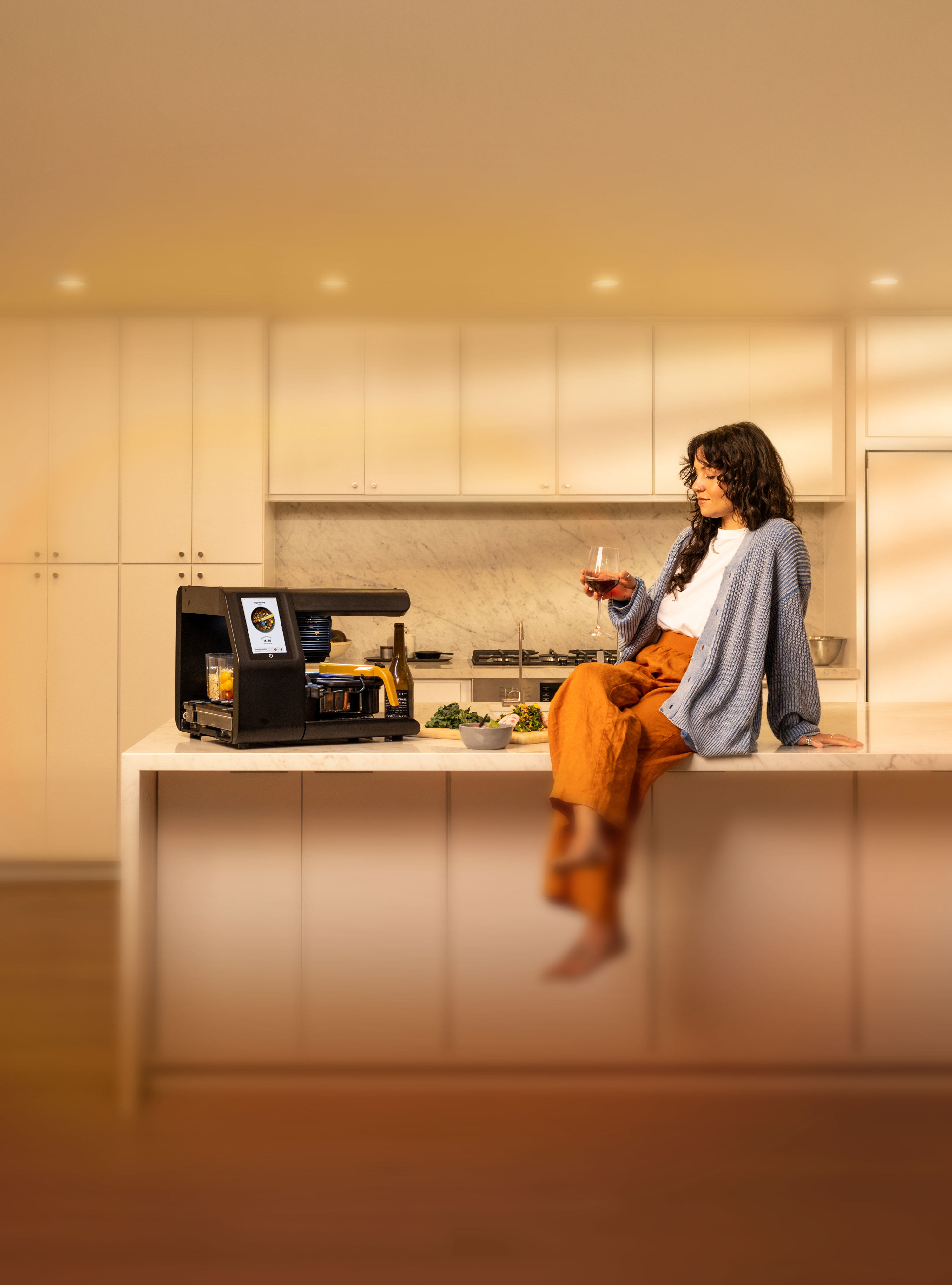
Dinner still begins with a person
A Posha meal starts in its app. Browse by cuisine or dietary preference, select servings and spice level, then follow the prep instructions. The app tells you which ingredients to cut, which container receives them and where the oil and water go. It can suggest simpler inputs, such as canned tomatoes instead of fresh ones, and offers a path to order recipe ingredients through Instacart. Personalization, including ingredient swaps, is marked as a beta feature.
Once loaded, the machine follows the recipe through the awkward middle: add this now, stir that for longer, turn the heat down. Its camera looks for changes in color, texture, size and structure. Think of onions becoming golden or liquid leaving a pan. A timer can say when five minutes have passed; a camera can at least attempt to say what happened during them. Posha describes a cooking dataset of five million data points, although the size of a dataset alone does not tell you how good tonight's curry will be.
The recipe library lists more than 1,000 dishes, from palak paneer and tom yum soup to pasta and fried rice. Yet variety has a physical boundary. TIME's 2025 assessment noted that Posha was limited to one-pot cooking. It cannot make every component of a multi-pan dinner at once, nor can it take an untouched bag of groceries and quietly turn it into supper. This is why the company's best claim is specific: it can free the cook from tending the pan, provided someone has done the shopping and prep.
“It's like a coffee machine for food.”Raghav Gupta, speaking to TechCrunch in 2025
The price of leaving the stove
Posha sells directly to US buyers. In its 2026 purchase guide, the robot lists for $1,750, with a limited-time price of $1,500. A refundable $25 deposit holds a reservation, and the balance is due when the unit ships. The offer and timing can change, a meaningful detail for anyone comparing a robot to tonight's takeout bill. Early 2025 coverage reported $1,750; current company materials show both figures.
Limited-time offer, versus a $1,750 list price. Ingredients are bought separately.
Or $139.95 a year for the full guided recipe library, after a 90-day trial.
Circle is optional. Owners retain the free Essential recipe collection and a manual Co-Pilot mode without paying for membership. Circle opens the full guided library and new recipes. That split is a candid reminder that a modern appliance is also a software business. Posha's economics depend first on selling a complicated physical machine, then on persuading owners that a growing catalog of dinners deserves a recurring fee.
The comparison is often framed as Posha versus a Thermomix, multicooker or smart oven. A programmable cooker can heat and mix; a meal kit can remove recipe planning; delivery removes the kitchen altogether. Posha occupies the narrow space between them. It keeps the family's own ingredients and fresh cooking but automates the repeated acts of waiting, adding, stirring and judging. That is valuable in a household that cooks often and dislikes those minutes. It is a poor fit for a person who loves tending a skillet, wants no prep at all, lacks the counter space, or mostly cooks dishes needing several pans.
A company built around the boring middle
The path from Nymble to Posha also says something about what the founders thought they were selling. The company says the name draws on a Hindi idea of nourishment. It is an ambitious word for a device with spice pods and a power cord, but it is pointed toward the customer rather than the mechanism. Most families are not seeking a better robot demo. They are seeking Tuesday dinner without another half hour of standing over a pan.
Posha launched its robot to customers in January 2025 and sold out its first batch, according to TechCrunch. That May, it announced an $8 million Series A led by Accel, with existing backers including Xeed Ventures, WaterBridge Ventures and Flipkart co-founder Binny Bansal. TIME placed the device on its Best Inventions of 2025 list. Posha now says its product is in more than 1,000 homes, a company-reported figure rather than an independently audited one. There is a Bengaluru engineering and recipe operation behind the US sales effort; the company's social posts show mechanical, electronics and culinary staff working together, which is exactly the mix such a product requires.
Its most transferable lesson may have little to do with artificial intelligence. The team put a rough machine in actual kitchens and watched where domestic life resisted it. The original arm proved a technical possibility. The next design answered a household objection. For an appliance maker, that is the difference between a charming machine on a stage and a useful one waiting beside the stove. The latter has to fit, cook and clean up. Dinner is a stern product manager.