A retirement account can be close to you and far from the person advising you. It appears on your statement. It takes a bite from your paycheck. It may help determine when you stop working. Yet your financial advisor can have a splendid view of your brokerage account and a distinctly less splendid relationship with your 401(k). The money has the same owner. The software has different landlords.
- The gap: workplace retirement savings often sit outside an advisor’s usual management system.
- The product: Pontera connects supported accounts for analysis, rebalancing and reporting, without moving the assets out of the plan.
- The bill: advisors buy the software; disclosed pricing examples use an annual percentage of connected assets.
- The catch: client permission, plan rules and recordkeeper access all matter.
The account with the wrong address
Wealth management calls these assets “held away.” It is a revealing phrase. Away from whom? Certainly not away from the worker who earned them. They are away from the advisor’s customary custodial infrastructure. An employer picks a workplace plan and its provider; an employee may pick an entirely different financial advisor. Those two decisions do not arrive with a common operating system.
Pontera is a New York software company working in that gap. An advisor using its platform can examine supported retirement-account holdings, monitor them, communicate rebalancing instructions and bring the information into portfolio reporting. The client’s workplace savings stay where they are. The advisor gains a way to include them in a broader investment strategy.
The distinction matters. Imagine, purely as an example, someone whose brokerage account is cautiously invested while a much larger workplace account is heavy on equities. Each account might look reasonable in isolation. The household could still be taking more risk than its owner intends. Coordinating the two requires useful information from both, followed by some practical way to act.

The X-ray became a bridge
Pontera began in 2012 as FeeX, a name its branding agency describes as “fee x-ray.” The early proposition was transparency: help people understand what they were paying on investments. The founding group included Yoav Zurel, David Weisz, Eyal Halahmi and Uri Levine, who also co-founded Waze. Today, Zurel is CEO, Weisz leads product and Levine chairs the board.
Fee analysis gives a saver an answer. It does not necessarily give that saver an afternoon free of financial administration. Someone still has to decide what to change, locate the right controls and carry out the decision. The company eventually moved toward software that let advisors manage held-away accounts. Catchword, the naming agency, dates its order-management launch to 2018.
In February 2022, FeeX became Pontera. The new name drew on the Latin root for bridge. Alongside the renaming, the company announced $80 million across three recent funding rounds led by Lightspeed Venture Partners. “We are very proud of what we accomplished under the FeeX brand,” Zurel said in the announcement. The modest pleasure of the new name is that it describes the job rather than the diagnosis.
The lesson for another founder is fairly concrete: look for the step after your product produces a useful answer. Who performs it? How often does it get postponed? Who would pay to make it easier? In Pontera’s case, the company’s evolution points toward the advisor as the buyer and implementation as the recurring problem. A better explanation of a fee was only one part of the job.
A button is a business model
Pontera sells to financial advisors and wealth management firms, including registered investment advisors and broker-dealers. The retirement saver authorizes the connection; the advisor supplies the investment judgment. Pontera’s own website says it does not provide investment advice. That division of labor is essential to understanding both the product and the bill.
A February 2023 Institutional Investor report described a 30-basis-point annual subscription. Thirty basis points means 0.30%. A 2024 disclosure from advisory firm Estrada Webb described paying that amount to Pontera from the advisory fee it already received, without charging the client a higher advisory fee for using it. That is one firm’s arrangement, not a promise about every customer’s invoice.
What 0.30% looks like
Balance × 0.003. A dated pricing example, not a current quote. This is the platform component alone; your firm’s agreement determines the total bill.
Asset-based pricing gives the vendor an economic interest in the size of the accounts connected to its service. It also gives advisors a way to expand the scope of what they manage. For a saver, the worthwhile question is wonderfully unromantic: what work am I receiving for the total fee? Access is useful, but access by itself is not a retirement outcome.
Distribution helps explain Pontera’s place in the market. In May 2025, an agreement with World Investment Advisors offered platform access to a network of more than 350 advisors. In April 2026, Orion and Pontera expanded their collaboration to incorporate workplace retirement accounts into Orion Eclipse trading and rebalancing workflows. That built on existing reporting and billing connections.
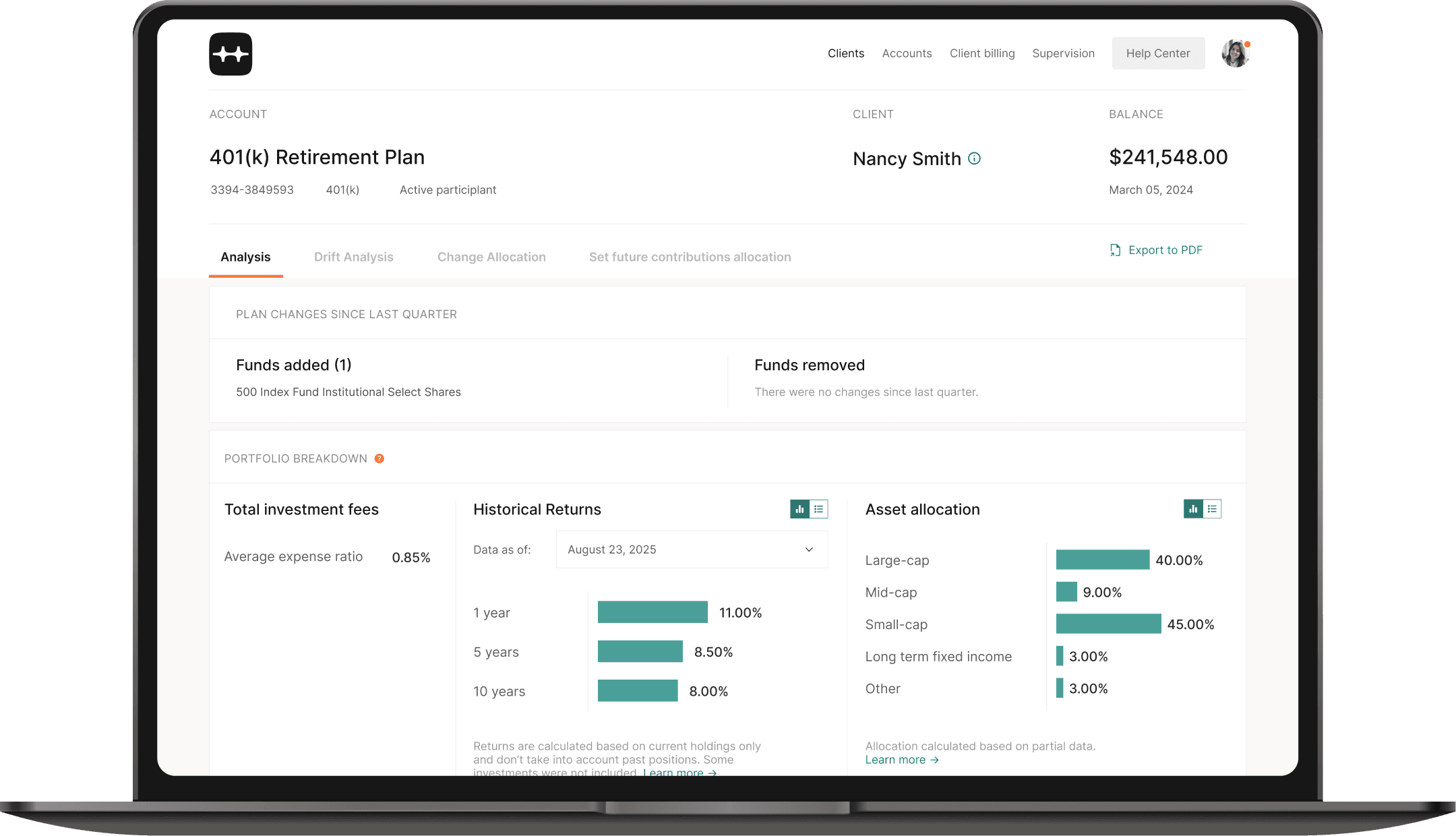
The firm’s expertise is in the connective tissue: account information, permitted actions, portfolio-system integrations and records for supervision. It fits alongside platforms such as Orion and SS&C Black Diamond. A read-only aggregator can show an account; an implementation system must also handle the journey from recommendation to order. Pontera’s proposition occupies that more demanding territory.
The bridge has a gatekeeper
The product is partly defined by its missing buttons. Pontera says advisors cannot use it to withdraw or transfer funds, initiate distributions, change beneficiaries or contributions, or see clients’ login credentials. Advisor activity produces time-stamped records for supervision. These are practical boundaries around what an outside advisor can do.
The security site reports SOC 2 Type II and ISO/IEC 27001:2022 credentials. Those address controls and information security. Whether a particular recordkeeper permits a particular connection is a separate question, and it has become an expensive distinction for the entire category.
In September 2024, Fidelity said it would begin preventing platforms reliant on credential sharing from accessing and taking action in customer accounts. In October 2025, Zurel publicly challenged those restrictions as anticompetitive. Fidelity rejected that interpretation and cited cybersecurity concerns. Its published Fidelity Access approach favors authorized data connections that do not require giving a third party the customer’s password.
There is a technical distinction worth keeping clear: an advisor not seeing a password does not mean that no intermediary uses credentials. Pontera’s published end-user terms authorize its use of credentials to connect supported accounts. The disagreement therefore cannot be settled by pointing only to what appears on the advisor’s screen.
The saver owns the money. The recordkeeper controls the doorway.
The institutional wrinkle
For an advisory firm, this is the dependency that deserves attention before a demonstration becomes a rollout. A willing client and capable software cannot guarantee an available connection. The investment menu and trading restrictions of the existing plan remain relevant, too. Software does not enlarge a plan’s fund menu by making it more convenient to navigate.
Less homework, fewer repeated clicks
Pontera’s 2026 developments show two different kinds of friction being addressed. Bulk Rebalancing groups select eligible accounts inside the same workplace plan, allowing teams to review and submit orders together and track results. The eligibility qualifier is part of the feature: a collection of unrelated retirement accounts is not automatically one batch.
In September, the company introduced its Non-discretionary Advice Workflow. Here the client implements the recommendation. The advisor can work with plan information and deliver structured guidance; the firm can monitor progress and maintain supervision records. Neither Pontera nor the advisor implements the recommended rebalance in this mode. The company says the expansion serves firms whose operating models require client-controlled action.
That is a useful acknowledgment of how people actually work. A recommendation that arrives by email can become financial homework. Homework has competitors: dinner, deadlines, children, the vague belief that next week will be quieter. Guided implementation and reminders address the distance between agreement and action, while preserving the client’s role in execution.

There are alternatives. A saver can implement an advisor’s recommendations manually, use a plan-provided managed-account service, or rely on a target-date fund where suitable. Future Capital also operates in held-away retirement management. The right comparison depends on the service needed, the available investments, permissions and the full cost. Paying for another layer makes more sense when that layer does work the household actually needs.
Pontera raised a further $60 million led by ICONIQ Growth in December 2023, bringing its reported funding at the time to $160 million. Capital supports product development and expansion; it does not resolve every institutional disagreement. The less celebrated work remains integrations, account support and fitting into advisory firms’ procedures.

Its careers material describes teams in New York, Herzliya and Warsaw, with hybrid work and investment in learning. The business may concern retirement, but its daily craft is contemporary software work: finding the recurring manual step, putting a boundary around it and making the result usable in someone else’s system.
For a reader considering the service, the practical starting point is a conversation with the advisor: which accounts are supported, who implements changes, how the relationship is supervised, and what the total fee buys. Pontera’s larger idea is attractive because it is ordinary. A household has one retirement to fund. Its accounts ought to be able to participate in the same conversation.