Steel is easiest to overlook once it has done its job. It disappears into bridge decks, truck suspensions, apartment towers and the mesh beneath poured concrete. Philippe Boulanger works in the part of the economy that makes this invisibility possible. As chief marketing officer of ArcelorMittal Long Products Canada, he has to turn metallurgy, mill capacity and carbon intensity into a proposition a customer can actually use.
His route to that job did not begin with a campaign. In 2017, Boulanger was running the company's Contrecoeur-Ouest and Longueuil complexes. Visitors to the Contrecoeur site that March watched scrap melt in an electric arc furnace, move through the ladle furnace, become billets and emerge from rolling as reinforcing bar. Boulanger and his team hosted the tour. The sequence is industrial, loud and specific. It is also the beginning of the marketing story he would later tell.
By 2018 he was publicly identified as vice-president and chief marketing officer. A current executive listing says he joined ArcelorMittal in 2009 and completed an MBA at HEC Montréal in 2010. The progression placed an operator at the point where steel meets the buyer. For a technical business, that move has a certain logic: a claim about performance lands differently when the person making it has managed the equipment, people and constraints behind the specification.
01 / The translation jobA catalogue with weight
In May 2018, Boulanger announced a detailed brochure called Our Products, Your Projects. Corporate brochures are rarely dramatic objects. This one reveals the difficulty of his assignment. Long steel products arrive in many dimensions, grades and specifications. The reader may be a sales representative, a technical specialist, a fabricator or a buyer comparing what a project demands with what a mill can reliably produce.
Boulanger described the catalogue as proof of the range customers could count on. More interestingly, it gave everyone who interacted with those customers a common tool. Marketing here is translation without simplification. Chemistry cannot become a mood. Tolerances cannot become a tagline. The work is to make complexity navigable while preserving the details on which a bridge, vehicle or production line depends.
“We do our research and development with our customers.”Philippe Boulanger, 2021
That sentence may be the cleanest account of his commercial philosophy. Research does not happen in a sealed room and arrive later as a finished pitch. Customer constraints help shape the development itself. In a 2021 interview, Boulanger pointed to high-tensile martensitic grades that allow lighter vehicle parts without surrendering required properties. He also discussed bainitic grades for hot forging and cold heading that can reach desired properties without heat treatment, reducing energy use and the footprint attached to the finished product.
Those examples convert an abstract promise into two practical questions. Can a part use less material? Can a customer remove an energy-intensive step? A useful innovation earns its adjective downstream, inside somebody else's process.
The company's quality policies place Boulanger beside the leaders responsible for operations, technology, finance, procurement, human resources and legal affairs. The document is plain by design. It commits the business to having slabs, billets, rolled products and wire products meet customer expectations, and it assigns the interpretation of that commitment to leaders across the organization. His signature in that group says something about where marketing sits in a steel company. The promise to a customer cannot be separated from production control, purchasing decisions or technical development.
This also changes the meaning of a brand. For a consumer product, the brand may be experienced on a shelf or a screen. For long steel, it can be experienced months later when material arrives, passes inspection and behaves correctly in fabrication. Reputation accumulates through repeatable properties and dependable transactions. A chief marketing officer in this setting inherits the long memory of physical evidence.
02 / The second lifeOld metal, new obligations
The most memorable fact in the company's 2021 account was circular: it described ArcelorMittal Long Products Canada as transforming up to one million tonnes of scrap into new steel each year. A discarded beam, machine or vehicle can return as feedstock. Hydroelectricity, local iron ore and recycled metal all figured in the case the Canadian operation made for its footprint.
Circularity is an attractive diagram. The mill still has to make each pass around the circle work. The metal must be collected and sorted. Furnaces need energy. Customers need consistent mechanical properties. Freight has a footprint. Capital equipment must be replaced or improved. The loop only matters commercially if the next product performs as promised.
This is where Boulanger's operating background sharpens the story. Lower-carbon steel is not presented as a separate ethical product placed beside ordinary steel. It is an engineering and investment path. In 2021 he shared ArcelorMittal's successful Contrecoeur test of partially replacing natural gas with green hydrogen in direct-reduced-iron production. His message linked the milestone directly to construction and specialized-product customers seeking to reduce the footprints of their own projects.
The distinction matters. Carbon travels through supply chains as both a physical consequence and an accounting problem. A steelmaker's process decision can change a builder's material total. A new grade can remove heat treatment for a parts producer. A lighter component can affect a vehicle later. Boulanger's public language keeps returning to that shared journey.
The green-hydrogen test made that journey unusually concrete. Direct-reduced iron uses a reducing gas to remove oxygen from iron ore before the material enters later steelmaking stages. The Contrecoeur trial tested whether green hydrogen could replace part of the natural gas used in that process. A successful trial does not finish the industrial transition, but it answers an essential first question: can an existing production route accept a different input under real operating conditions?
Boulanger's public response was commercial as well as celebratory. He described pride in the milestone, pointed to steel for construction and specialized products, and invited customers to ask how the company could help reduce a project's carbon footprint. The invitation turns a plant experiment into a conversation about procurement. It also puts a burden on the seller to connect process changes with information customers can evaluate.
“When we talk about making responsible choices, we also look at the quality and innovation of the product we offer to our customers.”Philippe Boulanger, 2021
03 / Beyond the materialConstruction as a system
Boulanger's explanation of Steligence, ArcelorMittal's building framework, expands the unit of analysis again. Instead of arguing about one material in isolation, the concept asks how steel solutions affect a building's environmental, economic and social performance across its life. Function and aesthetics enter alongside footprint. A building is treated as a long-lived system rather than a pile of separate purchasing decisions.
“People are saying that construction is not evolving,” Boulanger said. “But it is evolving.” The observation is playful because construction looks permanent by design. Yet the methods, grades, calculations and recovery plans can all move. His role is to make those changes legible to the people who specify and buy material. In this version of industrial marketing, the product story widens until it includes the thing the customer is trying to build.
04 / A place on the mapThe mill has neighbours
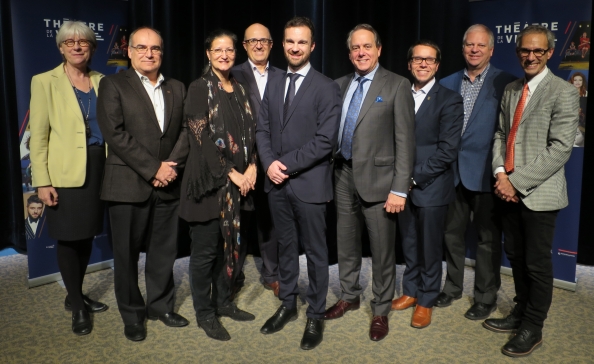
Boulanger's public appearances also trace a second loop, this one through the communities around Montreal's South Shore. In 2017 he served as scientific president of Quebec's Super Expo-sciences final. That same year he appeared among business leaders supporting the Théâtre de la Ville in Longueuil. ArcelorMittal later noted his service on the theatre's honorary committee during a benefit that raised $148,068 for an educational program reaching roughly 14,000 young spectators a year.
Science fairs and theatre benefits may sit far from an electric arc furnace, but both address the long horizon of an industrial employer. Technical talent grows through curiosity. A durable local business depends on a place where people want to live, learn and make things. The plant tour made this connection most visibly: open the gate, show visitors how scrap becomes rebar, and let the sequence replace some of the abstraction that surrounds heavy industry.
There is restraint in Boulanger's public profile. The available record is made mostly of corporate policy documents, product explanations, an interview and community appearances. Within it, a consistent figure emerges: an executive who talks about customers in the language of partnership, about sustainability in the language of process, and about steel as part of a larger system.
His career contains a useful tension. Marketing tries to make a choice clear. Steelmaking resists easy reduction. The product is old, technical and essential. Its next chapter involves hydrogen trials, more efficient furnaces, advanced grades, recycled feedstock and customer carbon targets. Every claim eventually meets a specification or a meter.
Boulanger's answer is to keep the factory close to the story. The brochure retains the grades. The interview retains the customer. The sustainability argument retains the process. The building retains its whole life cycle. Under that discipline, steel's second life becomes more than a neat circle. It becomes a series of obligations, each one testable, before yesterday's scrap can stand inside tomorrow's infrastructure.