The company that will happily sell you back your own waste - as chemicals worth twice what it cost to throw away.
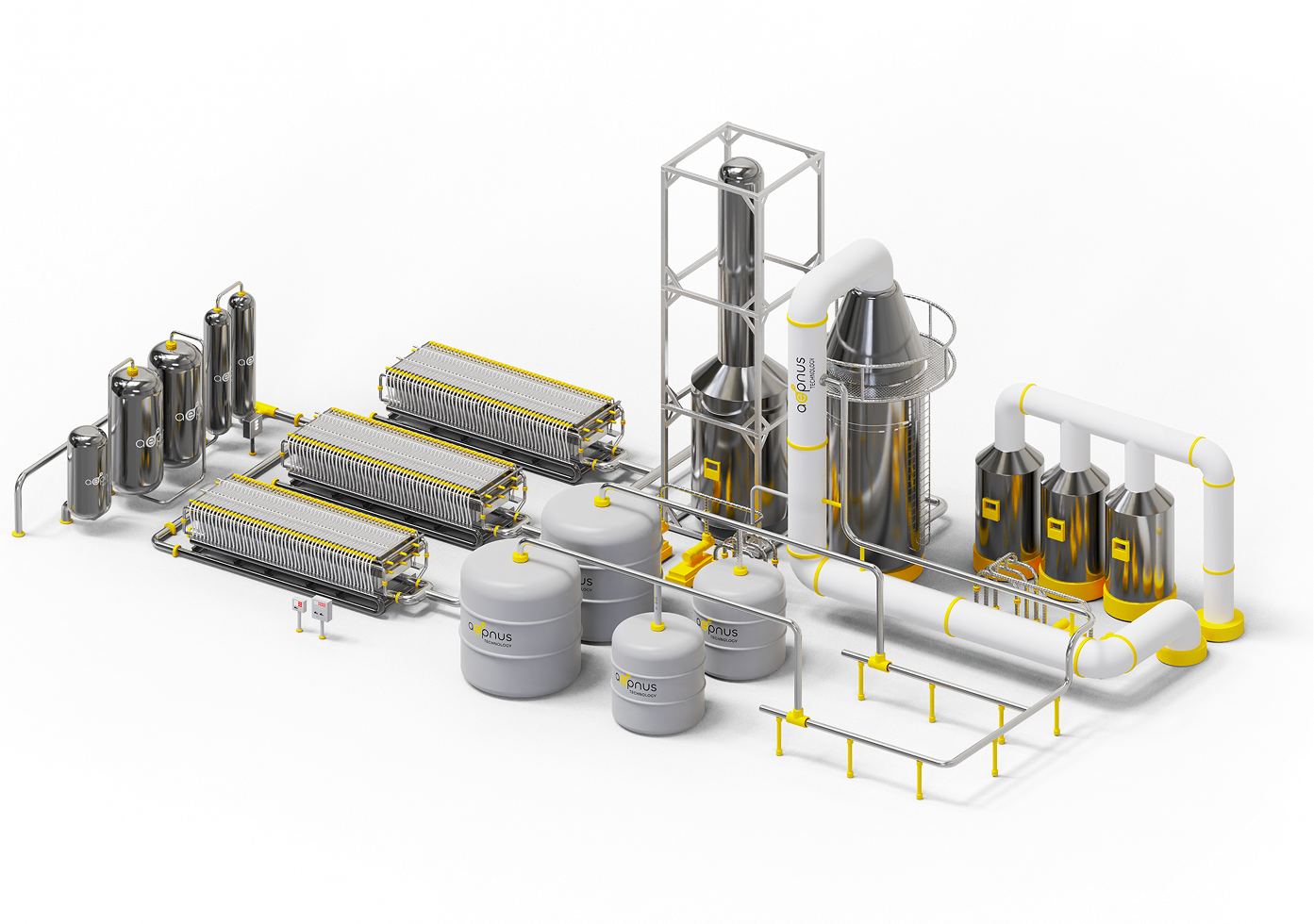
The machine, up close: Aepnus's electrolyzer stack is roughly the footprint of a pickup truck. It eats a waste salt nobody wanted and, with renewable electricity, hands back two of the most-used chemicals in industry. Unglamorous plumbing, quietly doing the hard part.
Here is a fact about making the batteries that are supposed to save the planet: the process generates a staggering amount of a boring, low-value salt called sodium sulfate, and for a long time the industry's plan for that salt was, roughly, to pay someone to make it go away.
Aepnus Technology, a nineteen-ish-person company in Emeryville, California, looked at that arrangement and noticed something that is obvious in retrospect and apparently was not obvious for years: sodium sulfate is not garbage. It is sodium and it is sulfate, and if you are willing to do some slightly clever electrochemistry, you can pull it apart into caustic soda (sodium hydroxide) and sulfuric acid - two chemicals that industry buys constantly, by the tanker-load, for real money.
So the pitch, stripped of jargon, is a kind of arbitrage. A battery-materials plant currently pays on the order of $350 to dispose of a tonne of sodium sulfate. That same tonne, run through Aepnus's machine, yields roughly $700 of usable acid and base. You have taken a line item that reads "waste disposal, negative" and rewritten it to read "chemical production, positive." The molecules did not change. The accounting did.
The device that performs this trick is an electrolyzer - a box that uses electricity to drive a chemical reaction - and Aepnus's version is notable for two things. First, it is small: about the size of a pickup truck, which is the sort of detail that makes industrial buyers nod. Second, and more importantly, it does not use iridium or other precious-metal catalysts, which conventional electrolyzers lean on and which happen to be rare, expensive, and sourced from an uncomfortably short list of places.
Leaving out the expensive catalyst is not a shortcut; it is the innovation. Precious-metal catalysts are a big reason conventional salt-splitting has been too costly to bother with. Aepnus's proprietary gas-diffusion-electrode approach is designed to hit high throughput and durability without them, and the company says the whole thing runs roughly 50% more energy-efficiently than conventional electrolysis. When your product is a commodity chemical, energy efficiency is not a nice-to-have. It is the entire margin.
The gap between those two numbers is the whole company. Everything else - the electrode chemistry, the pilots, the funding - exists to make sure that gap is real, repeatable, and large enough at scale to matter. Approximate figures, drawn from public interviews; your feedstock may vary.
Real-world waste salt is messy. The first stage cleans the incoming sodium sulfate stream so the electrolyzer sees a feedstock it can actually work with.
The core. Renewable electricity splits sodium sulfate into caustic soda and sulfuric acid - catalyst-free, higher throughput, lower energy draw.
The outputs are polished and concentrated to reagent grade, ready to be reused on-site or sold - closing the chemical loop instead of the landfill.
"Aepnus turns the battery industry's biggest waste problem into a profit powerhouse."— Lowercarbon Capital, on why it invested
An electrochemist by training who met his co-founder as an exchange student at UC Berkeley about 13 years ago. He runs the growth and commercialization side, framing the company less as a science project and more as a decarbonization business with unit economics that need to close.
The technology lead behind the catalyst-free electrode approach. The idea traces to electrochemical water-desalination research the founders did at Lawrence Berkeley National Laboratory - a lab-bench insight that turned into a truck-sized machine.
Generate caustic soda and sulfuric acid at your own facility instead of buying, trucking, and storing them - cutting logistics and exposure to price swings.
Turn sodium sulfate you currently pay to dispose of into a revenue-positive input, shrinking both waste bills and regulatory risk.
The full three-stage system - clean, split, purify - delivering reagent-grade output from messy, real-world feedstock.
Prove the process on your specific waste stream before committing to scale, with pilot testing and customer validation services.
Round led by Clean Energy Ventures, with Voyager Ventures, Lowercarbon Capital, Impact Science Ventures, Muus Climate Partners, and Gravity Climate Fund.
Pilot-scale project in the Bécancour / Shawinigan region with CNETE and battery-supply-chain partners.
More than doubled the 1,000-hour minimum for industry validation and produced one tonne of caustic soda from waste salt.
Additional financing reported, bringing total funding to roughly $12M as the company eyes a demonstration facility in Oakland and a commercial plant in Quebec before 2030.
| Round | Amount | Date | Lead & Participants |
|---|---|---|---|
| Seed | $8,000,000 | June 2024 | Clean Energy Ventures (lead); Voyager Ventures, Lowercarbon Capital, Impact Science Ventures, Muus Climate Partners, Gravity Climate Fund |
| Total to date | ~$12,000,000 | as of Feb 2026 | Cumulative, per public records |
Truck-sized hardware designed to process on the order of tens of thousands of tonnes of sodium sulfate per year at commercial scale.
By deliberately leaving out iridium and other precious-metal catalysts, Aepnus removes both a cost and a supply-chain risk.
Operations span Oakland/Emeryville, Montreal, and Stuttgart, Germany - unusual reach for a company this size.
The core idea started as electrochemical water-desalination research at Lawrence Berkeley National Laboratory.
Website, socials, and the coverage this profile drew from.
Aepnus Technology is an Emeryville, California cleantech startup that builds ultra-efficient, catalyst-free electrolyzers to turn sodium sulfate - a low-value waste salt produced in enormous volumes by battery-material and critical-mineral plants - back into two industrial staples: caustic soda (sodium hydroxide) and sulfuric acid. By splitting waste salt on-site with renewable electricity, Aepnus lets manufacturers cut disposal costs, reduce emissions, and shorten fragile chemical supply chains, converting a roughly $350-per-tonne waste-handling problem into about $700 of usable reagents per tonne.
Last updated: