The funniest thing about steel is how good it is at disappearing. ArcelorMittal Produits longs Canada makes the reinforcing bar inside bridges, the special steel inside truck suspensions, the wire inside ocean cables and - yes - material that becomes guitar strings. The finished objects get the photographs. The mill gets steam, noise and a purchase order with a chemistry specification.
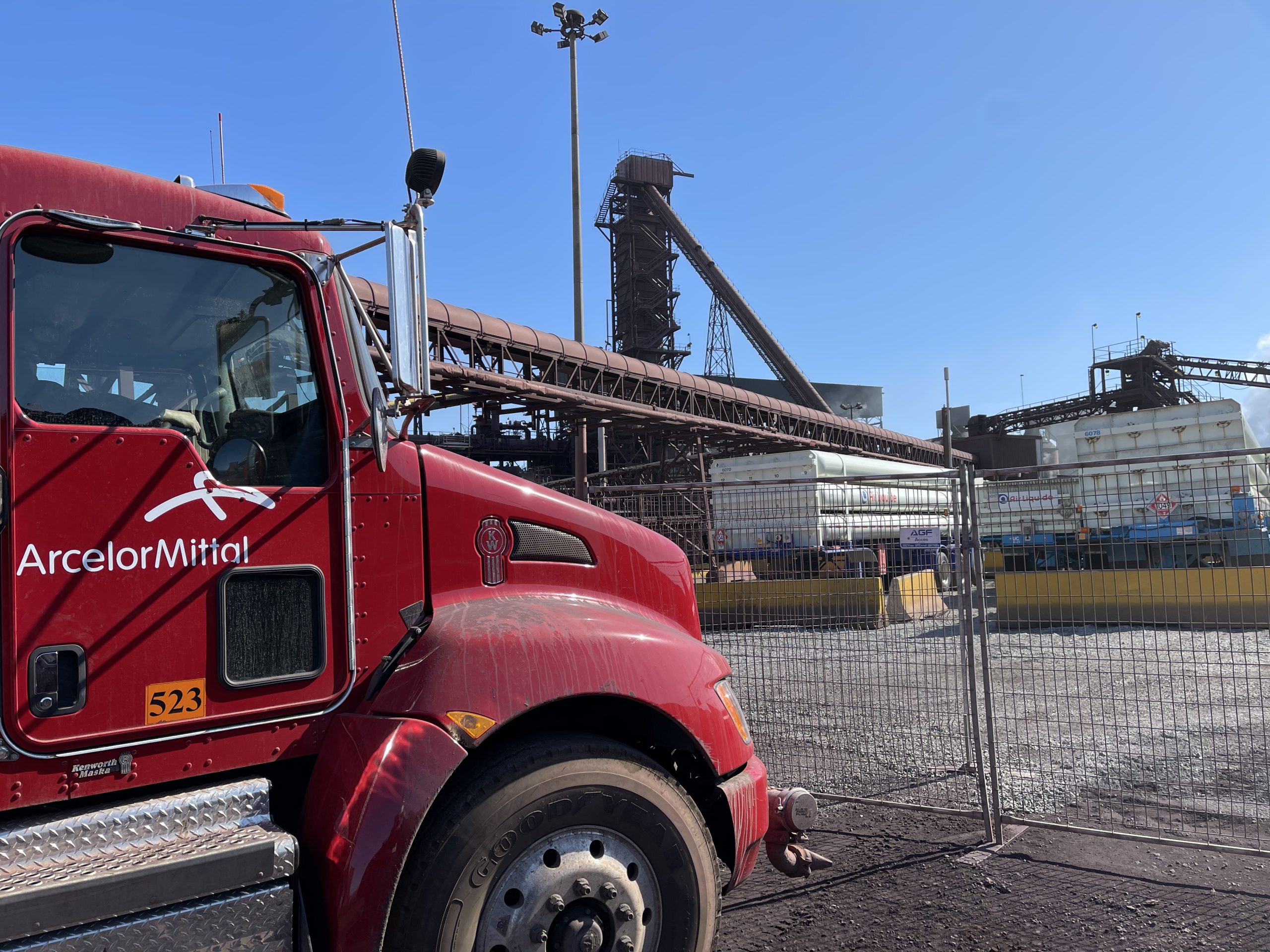
From Contrecoeur, on the south shore of the St. Lawrence River, the company runs a chain that begins with Quebec iron and old steel. Scrap is sorted and shredded. Iron ore from the North Shore enters a direct-reduction plant. Electric arc furnaces melt the metallic feedstock. Continuous casters form billets and slabs. Rolling mills turn billets into bar and wire rod; a Montreal wire mill can draw rod into thinner, value-added products.
That sequence is the business. It explains the customers, the climate argument and the company’s difference from a trader importing finished steel. Control more of the transformation, and a customer’s request can travel backward from the sales desk to rolling, casting and melt chemistry. The resulting catalogue covers construction, automotive, telecom, welding, energy, rail, agriculture, mining and general manufacturing.
01 / The operating system
First, own the handoffs
ArcelorMittal Produits longs Canada traces its history to the Saint-Patrick wire mill, opened in Montreal in 1914. The present company is not a startup and has no neat garage-founder story. It is the product of a century of plants, public ownership, privatization and consolidation: Sidbec-Dosco became Ispat Sidbec, then Mittal Canada, ArcelorMittal Montreal and, in 2016, ArcelorMittal Produits longs Canada.
The corporate genealogy matters less than the physical inheritance. Today’s network includes a direct-reduction plant, two steelworks, two bar mills, a wire-rod mill, wire drawing and steel-recycling centres. The company says it can produce more than two million tonnes of steel annually and recycle nearly one million tonnes of scrap. Its slabs largely move to sister company ArcelorMittal Dofasco. Most billets stay inside the network and become finished long products.
North Shore iron
reduction
furnace
slabs
+ wire
For buyers, this solves a boring but expensive problem: consistency. Special Bar Quality steel for forged automotive, energy or rail parts requires tight control of chemistry, surface condition and internal cleanliness. High-carbon wire rod destined for springs or music strings needs a uniform microstructure. Welding wire must draw cleanly and feed reliably. Those are not interchangeable lumps of metal.
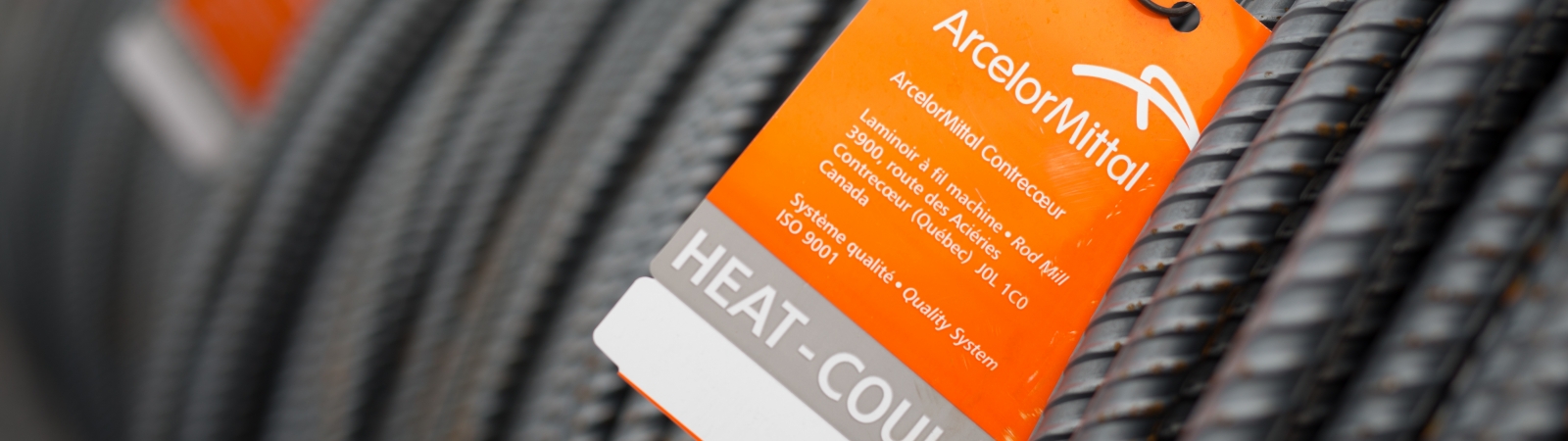
The company’s market position follows. It describes itself as Canada’s largest rebar maker and the world’s largest producer of steel for leaf springs used by major light- and heavy-truck brands. Its rebar has gone into the Samuel De Champlain and Confederation bridges, the Bell Centre, Centre Vidéotron, Highway 30 and offshore platforms Hibernia and Hebron. These are company-reported examples, but they illustrate the strategy: high-volume infrastructure at one end, specification-heavy niches at the other.
The moat is not one furnace. It is the feedback loop between scrap yard, melt shop, mill and customer.
02 / What it cost
Modernize one stubborn machine at a time
Industrial change arrives on a different clock from software. In 2017, after 18 months of work, the Longueuil bar mill inaugurated a C$27 million finishing line. Capacity rose from 400,000 to 500,000 tonnes a year. The mill could make new value-added sections, including angles used in transmission towers and buildings, while improving packaging and delivery. About 200 jobs were consolidated.
One check, three outputs
100,000 extra tonnes of annual rolling capacity, new value-added shapes and a cleaner path from finishing to shipment.
The previous Longueuil upgrade was a C$24 million reheating furnace in 2013. At Contrecoeur, a reheating furnace dating from 1964 survived until 2019, when a C$30 million, more efficient replacement entered service. This is how the company’s expertise compounds: not through one grand unveiling, but through accumulated knowledge about heat, chemistry, rolling tolerances, energy and uptime.
What failed first? In the literal modernization story, old reheating equipment became the constraint. In the larger business story, the first public break was profitability in wire drawing. In June 2025, the company announced that Hamilton production would close permanently and work would be concentrated at Saint-Patrick in Montreal. The closure affected 153 employees.
The company said the move was needed to improve operating efficiency, competitiveness and long-term profitability in wire products serving telecom, construction and automotive markets. It did not disclose unit economics or a single triggering event. The evidence supports a narrower conclusion: management changed the network once two-site wire drawing could no longer meet its performance expectations.
Three numbers that explain the strategy
03 / The climate bet
A serious experiment has a small number
Contrecoeur’s climate advantage begins with geography. Electric arc furnaces use Quebec’s largely renewable hydroelectricity. Scrap provides recycled metal. Direct-reduced iron helps control purity and supplies metallic input without the same route as a traditional blast furnace. This does not make steel impact-free, but it gives the operation a lower-carbon starting point.
The more interesting move came in 2022. For 24 hours, the direct-reduction plant replaced 6.8 percent of its natural-gas input with green hydrogen supplied from a third-party electrolyser. The number sounds modest because it was a trial, not a press-release fantasy. Direct reduction represented more than 75 percent of the Canadian unit’s CO2 emissions, so substituting hydrogen at that step attacked the large source.
The test also named the condition for scale: electricity. Producing green hydrogen on site would require enough power for electrolysers. Cheap, clean and available electricity is therefore not background scenery; it is the enabling infrastructure. Without it, the hydrogen route stalls. With it, the company said the reduction plant could potentially avoid several hundred thousand tonnes of CO2 annually.
04 / People and position
The culture has to survive the furnace

ArcelorMittal Produits longs Canada reported more than 2,000 employees before the Hamilton shutdown; another current company page uses 1,900. The difference is a reminder that headcount is a moving measure, especially after a closure. Stéphane Brochu leads the company as president and chief executive, backed by executives spanning finance and strategy, operations, technology, legal affairs, logistics, human resources, environment and decarbonization.
The stated culture is conventional for heavy industry - health and safety, quality, leadership and sustainable development - because conventional is useful when molten steel is involved. The more revealing signals are local. The company funds community programs and technical education, won a Quebec employer award in 2024, and in 2026 hosted 35 candidates in Contrecoeur for an initiative intended to build a cohort of women equipment operators.
Its expertise sits between commodity scale and custom manufacturing. A rebar order competes on availability, certification, logistics and price. A special automotive grade adds cleanliness, surface quality and exact metallurgy. Wire for subsea fibre-optic cable adds drawing and galvanizing. The integrated network lets one business serve all three, though it also carries the fixed-cost burden of furnaces, mills and sites.
What another operator can copy
- Own the quality-critical handoffs. Integration matters where defects compound between input, process and finished product.
- Price capital against a bottleneck. The C$27 million line came with an explicit 100,000-tonne capacity gain and new product capability.
- Run the smallest credible climate test. Twenty-four hours and 6.8 percent were enough to prove hydrogen could enter the process.
- Name the scaling condition. The hydrogen test requires available clean power; saying so separates a plan from a slogan.
- Consolidate when the network stops earning its complexity. The Hamilton decision was painful, but two sites were not treated as sacred.
Works when
Inputs are local, energy is reliable, volumes justify fixed assets, specifications reward process control and customers value regional supply.
Breaks when
Power is scarce, demand fragments, imports undercut price, utilization falls, or duplicated plants add cost without improving service.
05 / The honest conclusion
Steel tomorrow, with yesterday’s balance sheet
ArcelorMittal Produits longs Canada fits the market as a regional, integrated long-products producer inside a global steel group. That gives it access to group research and internal customers, while its Quebec footprint supplies a distinct material and energy story. Competitors include North American producers such as Gerdau, Nucor, Ivaco, AltaSteel and Commercial Metals, plus imported steel. The right alternative depends on grade and delivery more than brand.
The company’s lesson is not that integration automatically wins. Integration creates control and fixed costs at the same time. The Longueuil upgrade shows the upside: a measurable capacity increase, new products and protected employment. Hamilton shows the reverse: when a part of the network cannot reach the required performance, control means having to choose what stays open.
That tension makes the company useful to study. Its products are almost comically ordinary once installed, but the operating system behind them is not. Local material loops, decades-long equipment lives, careful quality work and constrained climate trials are what industrial progress looks like before someone turns it into a keynote. The bridge gets the ribbon cutting. The steelmaker keeps working underneath.