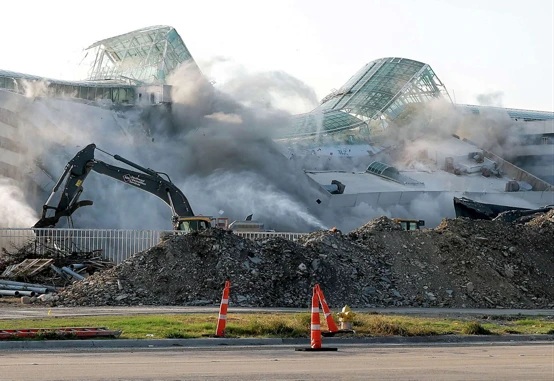
A building comes down in Plano, Texas, and CMC sees a future inventory delivery. In August 2026, the company described its recycling teams’ work on the demolition of the former Electronic Data Systems headquarters. The project was expected to yield about 11,000 gross tons of recyclable material. An office complex becomes feedstock. Somewhere else, a contractor needs reinforcement for fresh concrete. CMC has built a business connecting those two events.
- Scrap becomes steel, then reinforcement cut for a particular job.
- Tensar adds the soil beneath the structure; precast adds drainage and utilities.
- The bet: solve more problems before the building starts going up.
That connection explains more than the word “steelmaker” does. CMC buys and processes scrap, melts it, rolls steel products and fabricates reinforcing bar. It also sells ground improvement systems, construction supplies and concrete pipe. The common customer is someone trying to turn a set of drawings into something that stays put.
The useful thing about being underneath
CMC traces its beginning to Moses Feldman’s Dallas scrap operation in 1915. Its corporate history makes recycling the starting point. Today, contractors know it for rebar, the ribbed steel embedded in concrete. Engineers know its ground stabilization products. Manufacturers can sell it metal byproducts. Different customers meet different parts of the same system.
Consider a concrete contractor. The purchasing problem includes the right grade and quantity of reinforcement, but also bent shapes, approved details, placement sequences and delivery dates. A pile of cheap steel delivered at the wrong time can be an expensive possession. CMC’s fabrication teams translate drawings into cut and bent reinforcement and coordinate delivery. Their expertise lives in those handoffs.
This is where vertical integration earns its keep. Owning mills and fabrication facilities gives CMC more influence over material availability and production scheduling. It still competes with Nucor, Gerdau and regional suppliers. Electric furnaces alone do not distinguish it. The more interesting proposition is how much of a contractor’s material and coordination problem one organization can handle.
- 01 Collect scrap
- 02 Melt + roll
- 03 Cut + bend
- 04 Build + recover
Keep the steel hot
One of CMC’s consequential decisions was almost comically literal: keep things moving while they are hot. In 2009, CMC and equipment supplier Danieli commissioned a micro mill in Mesa, Arizona. Casting and rolling became one continuous process. The arrangement eliminated a separate reheat furnace, removing a step that otherwise consumes fuel.
The distinction matters because “recycled” describes the feedstock, while efficiency describes what happens afterward. Scrap still needs melting and processing. CMC uses electric arc furnaces; its micro mill design tackles additional energy use between production stages. A second micro mill followed in Oklahoma in 2018. Danieli’s account describes improvements drawn from the partners’ operating experience.
The same attention to an awkward production step appears in spooled rebar. Uncoiling steel can introduce tangles and interruptions at bending equipment. CMC markets tightly wound, twist-free spools intended to feed more smoothly, with known linear footage for planning. It is an appealingly unglamorous product idea: make the next machine’s job easier.

A $550 million look at the soil
Then CMC expanded the question. What else delays the customer before the concrete arrives? Weak ground is one answer. In April 2022, it bought Tensar for $550 million, net of acquired cash. Tensar’s polymer geogrids reinforce soil and aggregate, supporting roads, working platforms, walls and other structures.
CMC’s Tensar page describes a Chicago Transit Authority project where stabilizing poor subgrade saved a reported $500,000 and avoided 1,196 truckloads of material. Those are project-specific company figures, rather than a promise for every site. Their appeal is easy to understand: material that never needs hauling can save money before anyone worries about its purchase price.
The product range also addresses what happens years later. ChromX offers high-strength, corrosion-resistant reinforcing steel. GalvaBar applies a zinc coating through continuous galvanizing and allows subsequent fabrication. Engineers choose among such options according to exposure, design and required service life. The cheapest bar on delivery day may carry a different maintenance bill over a bridge’s lifetime.
“increasing the breadth of our participation on the job site”Peter Matt, on the CP&P acquisition, September 2025
Concrete gets a seat at the table
CMC made its next expansion expensive enough to remove any ambiguity. In December 2025, it completed the purchases of Concrete Pipe & Precast and Foley Products. Their announced cash prices were $675 million and $1.84 billion, respectively, subject to adjustments. Fiscal 2026 accounts put combined acquisition cash outflows, net of cash acquired, at about $2.52 billion.
These businesses supply the drainage, water management, utility and road products that sit beside reinforcement in the construction sequence. CMC issued $2 billion of senior notes in November 2025 to help finance Foley. The strategy has a financing cost as well as an industrial logic. Expanding the catalogue requires integrating plants, people and customer relationships.
The October 2026 results supplied an early reality check. Residential softness weighed on precast performance. An unplanned GalvaBar outage hurt shipments. A broader offering can still encounter a weak regional market or a stopped production line. Company-wide fiscal 2026 sales reached $9.394 billion, but expansion does not eliminate operating friction.
Follow the next handoff
The practical lesson is to inspect what happens immediately before and after your product reaches a customer. CMC’s sequence leads from scrap procurement to steelmaking, fabrication, soil and drainage. Each addition has a plausible place in the customer’s work. The test is whether the combined business makes those handoffs easier.
There are limits. Freight distances matter. Ground solutions require suitable engineering. Fixed-price fabrication contracts can suffer when input costs rise. Owning more steps also means paying for more equipment and carrying more operating risk. For buyers, the useful move is to ask CMC about a specific constraint: corrosion, soil conditions, reinforcement detailing or delivery sequencing. The conversation becomes much clearer when it starts with the job.
Go a little deeper
CMC website ↗ Tensar applications ↗ Spooled rebar ↗ Latest results ↗ Newsroom ↗ Investor webcasts ↗ CMC videos on YouTube ↗ LinkedIn ↗ Instagram ↗ Facebook ↗ X / careers ↗