Sun Metalon closes $9.1M Series A second round - May 2025Backers: Nippon Steel, JBIC, Airbus Ventures, ShimadzuToyota co-develops aluminum recycling processUp to 85% less energy than conventional remelting~$42M total raised since 2021HQ relocates to the Chicago area to sit beside the foundriesSun Metalon closes $9.1M Series A second round - May 2025Backers: Nippon Steel, JBIC, Airbus Ventures, ShimadzuToyota co-develops aluminum recycling processUp to 85% less energy than conventional remelting~$42M total raised since 2021HQ relocates to the Chicago area to sit beside the foundries
Company Profile / Climate & Industry
Sun Metalon Inc.
The deep-tech company recycling the scrap nobody else wants - turning oily, contaminated swarf into clean alloy briquettes, on-site, with near-zero CO2.
Founded 2021Wood Dale, IL + Japan37 employees~$42M raised
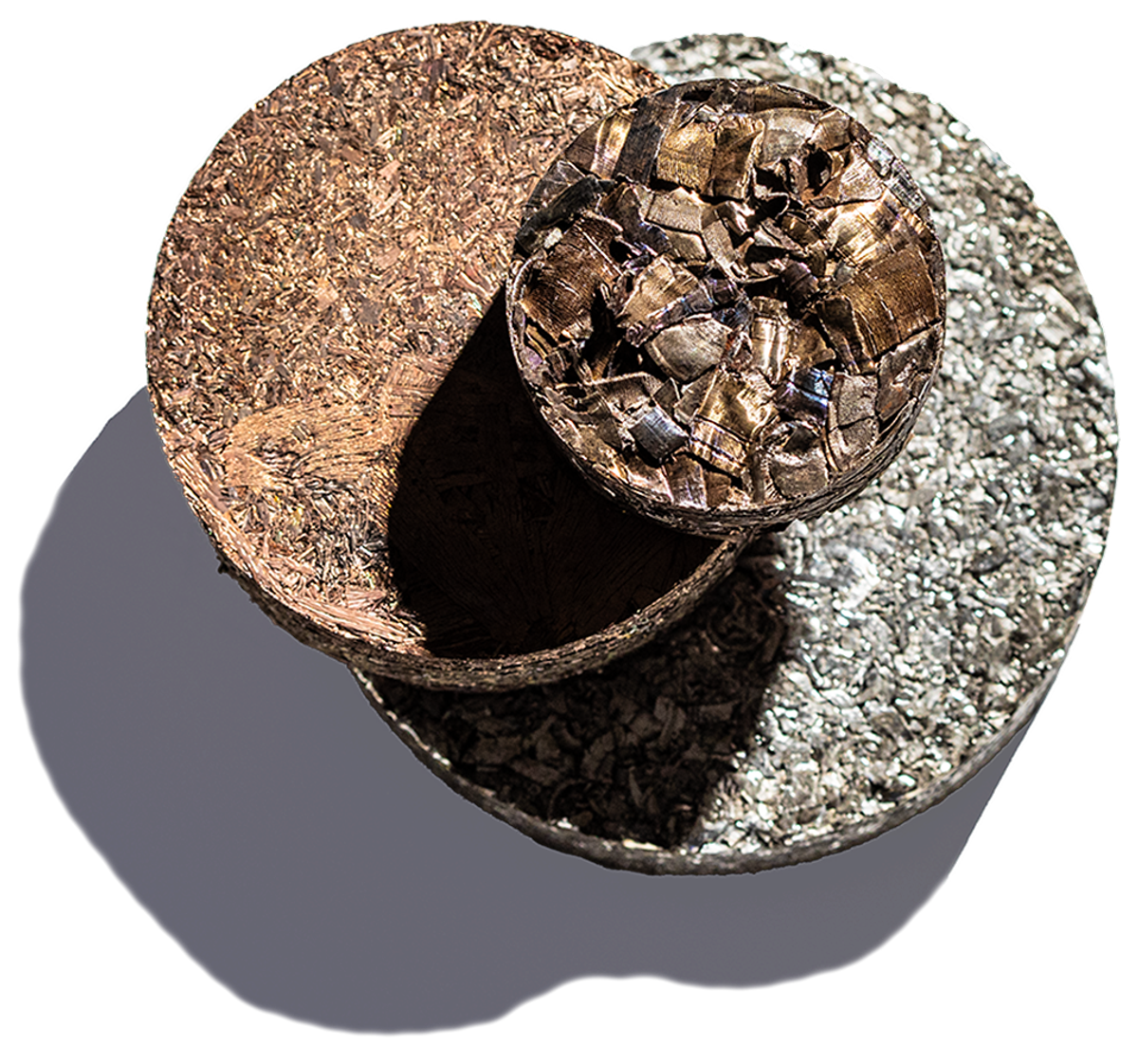
EXHIBIT A: A puck of recycled alloy, looking suspiciously pleased with itself for a former pile of contaminated swarf.
Who they are now
A machine on the shop floor, eating its own waste
Somewhere on a factory floor near Chicago, a box roughly the size of an industrial oven hums through its cycle. Into it goes a slurry of metal swarf - the oily, twisted shavings that come off a lathe and usually end up in a skip bound for landfill or a distant smelter. Out of it comes a clean, dry briquette of the original alloy. Same chemistry. No CO2 to speak of. That box is the point of Sun Metalon, and the entire pitch fits on it.
Sun Metalon is a binational deep-tech company, headquartered in Wood Dale, Illinois, with engineering roots in Japan. Thirty-seven people. Roughly $42 million raised. A founder who got the idea while doing a PhD near the very foundries he now wants as customers. It is small. It is also sitting on a claim large enough to make Toyota, Sumitomo, Nippon Steel and Airbus Ventures all write checks.
Metal waste used to be a line item under "cost." Sun Metalon's whole argument is that it belongs under "revenue."- The premise, in one sentence
The problem they saw
Up to 20% of metal disappears on the way to a part
Here is the inconvenient arithmetic of metal manufacturing. You start with a block of alloy, you machine it into a part, and a startling share of that block becomes chips, dust and swarf on the floor. Sun Metalon puts the figure as high as 20%. Some of that scrap is clean enough to recycle the ordinary way. A lot of it is not - it is contaminated with cutting oils, coolants and grit, which makes it expensive to haul, dirty to remelt, and prone to forming oxides that degrade the metal.
So it gets downcycled into something less valuable, or it gets landfilled. Either way, the manufacturer pays twice: once for the metal it lost, and again to make the loss go away. Conventional remelting, meanwhile, is energy-hungry and carbon-heavy. The metal industry is one of the harder corners of the economy to decarbonize, and contaminated scrap is one of its more stubborn problems.
The dirtiest scrap is usually the first thing a recycler refuses. Sun Metalon decided that was the part worth keeping.- The contrarian bet
The skeptic's question writes itself: if recycling oily, contaminated swarf were easy and cheap, someone large and well-capitalized would already be doing it. They mostly are not. That gap is the company.
The founders' bet
From DIY experiments to a patent
Kazuhiko Nishioka, Sun Metalon's co-founder and CEO, did not arrive at this from a whiteboard. He was an engineer at Nippon Steel, sent to study for a PhD at Northwestern University near Chicago with the company's backing. The problem of contaminated, hard-to-recycle scrap was not abstract to him - it was an industry he already knew from the inside.
In 2021 he and two Nippon colleagues started running what were, by their own account, DIY experiments: trying to clean up tiny metal scraps too oily to recycle conventionally. The experiments turned into a patented process. The colleagues turned into a company. The PhD-near-the-foundries detail turned out to be strategy in disguise - years later, the company moved its world headquarters to the Chicago area precisely to sit next to the foundry, die-casting, smelting and machining clients it wants to serve.
He learned the problem at Nippon Steel, studied it near Chicago, and then moved the whole company back to Chicago to solve it. The geography was never an accident.- On Kazuhiko Nishioka, Co-Founder & CEO
The product
The Venus-L6, and the physics underneath it
The flagship is the Venus-L6: a six-furnace, on-site recycling system sized for foundries and machine shops. It takes in contaminated swarf and chips and returns clean, dry briquettes of the original alloy, without CO2 emissions. The word "on-site" is doing real work in that sentence. The recycling happens where the scrap is made, which means no long-haul trucking, no waiting on a smelter, and no losing custody of your own alloy.
Underneath sits the patented part. Sun Metalon's process uses electromagnetic energy plus what it calls booster materials to heat metal fast and efficiently. Speed and efficiency matter because they are what let the system handle contaminated, non-ideal scrap while minimizing the oxides that normally ruin recycled metal. The contaminants are driven off; the chemistry of the alloy is left unchanged. The company claims the approach can cut energy consumption and CO2 emissions by up to 85% compared with existing methods for heating and purifying chips and swarf.
Venus-L6
Six-furnace, oven-scale system that lives on the shop floor and turns swarf into clean briquettes.
Electromagnetic heating
Patented energy + booster materials for fast heating with minimal oxide formation.
Same alloy out
Contaminants leave; the metal's chemistry stays put. No downcycling.
A recycling machine that fits in the room where the waste is made. The radius of the problem just shrank to a few feet.- On the Venus-L6
The short, busy history of Sun Metalon
2021
Founded. Nishioka and two Nippon Steel colleagues turn DIY scrap-cleaning experiments into a company, US and Japan.
2023
Toyota tests. Joint aluminum recycling work with Toyota presented at the Japan Foundry Engineering Society; pre-Series A tops up by ~$2M.
2024
$21M Series A and an alliance with Sumitomo Corporation Global Metals. HQ relocates to Illinois.
2024-25
Colorado invests nearly $1M in Sun Metalon's zero-emission recycling.
2025
$9.1M Series A second close from Nippon Steel, JBIC, Airbus Ventures and Shimadzu's fund - total raised reaches ~$39.8M including loans.
The proof
Who's writing the checks - and why it matters
A startup can claim 85% anything. What's harder to fake is the cap table. Sun Metalon's Series A came together at $21 million from JIC Venture Growth Investments, HITE Hedge Asset Management and Sumitomo Corporation Global Metals, alongside earlier backers UTEC, Globis Capital Partners, D4V, i-nest capital, Scrum Ventures and Berkeley SkyDeck. In May 2025 it added a $9.1 million second close from Nippon Steel, Japan Bank for International Cooperation, Airbus Ventures and Shimadzu's innovation fund, bringing total capital to roughly $39.8 million including loan facilities - about $42 million all in.
~$42M
Total raised
85%
Claimed energy cut
20%
Metal lost in mfg.
37
Employees
Read that investor list again. Nippon Steel is the founders' former employer and one of the largest steelmakers on earth. Sumitomo is a trading and metals giant. Toyota co-developed an aluminum recycling process and presented the results publicly. Airbus Ventures suggests interest from aerospace, where scrap is expensive and alloys are fussy. These are not tourists in the metal industry; they are the metal industry, and they are validating both the technology and the customer demand.
Funding, round by round
USD raised, approximate. Source: company press releases & coverage.
Pre-Series A +
$2M
Series A
$21M
Series A (2nd)
$9.1M
Total (incl. loans)
~$42M
The energy argument, illustrated
Relative energy to heat/purify chips & swarf. Company claim, directional not audited.
Conventional
100
Sun Metalon
~15
Worth a caveat the company itself would survive: the 85% figure is Sun Metalon's own, and "up to" is carrying weight. Independent, audited numbers across many real installations are the next thing the skeptic should ask for. The funding says serious people find the claim plausible enough to fund. It does not, on its own, prove it at scale.
When your former employer, a car company, a trading house and an aerospace fund all invest, you are no longer a science project. You are a supply chain bet.- On the cap table
The mission
A local, circular metal economy
Strip away the funding theatre and the mission is unfussy: reimagine metal recycling so that contaminated, low-value scrap gets recovered on-site, cheaply, with near-zero emissions, instead of being trucked off or buried. The economic and the environmental case are meant to be the same case. Recover the alloy you already paid for, cut the carbon, lose the disposal bill. CEO Kazuhiko Nishioka frames it plainly.
Our patented heating technology tackles both environmental and economic challenges by drastically reducing CO2 emissions and enabling efficient metal recycling.- Kazuhiko Nishioka, Co-Founder & CEO
That dual framing is the smart part. Plenty of climate hardware asks a buyer to pay a green premium and feel good about it. Sun Metalon's bet is that decarbonizing the metal industry can be the cheaper option, not the virtuous one - which is, historically, the only kind of green technology that scales.
Why it matters tomorrow
If the box works, the math changes everywhere
Heavy industry is where decarbonization gets hard and where good intentions go to be expensive. If a shop-floor machine can genuinely turn a manufacturer's worst scrap back into usable alloy, on-site, for less energy and money than the status quo, the implications run well past one factory near Chicago. Automotive, construction machinery, aerospace, steel - every sector that machines metal makes the exact waste Sun Metalon wants to eat. That is a very large room full of very expensive swarf.
The honest version is that Sun Metalon is still early. Thirty-seven people, a flagship product, a fistful of strategic checks, and claims that deserve independent verification at scale. The next few years are about installations, audited numbers, and whether the unit economics hold outside a pitch deck. But the direction is coherent, the backers are the right ones, and the problem is real.
Back on that factory floor, the box finishes its cycle. The skip that used to leave full now leaves empty. The alloy never left the building. That is the whole idea, working.- Back where we started