Peter Matt is sixth from the left in the ribbon-cutting photograph, smiling beside an enormous pair of scissors. Behind the assembled officials stands a steel mill in Mesa, Arizona. In front of them, the ribbon waits to become two ribbons. Manufacturing has its ceremonies, too. On October 25, 2023, Matt was helping dedicate Steel Arizona 2, less than two months after becoming CMC’s chief executive.
The photograph catches a particular stage in a long career. For three decades, Matt had worked in investment banking, advising industrial businesses. Then he became a finance chief at an aluminum manufacturer. Now he was standing outside a steel mill as the person responsible for the company operating it. The distance between those jobs is measured in more than promotions.
His task at Irving-based CMC has become increasingly specific: make the company useful across more of the work that happens before a building rises. Steel reinforcement remains central. Concrete pipe, ground stabilization and foundations extend the proposition. Much of what Matt sells will eventually disappear beneath something else. His job is to make the economics visible.
Thirty years on the other side of the table
Matt graduated from Amherst College in 1985, having studied English. His investment banking career at First Boston and Credit Suisse ran from 1985 to 2015. Over those years, he developed metals and diversified industrials coverage businesses. From 2010 to 2015, he was a managing director and group head responsible for Global Industrials in the Americas.
The work placed him close to manufacturers and the decisions that shape them: raising debt and equity, restructuring, financing assets, buying businesses and selling them. Those are consequential assignments. They also come with an unusual vantage point. A banker can see many companies wrestle with similar questions about capital, timing and growth.
He had once considered leaving that profession for law school. After missing out on his preferred schools, he took his father’s advice to pause and reconsider. He stayed in business. An abandoned plan can look rather respectable after forty years.
Following a period as managing partner at Tumpline Capital in 2015 and 2016, Matt joined Constellium as chief financial officer designate in November 2016. He became executive vice president and CFO on January 1, 2017. The adviser had crossed into management.
A succession, with time to learn
Constellium brought a different set of responsibilities. The company manufactures aluminum products for markets including packaging, automotive and aerospace. At CMC, the board later credited Matt with helping engineer a manufacturing turnaround, citing work spanning operational finance, planning, strategy and governance. His financial experience had acquired an operating context.
He joined CMC’s board in June 2020 while still at Constellium. That detail matters to the shape of his arrival. He had several years to learn the steel company as a director before moving into its management. In February 2023, CMC announced his appointment as president, effective that April.
Barbara Smith initially remained chairman and CEO. In July, the board announced that Matt would become president and chief executive on September 1, with Smith moving to executive chairman. The board’s vote was unanimous. It was a staged handover at an established manufacturer, with continuity built into the timetable.
CMC already had a construction business extending beyond conventional steelmaking. Tensar’s ground stabilization products, along with acquisitions such as Tendon Systems and EDSCO Fasteners, supplied a broader collection of needs on building sites. Matt inherited that direction. His subsequent decisions have enlarged it.
Three letters, a wider job description
In October 2023, Commercial Metals Company introduced its refreshed identity as CMC. Customers already used the initials. The change gave formal prominence to a name spacious enough to cover products beyond metal. Rebranding is often an expensive exercise in changing stationery. Here, it also supplied an early statement of intent.
Matt explained that the old name had suited a group assembled around metals businesses. As the scope of its products expanded, the way it presented itself needed to change. That argument becomes easier to follow when you consider a construction site rather than a steel price chart.
A project needs ground prepared, foundations supported, reinforcement supplied and underground systems installed. CMC’s growing portfolio reaches across those tasks. The commercial opportunity lies in knowing more of the customer’s project and providing more of the products it requires. Each new capability must still earn its place.
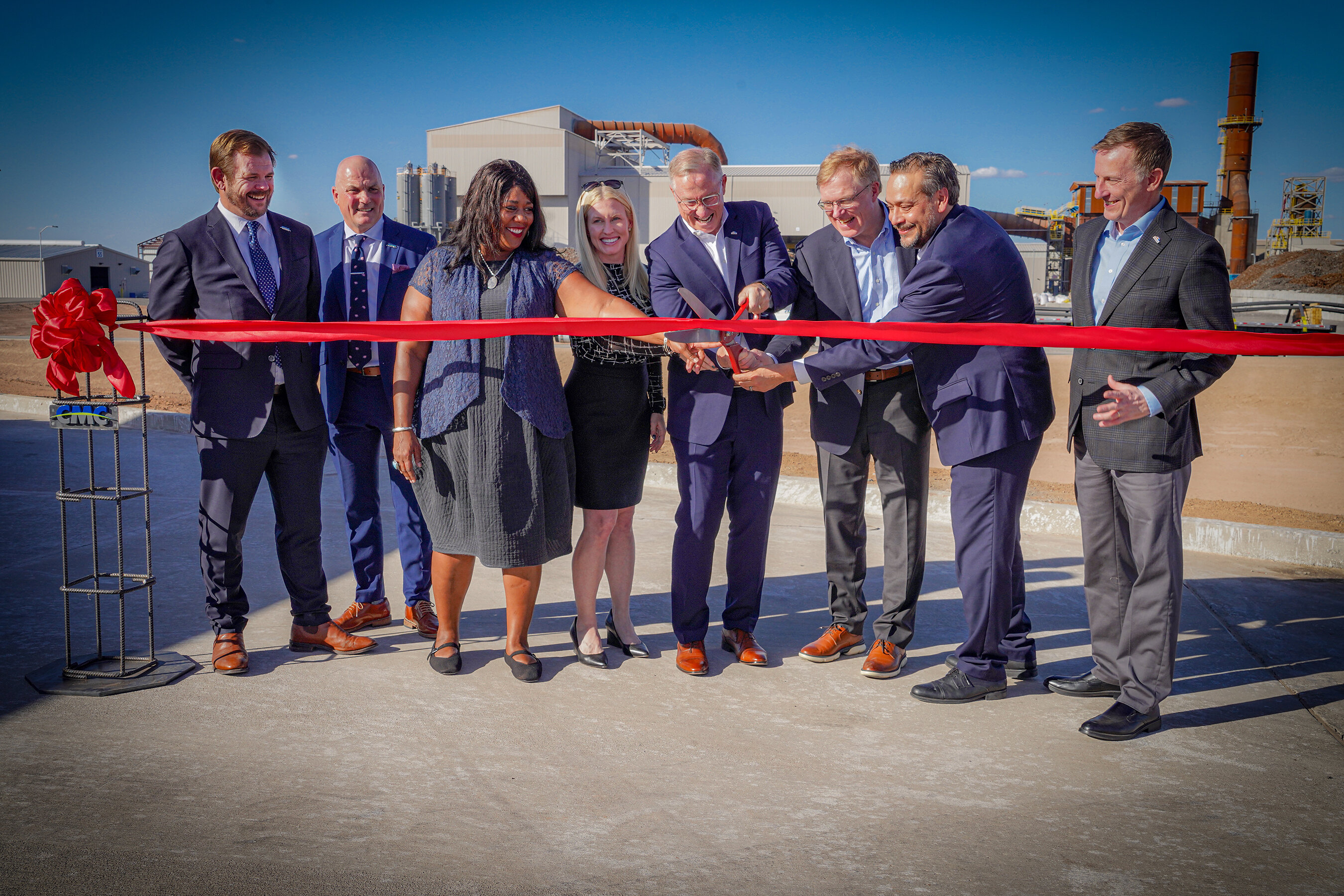
The Arizona mill offered a physical example of expanding capability within steel. Designed for a nominal annual capacity of 500,000 tons, including 150,000 tons of merchant products, it combined rebar and merchant bar production with a continuous melting, casting and rolling process. At dedication, CMC said it employed roughly 185 people.
The project was already underway before Matt became CEO. His responsibility included turning that investment into operating performance. A ribbon is obligingly easy to cut. A mill takes longer to bring up to speed.
The unglamorous arithmetic of getting better
Another part of Matt’s program involves getting more from facilities CMC already owns. TAG, the company’s operational and commercial improvement effort, became a recurring subject in his discussions with investors. By October 2024, CMC had identified more than 150 initiatives and was moving a subset through detailed planning and execution.
The examples are satisfyingly concrete: improve scrap purchasing and use, reduce consumables, improve logistics. These are the recurring decisions through which an industrial company spends money. Better results have to survive thousands of repetitions. An improvement that works once makes a good presentation; one that keeps working changes a business.
In the fiscal 2025 shareholder letter, Matt reported more than $50 million in EBITDA benefits during TAG’s first year. EBITDA is a measure of earnings before interest, taxes, depreciation and amortization. It is useful for discussing operations, although it does not replace the accounts or the cash required to run a company.
At the 2026 investor event, the discussion also turned to cooperation among mills. Executives described sharing expertise across locations. Matt emphasized that individual mills have different strengths and weaknesses. The practical management problem is familiar: persuade people who know their own operation to let somebody else help improve it.
“Remember, CMC is your company and you have a role in its success.”
Peter Matt, letter introducing CMC’s Code of Conduct
A December measured in concrete
The wider construction strategy acquired considerable weight in December 2025. On December 1, CMC completed its $675 million purchase of Concrete Pipe & Precast, subject to customary adjustments. CP&P brought 17 facilities serving seven core states in the Mid-Atlantic and South Atlantic, along with about 700 employees.
Its products included reinforced concrete pipe and engineered precast solutions for infrastructure, residential and nonresidential projects. The demand CMC identified included stormwater management, industrial investment and data centers. These are early construction requirements with a clear relationship to the sites CMC already serves.
Two weeks later came the completion of Foley Products Company’s acquisition for $1.84 billion in cash, again subject to customary adjustments. Foley operated 18 facilities across nine states. It supplied drainage, water management, dry utility and road construction applications, with a substantial Southeastern presence.
$2.515bn combined, before customary adjustments. Bar lengths compare purchase prices.
Together, the purchases added a substantial precast business. For Matt, they brought the two sides of his experience into the same assignment. Deal-making secured the assets. Operating leadership would determine how well the businesses worked together afterward.
In March 2026, he described retaining experienced management while standardizing practices and pursuing commercial and logistical opportunities. Integration makes modest-sounding demands: keep expertise, coordinate operations, find sensible ways to serve shared customers. The purchase price arrives in one announcement. The work arrives every morning.
The numbers now have a deadline
On August 5, 2026, CMC laid out fiscal 2029 mid-cycle targets. They included core EBITDA of $1.65 billion to $1.8 billion, a core EBITDA margin of 15% to 16%, and return on invested capital of 13% to 14.5%. These were management’s forward-looking targets, dependent on future execution and conditions.
CMC’s target core EBITDA margin at mid-cycle.
A stated goal, not an achieved result.
The margin target puts a number against the direction Matt has described: a company whose mix of businesses and operating practices can produce more durable earnings. Return on invested capital adds a second test. Buying and building more capacity only works for shareholders if that capital produces an adequate return.
The October 15, 2026 results offered a mixed but informative checkpoint. Fourth-quarter core EBITDA reached $393.7 million, up 35.1% from a year earlier. Net earnings were $212.5 million. CMC reported stronger North American steel performance and continued TAG benefits. Precast, however, fell below management’s expectations as regional residential weakness affected volumes and mix.
That complication belongs in Matt’s story. A broader portfolio still has customers exposed to construction cycles. The new business must prove its economics through conditions its chief executive cannot schedule.
The work before the skyline
Outside CMC, Matt remains a board member of his family’s FX Matt Brewing Company, founded in 1888. He also serves on the Metals Service Center Institute board and mentors military veterans through American Corporate Partners. Those commitments place him in several different conversations about work, industry and career transitions.
He was born in Utica, New York, and his first jobs included production-line work and factory clean-up at the family brewery. Asked about interviewing candidates, he offered a short question: “What motivates you?” It is a useful question to carry into a business full of people doing jobs the customer rarely sees.
For Matt, the next chapter is already attached to identifiable work: integrate the precast acquisitions, improve existing operations and earn returns on growth investments. The steel, pipes and ground systems will largely vanish into finished projects. His results will remain above ground, in the numbers.
Follow the work
Conversations, company updates and further reading.