Philip Rosedale built a world in which people could fly, conjure houses and trade objects made from code. Then the inhabitants discovered something else they could do: object to the taxes. In 2003, residents of the young Second Life staged their own Boston Tea Party. Even a universe with editable scenery had acquired the familiar sound of annoyed citizens.
The dispute concerned a tax on the objects people built. Complexity consumed computing resources, so charging for it had an engineering logic. Residents found the bill hard to predict. Protest followed; Linden Lab abandoned the system. Rosedale later wondered whether a simpler version might have worked better. Creating the laws of physics, it turned out, did not spare anyone the business of explaining a bill.
This is a useful place to begin with Rosedale, the founder of Linden Lab, cofounder and advisor at High Fidelity, and, since October 2024, Second Life’s returning chief technology officer. His career has involved transmitting video, building virtual worlds and making voices sound as though they occupy a room. It has also become a continuing encounter with people who insist on using his inventions in ways no diagram quite captures.
A universe small enough to fit on a desk
Born in San Diego in 1968, Rosedale moved around the United States with a family whose father was a Navy carrier pilot. Computers caught his attention in middle school. He started a software business while still in high school, helping pay his way through college, and earned a physics degree at the University of California San Diego in 1992. The combination matters: programming offered a way to make rules executable; physics supplied something worth trying to reproduce.
His early fascination was with a place inside a machine. Experimenting with mathematical modeling on a friend’s computer, he saw the possibility of recreating aspects of the world as simulation. He also built things outside the screen, including a backyard hovercraft and a mechanical Star Trek door for his bedroom. A sliding door seems a reasonable domestic requirement for someone whose imagination was already elsewhere.
By 1994 he was in San Francisco. FreeVue, his early videoconferencing application, worked with dial-up connections and the first webcams. RealNetworks acquired it, and Rosedale became the company’s CTO, helping lead the development of RealVideo. The practical task was to move pictures across an internet that made every bit count. The larger fascination remained: how much of another person’s presence could a computer carry?
In 1999 he left to establish Linden Lab. A successful career in internet video had provided a route toward the thing he had wanted to build as a boy. Now he needed people willing to help turn a simulation into somewhere others would choose to spend their time.
The guests rearranged the furniture
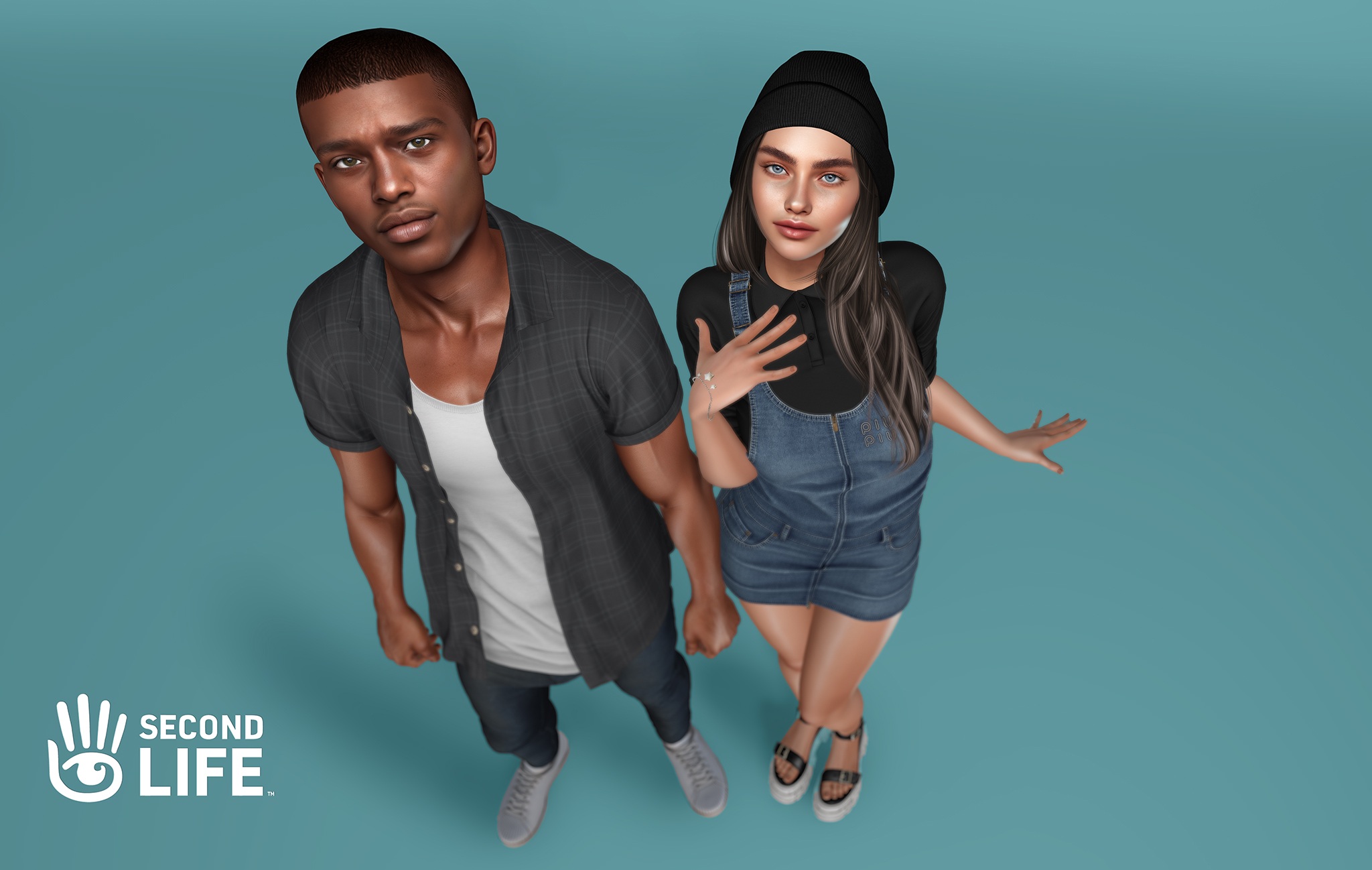
The early company experimented with immersive hardware, including a contraption called the Rig that translated tiny physical movements into movement on a screen. Rosedale’s ambition extended to simulated ecosystems. Yet the enduring result was a world whose inhabitants could create its contents. Second Life launched in 2003, offering building tools and a shared setting rather than a prescribed sequence of victories.
That choice changed the relationship between maker and visitor. A resident could fashion clothing, build a venue, script an object or sell something another resident wanted. The software supplied the possibilities; people supplied taste, desire and an astonishing willingness to spend time adjusting things. A place becomes rather more interesting when its inhabitants have strong opinions about the curtains.
Rosedale had also found an influence away from computers. At Burning Man, the self-described introvert experienced an ease of conversation and a sense of collective invention that stayed with him. Strangers had built a temporary social world together. Second Life offered a different setting for that impulse, one where distance could be crossed without a journey across the desert.
“The whole point was to build things with other people.”
Philip Rosedale, 2024
The public attention became substantial. Rosedale appeared on the 2007 TIME 100 list. Linden Lab’s work received a Technology & Engineering Emmy in 2008. But recognition is a poor guide to what makes a place last. Inside the world, the ongoing work was smaller and more particular: making an object, finding a customer, returning to meet someone.
The money arrived with the neighbors
Once people could make things, they needed a way to exchange them. Direct barter is inconvenient even when the goods have no weight. The Linden dollar let residents sell their work and buy somebody else’s without first locating a person whose wants matched their own. The currency became part of the everyday machinery of the place.
By May 2024, Rosedale put the cumulative value of virtual goods and services traded over roughly two decades at around $10 billion. That is his historical estimate, rather than an annual revenue figure. The distinction is useful because a resident economy and the company operating its infrastructure are different things. Money passing between creators says something about what people value inside a shared world.
Cumulative virtual goods and services traded over about 20 years, as estimated by Rosedale in May 2024.
Maintaining that economy required interventions. Currency entered through stipends and sales; fees removed it. The tax revolt was one lesson in how reasonable technical intentions could become bewildering social rules. A virtual world offered unusual freedom to try an arrangement, but the people living with it still expected that arrangement to make sense.
FairShare carries this curiosity into a separate project: communities creating their own currencies, with basic income supported by transaction fees. Members can vote on fees and income, endorse new members and transfer currency. These are proposed mechanisms for organizing exchange and limiting wealth concentration. Their existence does not establish that the economic ambition has been achieved. Rosedale is still running the experiment.
A room has to sound like a room
After stepping away from Linden Lab’s original CEO role, Rosedale pursued ventures including LoveMachine, Worklist.net and Coffee & Power. The subjects varied, but work, coordination and exchange kept recurring. If strangers could build a city together online, perhaps the arrangements surrounding ordinary work deserved some experimentation too.
High Fidelity, cofounded in 2013, returned him to virtual worlds, this time with an open-source platform designed for VR headsets. Consumer adoption proved slower than the company had hoped. In 2019 it refocused on spatial audio. The change brought a broad ambition down to a specific problem: how to let several people talk naturally in a shared online space.
In a physical room, voices reach us from different positions. That separation helps us follow one conversation while another continues nearby. Put every speaker in the same apparent location and the room loses an ordinary convenience. High Fidelity’s approach uses timing and frequency changes to make a sound seem to come from a particular direction.
For Rosedale, this makes sound a social design question. A gathering feels different when people can hold overlapping conversations rather than wait for the floor. The solution involves signal processing, but its purpose is familiar to anyone who has tried to join a busy table.
The birthday present that kept asking questions
Another problem has been harder to resolve. Rosedale’s wife, Yvette, gave him Neal Stephenson’s Snow Crash for his birthday, recognizing something of his interests in the novel. He returns to it periodically. In 2024, a passage about the importance of facial expressions struck him again: the fictional metaverse depended on conveying the information people exchange without speaking.
He proposed a wonderfully domestic test for the technology. Could you recognize a parent or spouse through an avatar, and read how that person felt? It is a more demanding question than whether a demonstration looks impressive. Familiarity makes us exacting viewers. A slightly wrong expression can defeat an otherwise elaborate reconstruction.
Rosedale openly described his frustration with the limits of both Second Life and High Fidelity in this respect. His hope involved cameras and machine learning that could infer and transmit nuanced expressions. In his 2025 interview about Second Life, language translation and better nonverbal communication were among the possibilities he discussed. These remain engineering aims, carrying no guarantee that every difficult conversation will suddenly become easy.
Back to a place people already inhabit
His return happened in stages. In January 2022, High Fidelity invested in Linden Lab and Rosedale became a strategic advisor. In October 2024, he returned full time as CTO and joined the board, working alongside executive chairman Brad Oberwager. The assignment gave him daily responsibility for technology and product strategy in a world that had continued living during his absence.
He has become more selective about promises of mass adoption. In a June 2025 conversation, he argued for supporting unusual, creative uses of virtual worlds while the technology remained difficult for mainstream activities. That position leaves room for the people already there. Their experiments need not wait for a universal future to justify themselves.
His own workshop remains busy. In 2026, his website lists experiments with artificial neurons, a piano-learning network and flocking simulations. FairShare and work exploring machine consciousness sit alongside his continuing involvement in Second Life. There is a recognizable thread: set a few rules, let the parts interact, watch what emerges.
The residents who protested a tax were doing something similar from the other side. They encountered the rules, organized themselves and changed the outcome. Rosedale had made room for people to build. They promptly began negotiating the terms. More than twenty years later, he is back at work in the world that answered him.
Keep the conversation going
Visit Rosedale’s workshop, read his essays, or follow him on LinkedIn and X.