Before there was a company, there was a phone. In 2014, Roddy Lindsay was volunteering at FWD.us, the immigration reform organization, and trying to persuade people to turn up. Email could deliver the invitation. Getting a reply was another matter. He began texting members from his own mobile, opening conversations rather than dropping another announcement into their inboxes. People answered. For someone who had spent six years inside Facebook, this was an appealingly small piece of evidence: a person at the other end, writing back.
The experiment became Hustle, which Lindsay co-founded with Perry Rosenstein and Tyler Brock in December 2014. Campaign organizers would come to know it as a way to contact supporters individually without spending the entire day peering at one telephone. But the phone came first. So did the practical question: how do you make an invitation feel worth answering?
Lindsay’s subsequent work has ranged from political identity checks to a documentary about disco. Read as a list, the career seems to require several different business cards. Read as a story, it keeps circling the distance between having a channel and making a connection. A text can reach a pocket. A record can reach a room. Neither event guarantees that the right person has been heard.
The data scientist leaves the feed
Lindsay graduated from Stanford’s Symbolic Systems program in 2007 and worked at Facebook from that year until 2013. The degree put language, computation and human thought in the same frame. His early job gave him an enormous supply of human expression to examine. He joined the Data team as a summer intern with interests in linguistics and statistics, then built Lexicon, a system for tracking trends in the words people posted on Facebook Walls.
Lexicon used Hadoop to process quantities of writing that would defeat any reader armed with coffee and good intentions. Its public premise was accessible: show what people were discussing and how those discussions changed over time. Lindsay’s name appeared on the Facebook announcement in April 2008. The work belonged to a period when social data was becoming something engineers could store, query and turn into new products.
There is a useful tension here. Seeing language in aggregate can expose patterns invisible in one conversation. It can also make one conversation disappear. The later Hustle experiment started at the opposite end of the telescope. Instead of asking what millions of people were saying, an organizer needed to know whether a particular person would come to an event. The difference is a product decision as much as a philosophical one.
A wine list, mercifully translated
In 2014, another Lindsay project addressed a quieter problem of participation: ordering wine without understanding the menu. WineGlass let diners photograph a restaurant’s wine list, then inspect information about the bottles. Optical character recognition met CellarTracker’s tasting notes, ratings, food pairings and price information. The bewildering document became something a diner could use.
A wine list is an unusually efficient way to make a literate adult feel unqualified. It arrives at precisely the moment a decision must be made, often in company, usually with prices attached. WineGlass moved the explanatory work onto a device already sitting near the table. It offered a little context before the waiter returned, which is a considerate deadline for software.
The app’s usefulness lay in its timing. A database of wine reviews might contain the answer, but the diner still had to identify the bottle and find the relevant entry. Photographing the list shortened that journey. Lindsay was working on a familiar problem from a different direction: a large body of information becomes useful when someone can act on it at the moment they need it.
The invitation gets an answer
Hustle carried that practical instinct into organizing. Organizations uploaded their contacts, prepared a campaign and gave agents suggested opening scripts. The agents could initiate individual text conversations rapidly, then respond to the people who replied. Integrations with Salesforce and NGP VAN helped return those responses to an organization’s existing records. The exchange had somewhere to go after the initial message.
“What we do is called peer-to-peer texting; it’s not broadcast messaging or ‘blast’ texting.”Roddy Lindsay, 2018
The distinction mattered to his account of the product. A reply could reveal a question, an objection or an intention that an email-open counter would never capture. His 2018 explanation emphasized relationship building across political campaigns, fundraising and education. A suggested script could start the exchange; a person still had to carry it forward. Efficiency bought time for the conversation rather than supplying its entire contents.
Bernie Sanders’s 2016 campaign became an early example. Its text outreach team found Hustle useful for recruiting and organizing volunteers. That is less glamorous than a theory about an app winning an election, and more informative. A campaign needs people who will do things: attend, volunteer, speak to someone else. Getting them to answer is one step in a much longer sequence.
By August 2017, Lindsay’s Series A announcement counted more than 38 million one-to-one conversations with more than 25 million people in the United States, Canada and Australia. The company had raised an $8 million round led by Social Capital. The founding experiment had acquired staff, investors and international customers. It also retained a demanding promise: scale the work without flattening the people receiving it.
More capital followed. In May 2018, Hustle announced a $30 million financing led by Insight Venture Partners, with GV and Salesforce Ventures participating. Raising money also changed the job. A founder who had discovered a useful behavior now had to oversee an organization expected to repeat and expand it. Product curiosity and company management occupied the same calendar, whether or not they sat comfortably together.
A founder can change seats
Lindsay stepped down as Hustle’s CEO in 2019. Social Capital acquired the company in 2020. He continued as an individual contributor founder until 2023, a change that gives his career a more interesting shape than the customary sequence of promotions. The company could keep developing while its co-founder changed the kind of work he did inside it.
He later made the case for an individual contributor track for founders. The title of his essay posed a practical question for startup culture: must founding a company commit someone to managing it indefinitely? His own transition supplied an example. A founder’s usefulness can survive a change in reporting lines. Institutional memory, product instincts and technical ability do not vanish when a CEO title is handed over.
That possibility matters because technology careers are often narrated as a staircase. Engineer becomes founder; founder becomes chief executive; each new title is treated as proof that the previous one has been surpassed. Lindsay’s route allows movement sideways. There is something pleasantly sensible about a company permitting a builder to build. The difficulty is persuading everyone that the seating plan can change without the story ending.
Another kind of listening room
Music was running alongside the startup work. Lindsay co-founded Envelop in 2014, and Gray Area’s biography describes nearly twenty years of DJing and collecting classic disco and house records. His involvement extended to the nonprofit’s board leadership. This was a sustained second practice, with its own tools, community and reasons to gather people in a room.
Envelop’s San Francisco listening space at the Midway uses an array of speakers to surround an audience with sound. A recording can occupy space rather than arrive from a pair of boxes at the front. The organization also makes its software tools free and open source, giving artists a way to work with immersive audio beyond a single venue.
A listening room changes the social bargain. The audience assembles to give a piece of music attention. For a career spent around messages, feeds and responses, that is an intriguing companion project. Here the desired activity is staying with what is already playing. Engineering becomes part of the conditions for listening, less conspicuous than the music but essential to how it reaches the room.
That interest led into film. In autumn 2022, Lindsay began the documentary project Taking Back the Groove, working as producer. Directed by Celia Aniskovich, the short follows disco artist Richie Weeks and his effort to secure his musical legacy. DOC NYC programmed it in 2023; Resident Advisor published the film in September 2024.
The credits place Lindsay among a group that includes musicians, filmmakers and fellow technology figures. More revealing than the professional crossover is the subject: the relationship between making something and retaining a say in what happens to it. The person behind a recording can recede while the recording circulates. A documentary gives that person time, a face and a story. For a record collector, the sleeve opens onto a life.
Who is on the other end?
Campaign Verify brought Lindsay back to messaging through the problem of identity. Founded in 2020 as a nonpartisan nonprofit, it verifies political organizations so communications services can establish who is sending. Lindsay is its founder and chief architect. The practical ambition is to make a real campaign distinguishable from an impersonator, with a vetted identity rather than a persuasive-looking message doing the work.
His current company, TexterID, applies identity verification and compliance tools to the wireless messaging industry. He serves as founder and CEO. Its account of his background emphasizes experience on both sides of the process: building a messaging platform at Hustle and a verification service at Campaign Verify. The friction is familiar to anyone who has built a product that depends on someone else’s network.
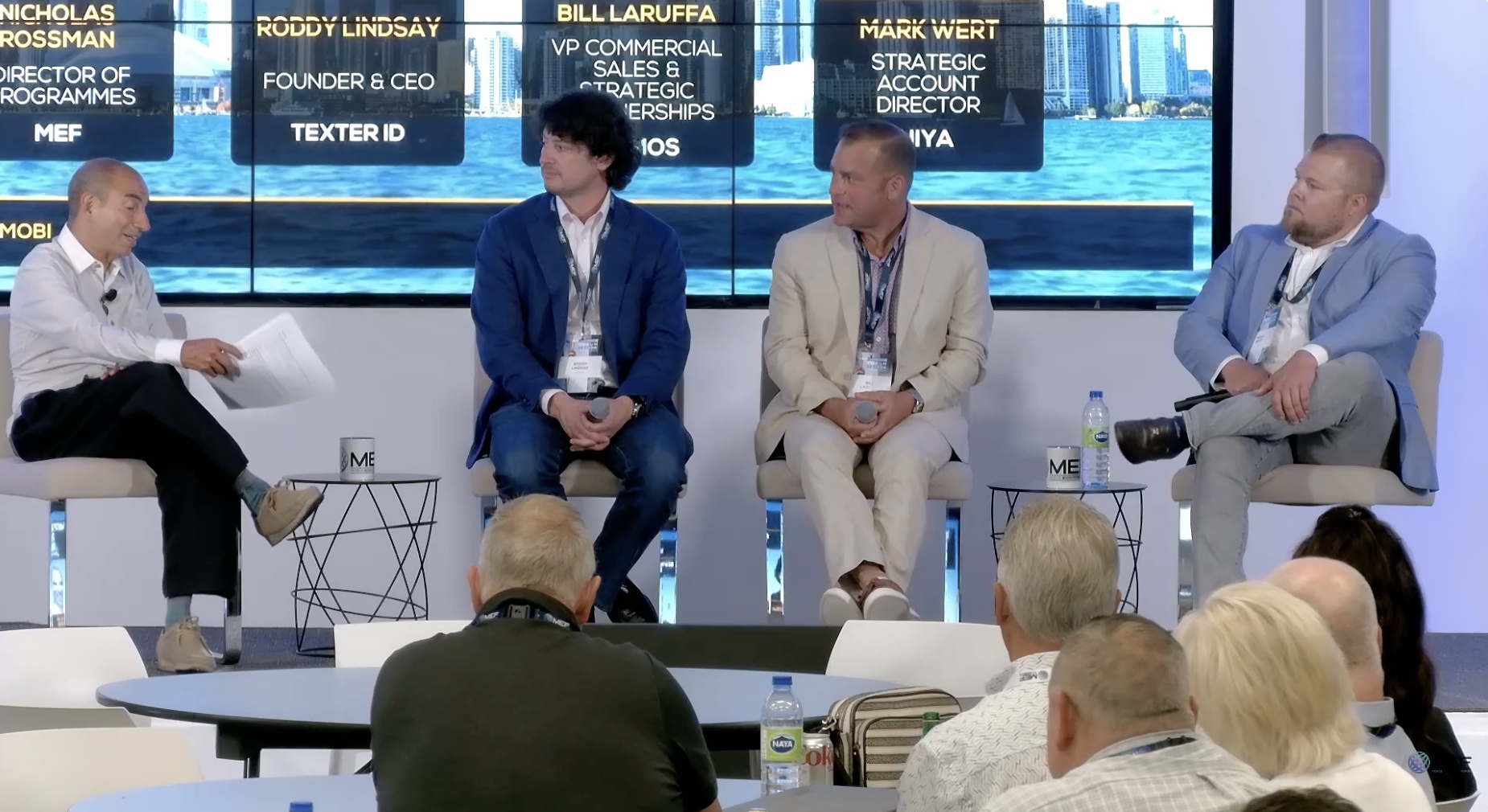
In July 2026, Lindsay appeared with leaders from Somos and Hiya at the MEF Leadership Forum Canada for a discussion of trust across voice, messaging and digital identity. Telephone numbers remained central to the discussion, even as communication moved across channels. The career had returned to the phone, carrying a different question. Reaching someone is useful. Helping them recognize who has reached them is now part of the job.
There is room for humor in this rather procedural world. In a 2026 LinkedIn post announcing TexterID’s membership in the Mobile Ecosystem Forum, Lindsay also advertised an industry afterparty with Vibes and Campaign Verify. It was called Club 160, and he would be on the decks. The message invited readers to spot the joke. A telecommunications gathering had found its way to a dance floor.
That is a fitting place to leave him: an engineer with a microphone in one setting and records in another, still arranging the conditions under which people meet. The work has changed from counting words to starting conversations, from shaping sound to checking senders. Its recurring challenge is concrete enough to fit inside the original phone. Someone is there. Give them a reason to answer.