Before the spaceship arrives, listen to the silence. On magnetic tape, silence used to have a sound: hiss. Copy the recording and the unwanted noise accumulated. A quiet passage could carry an extra performer nobody had hired. In 1965, Ray Dolby developed circuitry to tackle that problem. Six decades later, his company occupies a curious position in entertainment. You recognize its name. You may never have bought anything directly from it.
- Dolby develops sound and picture technology that other companies put into their products.
- Licensing supplied about 93% of its fiscal 2025 revenue.
- Its advantage depends on connecting the studio, the distributor and the playback device.
The business inside the badge
The useful number is $1.248 billion. That was Dolby’s licensing revenue in fiscal 2025, against $1.349 billion in total sales. Products and services supplied the remaining $101.1 million. For a company associated with speakers, screens and the physical thrill of a cinema, that is a wonderfully revealing split.
Dolby sells permission to use inventions, alongside the engineering needed to implement them. Its licensees can build the television, phone or audio system. Dolby can earn money inside those products without manufacturing the finished device. The badge makes an otherwise obscure technical transaction visible to the person holding the remote.
of revenue came from licensing
The published licensing process makes the arrangement tangible. A manufacturer applies, signs an agreement and pays an initial license fee. Dolby supplies technology and implementation, marketing and testing tools. The manufacturer then submits its product or implementation for testing and approval. The process helps explain why a logo can mean something to buyers: there is an implementation process behind it. An idea has to become a product that passes inspection.
Think of the company as an agreement stretched across an industry. A filmmaker needs tools. A distributor needs a deliverable it can transmit. A device maker needs something it can decode and reproduce. The viewer wants the scene to work. Dolby’s commercial opportunity sits in getting those interests to line up.
First, get rid of the hiss
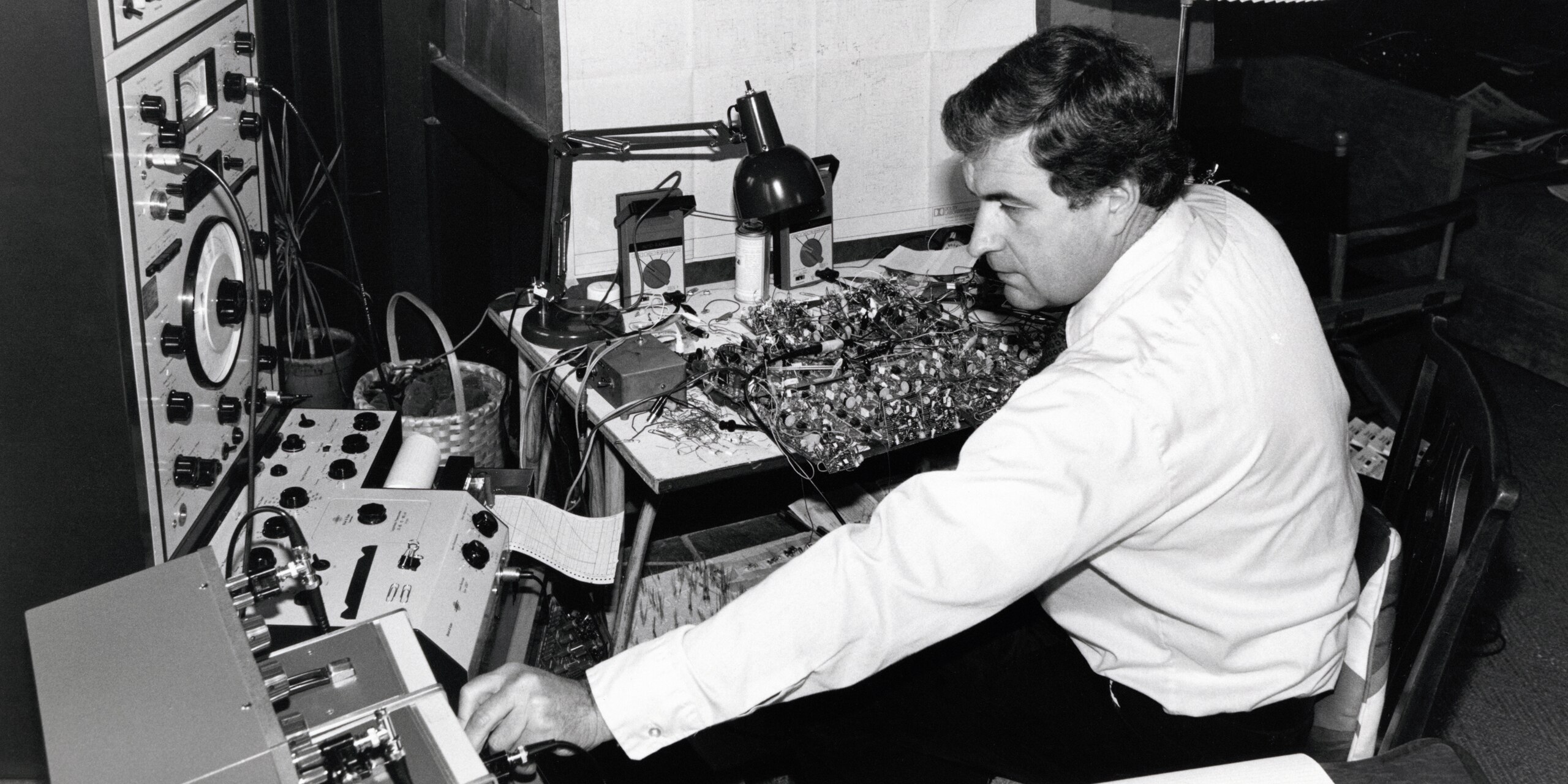
Dolby began in London in 1965. The Smithsonian’s account describes the first A301 system as circuitry that compressed and expanded audio signals to reduce tape noise. Recording studios adopted the approach; consumer cassette equipment followed. The original promise was pleasingly concrete: hear more of the recording and less of the machinery.
Cinema introduced a different obstacle. Better sound in a studio needed theaters capable of reproducing it. Dolby Stereo’s early reception was constrained by the shortage of equipped venues. Then Star Wars arrived in 1977. Its success and use of sound helped accelerate adoption, as TIME’s historical account explains. The invention needed a film people wanted to hear.
That distinction matters. Technical improvement alone did not complete the sale. A memorable demonstration gave another participant in the chain a reason to invest. For anyone building a platform, the lesson is awkward and useful: your customer’s customer may decide whether your technology spreads.
Give every sound an address
Dolby Atmos, introduced theatrically with Pixar’s Brave in 2012, extends that logic. Traditional surround mixes assign sound to channels. Atmos also lets creators describe individual audio objects and their positions. Playback rendering adapts that information to the available system. A sound can have a location and movement, rather than being tied only to a particular speaker channel.
- 01CreateMix sound.
Grade the picture. - 02DeliverCarry the content
and its instructions. - 03PlayRender for the
supported device.
A simplified view of the creator-to-audience chain.
Dolby Vision tackles the picture. Its HDR workflows carry metadata that helps compatible displays reproduce images. The technologies solve related problems: preserving creative decisions when the audience’s equipment differs from the equipment used to make the work. Dolby Cinema brings Vision and Atmos together in a premium theatrical offering.
The customer list therefore has several layers. Electronics manufacturers license implementations. Exhibitors equip auditoriums. Studios and artists use production workflows. Audiences encounter the results in films, music and games. Apple’s iPhone 16, for example, supports Atmos and Vision and records Vision video. One device can participate at both ends of the chain.

The bill for staying inside the signal
This business requires continuing invention. Dolby reported $261.8 million in research and development expense for fiscal 2025. In 2024 it also agreed to buy GE Licensing for $429 million in cash, adding digital-media intellectual property. The deal broadened a patent business that reaches beyond the familiar branded entertainment experiences.
Another purchase addressed a problem sports fans know without needing an engineering degree: someone celebrates a goal before your stream shows it. Dolby acquired video-player and low-latency specialist THEO Technologies in July 2024 for approximately $58 million cash at closing. Its OptiView platform now covers playback, streaming, advertising and audience engagement. Customers include the NFL, which uses its player technology for NFL+.
“To be an inventor, you have to be willing to live with a sense of uncertainty”
Ray Dolby · on invention
The badge needs a working chain
There are alternatives. DTS:X competes in immersive audio; HDR10+ offers another dynamic-metadata HDR route and describes itself as royalty-free. Dolby’s practical distinction is the combination of creator workflows, device integrations, licensing and recognizable branding. Its product-licensing process includes implementation tools and testing before approval. That coordination is part of what customers buy.
It still has limits. Supported content, the application, playback hardware and connections all matter. Sony’s support guidance explains that an incompatible Atmos audio path can fall back to Dolby Digital or Digital Plus. A logo cannot make every link compatible. Before spending, check the actual service, title, device and connection you intend to use.
For builders, the useful move to copy is the discipline around the handoff. Demonstrate a benefit people can recognize. Give partners the tools to deliver it. Check the result where the audience actually encounters it. That is an interpretation of Dolby’s history, but it is also a concrete way to turn an invention into something another business can reliably sell.
The next links are appearing. Dolby Vision 2 began reaching select Hisense TVs in August 2026. Marc Whitten became CEO that month. In September, Dolby and Meta announced Atmos capture for AI glasses and sharing on Instagram. The scale has changed since the tape machine. The underlying challenge remains remarkably specific: get the experience from the person who made it to the person waiting to feel it.