§ 01 / THE SCENEThe grid that refuses to log off
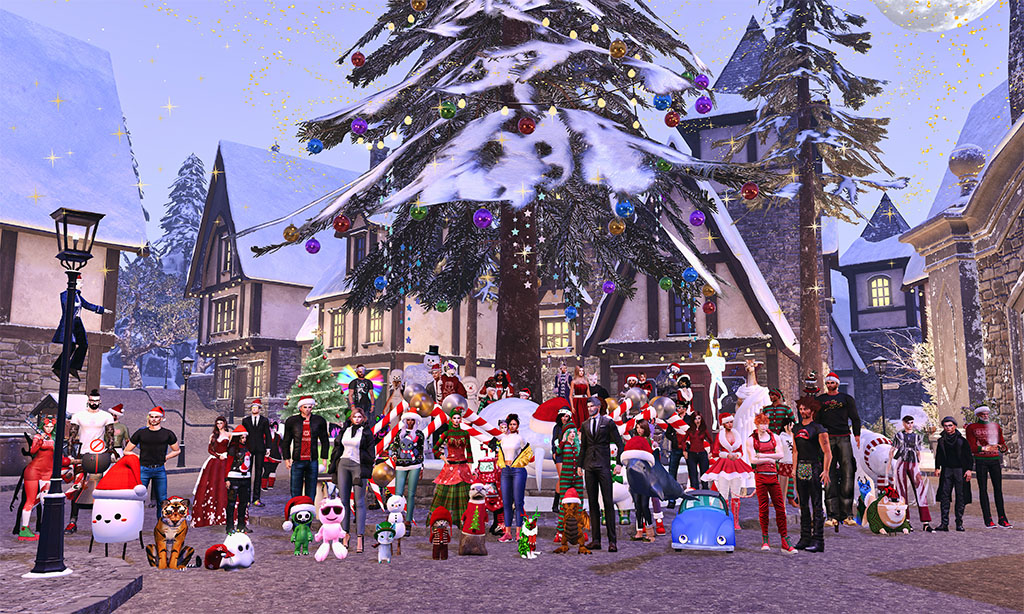
Open Second Life on a Tuesday night and you'll find a couple dressed as wolves attending a poetry reading on a sim sponsored by a Brazilian shoe brand. A few thousand virtual blocks away, someone is making rent by selling animated hairstyles. This is not a marketing campaign. It is just Tuesday on Linden Lab's grid - and it has been Tuesday like this, more or less, since 2003.
Linden Lab occupies an unfashionable corner of the technology industry: a company that does exactly what it has always done, only better, while everyone else loops through hype cycles. The metaverse boom rose around them in 2021 and crashed by 2023. They kept shipping. The AI gold rush rerouted the discourse. They kept shipping. Their residents, many of whom are now into their second decade of in-world life, did not seem to notice the noise.
"They didn't pivot to the metaverse. They never left it."- The internal joke at half of Silicon Valley
§ 02 / THE PROBLEMThe internet had no place to actually stand
In the late 1990s, the web was a set of pages you visited. It was static, two-dimensional, and lonely in a way that took a while to articulate. You could chat. You could shop. You could read. You could not, in any meaningful sense, be somewhere.
Philip Rosedale was building video-compression software at RealNetworks and obsessing over a different question: what would it take to give the internet a body? Not a profile picture - a body. A place. A shared physics. He thought the answer was hardware. He thought wrong, which turned out to be productive.
The "Rig" - a clunky steel headset Rosedale's small team prototyped in San Francisco - was the first version of the company's pitch. The hardware did not ship. The idea did.
"The dream was always a world built by the people in it, not for them."- Philip Rosedale, paraphrased from early Linden interviews
§ 03 / THE BETGive the users the tools and walk away
Rosedale founded Linden Lab in 1999 - named, with a kind of low-effort San Francisco honesty, after the street the office sat on. He'd been CTO of RealNetworks at 27. He raised early money from Mitch Kapor of Lotus fame. The first product, code-named Linden World, was a tech demo of avatars throwing physics-enabled objects around an island. It was not a game. It was a kit.
The bet was almost theological: that if you handed regular people a 3D building toolkit, an avatar, and a currency they could cash out, they would build a civilization. Not a great civilization, necessarily. A complete one. With weddings and clubs and tax evasion and bad art and inexplicably popular nightclubs.
This was, by the standards of 2003, deeply unfashionable. The web was supposed to be about pages and ads. Games were supposed to have endings. Investors wanted product-market fit, not landlord-tenant disputes between strangers wearing fox tails.
Second Life launched on 23 June 2003. It immediately became something nobody on the team had quite predicted: a place where people lived rather than visited.
§ 04 / THE PRODUCTA whole planet, slightly hand-built
Second Life is, technically, a 3D virtual world streamed over the internet. Practically, it is a set of overlapping economies. Residents create avatars - the more elaborate, the better - then buy clothes, hair, skin, animations and land from other residents. They pay in Linden Dollars (L$), which exist as a real currency on Linden Lab's internal exchange and convert into U.S. dollars at a known rate. The conversion is the entire trick.
Other platforms have virtual goods. Linden Lab has a virtual goods economy with cash exits, which is a different animal. Some residents make more from in-world sales than they do from their day jobs. Some residents do not have day jobs.
Second Life
The 3D world itself - desktop client, persistent grid, user-built sims. Still the flagship after 22 years.
Second Life Mobile
iOS and Android public beta. Chat, social, and pocket presence for residents on the move.
Linden Dollars (L$)
In-world currency, exchangeable for USD on the LindeX. The plumbing of the creator economy.
Marketplace
The web storefront where residents trade everything from animations to entire islands.
Premium Memberships
Subscription tiers that include virtual land, weekly stipends and other resident perks.
"Second Life is the original metaverse - and we're still here."- Brad Oberwager, CEO
A short history of a long-running world
Linden Lab milestones / 1999 - 2026Philip Rosedale founds Linden Lab on Linden Street, San Francisco.
Second Life launches publicly on 23 June.
$11M Series B led by Benchmark Capital. Cover of Business Week.
Rosedale steps back from day-to-day CEO duties.
Tilia, the in-world payments engine, is carved out as a standalone company.
Second Life turns 20. J.P. Morgan invests in Tilia.
Second Life Mobile public beta opens.
Thunes agrees to acquire Tilia from Linden Lab.
Product ops reorg under CEO Brad Oberwager; SVP Patch Linden departs.
§ 05 / THE PROOFThe numbers behind a quiet economy
Linden Lab does not publish quarterly slides, which is the most flattering thing one can say about a privately held company in 2026. What it does publish, periodically, is the size of the creator economy it sits on top of. Residents have cashed out hundreds of millions of dollars over the platform's lifetime. The company itself runs at roughly $55M in annual revenue with about 200 employees - small enough to know everyone, large enough to be a real business.
Second Life's creator economy, by approximate scale
Snapshots, not financial guidance. Sources: Linden Lab statements, press archives, Crunchbase."We have residents who pay rent from inside the grid. Their virtual storefronts pay their real mortgages."- Internal Linden Lab phrasing, paraphrased
§ 06 / THE PEOPLEFounder, operator, residents
Philip Rosedale
Built the first prototype. Later left to start High Fidelity, returned as an advisor, never quite stopped tinkering with the idea of a peopled internet. Now in his second act, still convinced this was the right bet.
Brad Oberwager
Took the wheel via Waterfront Capital's acquisition of the company. Operator's operator. Spent the last few years pushing Second Life onto phones and tightening the platform's economics without scaring the residents.
§ 07 / THE MISSIONA world where you make the rules
Linden Lab's stated mission has not changed much in 22 years, which is unusual. The wording shifts - "improve the human condition," "empower creators," "build the open metaverse" - but the substance is consistent: give people enough tools to assemble a place worth being in, then get out of the way.
This is harder than it sounds. The company has had to be, by turns, a software studio, a real estate platform, a content moderator, a bank, a customer support organization, a legal team responding to virtual divorces, and an audio engineering shop. Its long-tenured staff treat the platform less like a product and more like a city they're collectively maintaining.
The metaverse, as a marketing category, is now mildly embarrassing to talk about in 2026. Most of the funded versions have closed or quietly stopped updating. Linden Lab simply kept doing it, and as a result is one of very few places where the idea has actually been tested at length, with real users spending real money on virtual things they actually wanted.
§ 08 / MARGINALIAThings worth knowing at a dinner party
§ 09 / WHAT'S NEXTWhy it matters tomorrow
The argument for Linden Lab in 2026 is structural, not nostalgic. AI is making content creation cheaper. Phones can now run 3D worlds at quality that used to require a desktop gaming rig. A whole generation grew up on Roblox and Fortnite and treats virtual places as ordinary. Each of these forces happens to point at exactly the thing Linden Lab has been doing since George W. Bush's first term.
The company's Second Life Mobile beta is the most consequential bet they have placed in years - not because mobile is glamorous, but because it removes the one barrier that has gated their residents for two decades. Add AI-assisted creation tools, lower friction for new users, and a payments stack that now talks to one of the world's largest cross-border fintechs through Thunes, and the platform's runway looks longer than its history.
None of this guarantees the next decade. But Linden Lab has already done the thing the rest of the industry talks about: built a virtual world that earned the right to keep existing. Most companies pitch the future. They quietly run one.
§ 10 / THE SCENE, REVISITEDBack on the grid, Tuesday night
The wolves are still at the poetry reading. The Brazilian shoe brand has changed its sim's lighting. Down the road, the animator selling hairstyles has rolled out a new collection and gone to bed in São Paulo. Her storefront is open all night. Her commission has already converted into reais.
This is what the metaverse looks like when it works. Not a press conference. A Tuesday.
Linden Lab did not predict the future. They just kept showing up for it.