The question arrived by telephone, late in 2006. A friend wanted to know what Peter Weijmarshausen knew about rapid manufacturing. Very little, as it happened. His working world was software and the internet. The friend persuaded him to visit and showed him some plastic objects. They had been made with selective laser sintering, using nylon. For Weijmarshausen, the objects suggested something rather more interesting than another machine.
He knew people who could use them. Through his work at the company that originally published Blender, he had friends who spent time making three-dimensional designs on computers. Those designs were visible, rotatable, shareable. Now they could become things you could pick up. He showed Blender users what the technology could do and began to see a business in connecting their work to machines they did not own.
That sequence explains much of his subsequent career at Shapeways. A discovery became an invitation. Instead of asking everyone to become a manufacturing expert, he wanted to make the equipment available through a service. There is a particular pleasure in discovering a technology; his instinct was to find somebody else who might enjoy it too. The commercial question followed close behind: would enough people want to pay?
A programmer crosses into the physical world
Weijmarshausen grew up in the Netherlands, interested in computers and coding. He studied applied physics at Eindhoven University of Technology. His early career took him through software and communications businesses, including Not a Number, where he worked as ICT manager and helped the adoption of Blender. Later came engineering work at Aramiska and the CTO role at Sangine, involving broadband delivered by satellite.
These were useful experiences for someone who would end up joining a website to a factory. Satellite broadband also asks software to cooperate with physical equipment. The world does not become conveniently immaterial because the interface looks tidy. At Shapeways, a design would eventually have to survive an encounter with a material, a machine, a finishing process and a shipping box.
The company began inside Philips’ Lifestyle Incubator in Eindhoven in 2007, with Weijmarshausen, Robert Schouwenburg and Marleen Vogelaar as co-founders. The public service followed in 2008. In 2010, Shapeways became independent and moved its headquarters to New York. Weijmarshausen moved there too. The business had crossed from a Dutch corporate incubator into a city with customers, designers and investors close at hand.
You could open a shop without filling a garage
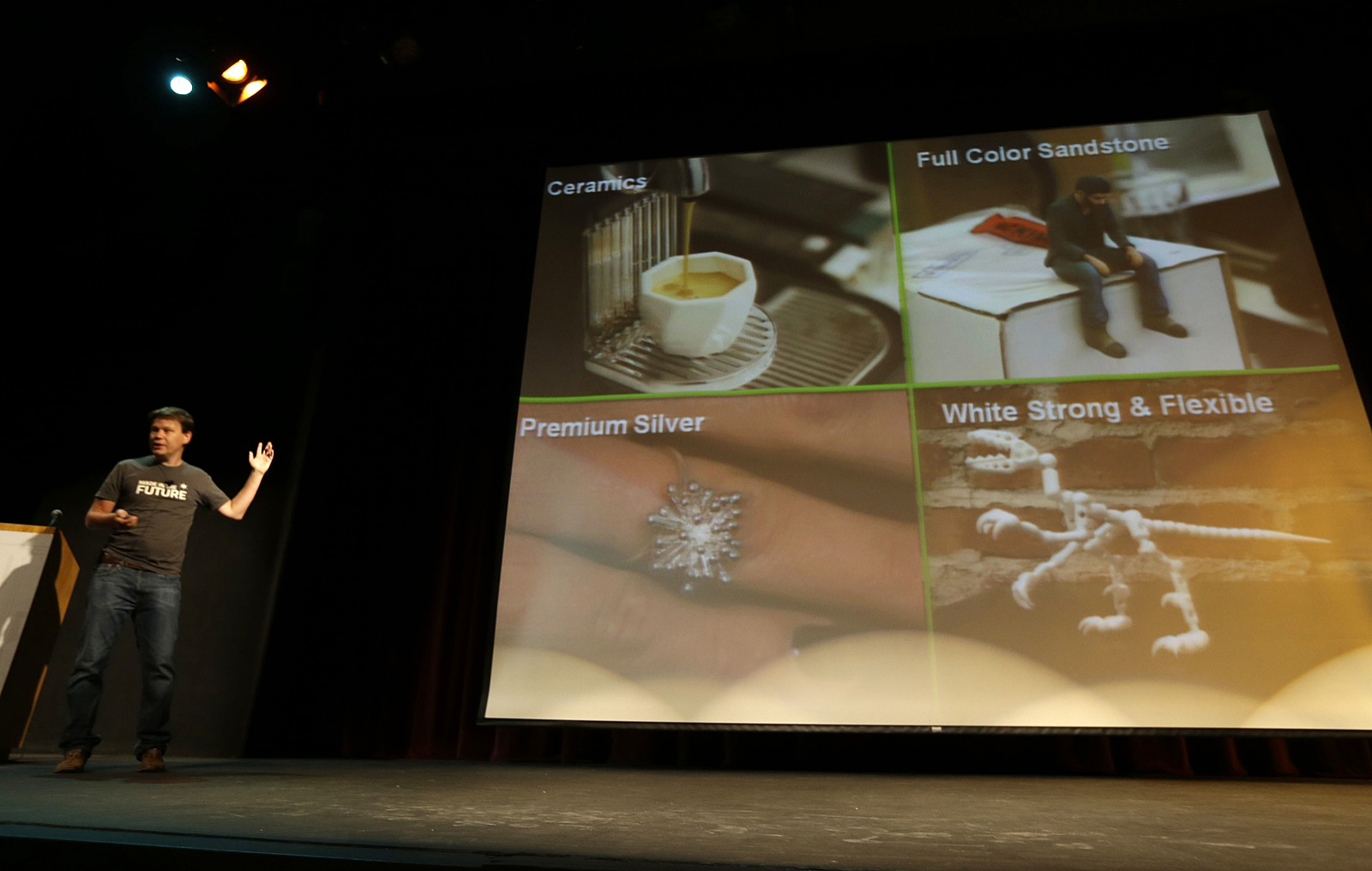
The offer was easy to understand. Upload a design, select a material and have an object made. A designer could also offer the design for sale. Shapeways would handle production and shipping when an order arrived. An online shop could begin as a collection of files, without shelves full of products waiting for a customer to develop the appropriate taste.
Weijmarshausen’s interest was in the person at the other end of that transaction. In a 2013 interview, he described the point as “empowering people to get what they want.” Customization gave a buyer a role in the product, rather than merely a choice between things somebody else had already decided to manufacture. The machine was part of the arrangement; participation was the attraction.
Consider the economics from a designer’s side. A small audience can be hard to serve when making a product requires paying for tooling and committing to stock in advance. Making to order changes that commitment. It does not guarantee a market or a profit. It does let the designer try an idea without first finding somewhere to store a thousand copies of it.
By 2015, he was reporting that more than 30,000 people used Shapeways to run their businesses. The company’s database contained more than 2.5 million printable products. Those were different measures of participation, rather than a claim that every designer had built a flourishing enterprise. Still, the range of ideas mattered. A service could accommodate many small enthusiasms that would never warrant a production line of their own.
- 01 / DesignA file becomes a product proposal.
- 02 / MakeReview, print, clean and finish.
- 03 / DeliverThe object goes to its buyer.
A factory still needs people who count
At the Long Island City factory’s ribbon-cutting in 2012, Weijmarshausen encountered a surprisingly awkward question: how many people worked for him? He admitted that he had once thought CEOs who could not answer were bluffing. Then he had to stop and add up his own team across New York and the Netherlands. His answer was 57.
The scene catches the change in scale better than a funding announcement. The company had a 25,000-square-foot factory in a New York manufacturing district. This was a technology business with a website at its front door and industrial space behind it. Growth meant hiring people, finding room for machinery and making different kinds of work fit together.
It also meant keeping the less photogenic promises. In May 2012, Weijmarshausen explained a payment error to shop owners. The team had been automating payments and reporting, then sent the previous month’s payments instead of the current month’s. He said the error had been corrected, affected people notified and additional checks introduced.
The website had initially been specified for 10,000 users. It was now dealing with multiple distribution centers, suppliers and thousands of shops. His account is revealing because the problem was ordinary. A business proposing a new way to manufacture still had to pay people correctly. The designer waiting for money has little use for a grand theory of industrial change. Here, the practical test of the vision was an accounting process.
The pony and the permission slip
Some of Shapeways’ experiments concerned permission as much as production. In July 2014, Hasbro and Shapeways launched SuperFanArt, beginning with My Little Pony. Selected fan artists could make designs based on familiar characters available through the platform. A fan’s creativity and a corporation’s intellectual property could meet inside an authorized commercial arrangement.
For Weijmarshausen, the partnership extended a pattern already visible in the community: people wanted products shaped by their own enthusiasms. Hasbro brought recognizable characters; the artists brought individual interpretations. Access to a printer would not, by itself, settle the rights question. The agreement helped make that particular kind of participation possible. Even a very small pony can require a substantial permission slip.
Other objects made the production method itself part of the delight. Shapeways offered miniature reproductions of Theo Jansen’s Strandbeests, the walking sculptures, which could emerge with their moving parts already assembled. In 2011, Weijmarshausen explained that Jansen had approached the company about manufacturing and sales. The result gave a customer something to turn over, examine and set in motion. It was a persuasive demonstration because the object did the explaining.
The stubborn price of a good idea
The service attracted investors as well as designers. In June 2015, Shapeways announced a $30 million financing led by INKEF Capital, with participation from Hewlett Packard Ventures, Presidio Ventures and existing backers. Money could support development of the platform and its production capabilities. It could not simply declare the underlying manufacturing problems solved.
A year later, Weijmarshausen was discussing a new material for detailed objects such as miniatures and collectibles. Customers wanted finer detail at a more affordable price. The company introduced black High Definition Acrylate, and he said demand had exceeded expectations by more than four times. His response was delight mixed with an immediate operational consequence: they needed more machines.
That is a useful correction to the effortless image of digital production. Demand appears on a screen; capacity occupies a building. A successful launch can create a queue. Customers judge the finished object by its detail, surface, price and arrival date, regardless of how exciting the process sounded in a demonstration.
In 2016, Shapeways was working with HP on its Jet Fusion technology. Weijmarshausen described the appeal in terms customers could recognize: quality, material choices, shorter lead times and lower costs. These were recurring demands from the community. His enthusiasm for new equipment had a specific commercial purpose. Better machines might let a designer sell an object at a price a customer would accept.
“We like to listen to our community and what they want.”Peter Weijmarshausen, 2016
Ten years, then another chapter
In August 2017, Weijmarshausen stepped down as CEO after a decade at Shapeways, remaining on the board at the time. COO Tom Finn took over on an interim basis while the company looked for a permanent successor. Weijmarshausen spoke of taking time to reflect on what had been achieved and consider his next chapter.
His later career included co-founding Humane Genomics, where the company’s current team page identifies him as CEO. He also co-founded Beheld3D, whose premise was to bring photography into three dimensions using a scanning booth. The ventures show a continued appetite for building companies around unfamiliar technical tools, even as their markets and working requirements differ.
Shapeways’ subsequent history belongs to a later period. The former business entered bankruptcy in July 2024. A new operation acquired available assets and relaunched the brand from Eindhoven. Its returning co-founders were Vogelaar and Schouwenburg, working with the Dutch management team. Weijmarshausen had left the CEO role seven years earlier. Keeping those dates straight makes his contribution, and the company’s later changes, easier to understand.
A little room for the pepper plants
There is more to his curiosity than factory equipment. In a 2020 introduction, Weijmarshausen listed interests including astrophysics, Raspberry Pi projects, programming in different languages, brewing beer, cooking, growing pepper plants and online car racing. He also described himself as the proud father of two girls. It is an appealingly crowded list. Apparently the peppers must compete with the universe for attention.
The list helps explain the tone of his public accounts of Shapeways. Technical subjects repeatedly become occasions to make something, test something or show somebody what can be done. A programmer can appreciate an elegant model; a cook has to deal with the result. Both habits seem well suited to a business where a digital design eventually lands on somebody’s doorstep.
Asked later about his interests in 3D printing, he said he wanted the technology to fulfill its promise of making manufacturing more accessible, local and sustainable. That remains an aspiration, rather than a result to assume. The question underneath his Shapeways years is still a good one: what might people make if the distance between having an idea and holding it became shorter?