A company can have offices, computers, trained employees and almost nothing for them to do. Rohit Kapoor learned that early at EXL. The outsourcing business he had co-founded in 1999 became part of the insurer Conseco, then found itself exposed when its parent ran into financial trouble. The promising new enterprise had acquired the sort of customer relationship nobody wants: dependence.
Kapoor and co-founder Vikram Talwar helped buy the business back with investor backing in 2002. Starting a company had been one challenge. Recovering one they had already started was an education with less attractive stationery. Before the stock exchange, the acquisitions and the arguments about artificial intelligence came a fairly blunt question: what could this group of people do next?
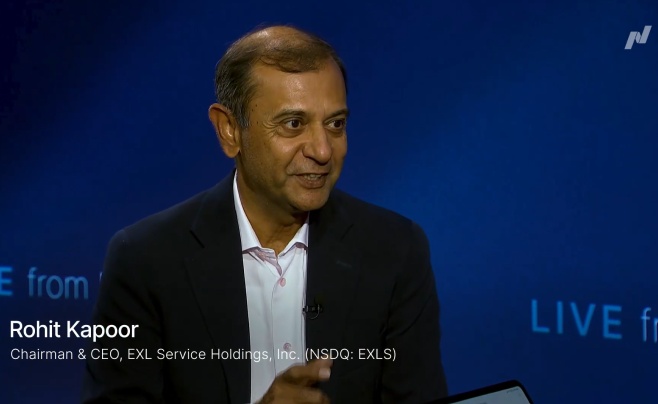
Today Kapoor is EXL’s chairman and chief executive, based in New York. The distance between those two moments is the useful part of his story. It explains why a founder from the outsourcing era now spends so much time talking about data, business judgment and the practical business of getting technology to work.
The business had to be started twice
EXL began during the expansion of India’s business process outsourcing industry. Talwar and Kapoor had known each other through Bank of America. They saw a way to connect Indian talent with work being done for overseas businesses. The opportunity was international from the beginning; the early operating base was Noida.
Gary Wendt, the former GE Capital chief, became an early investor and chairman. Conseco subsequently acquired EXL in 2001. When the insurer’s difficulties arrived, the relationship that had supplied much of the work became a liability. Kapoor later recalled a team of around 1,500 with too little work, while rival employers were eager to recruit them.
His account of the response is specific: the company retained employees, trained them for other processes and won business from clients including Aviva and Dell. The transaction that restored independence brought in Oak Hill Capital Partners and FTVentures. Survival required financing, customers and employees who could do something different from yesterday.
- 1999Kapoor and Vikram Talwar co-found EXL.
- 2001Conseco acquires the business.
- 2002A buyout restores independence.
- 2006Inductis acquisition and Nasdaq listing.
- 2008Kapoor becomes chief executive.
- 2024He adds the board chair role.
The episode makes a useful corrective to the usual founder portrait. Entrepreneurship is often illustrated with a launch. Here, the more revealing picture is a restart: existing commitments, an uncertain order book and people whose skills had to find another buyer. The founders could recover ownership. They still had to recover a business.
An engineer who wanted to sell
Kapoor studied mechanical engineering at IIT Delhi, then completed his MBA at IIM Ahmedabad in 1988. His first career interest was marketing. At Nestlé, he entered a management training programme that put him close to the everyday work of the organisation. He later described those early assignments as an education in what individual employees actually did.
Bank of America followed, with roles in India and the United States. In 1993 he moved to America to build its non-resident Indian business. There was a bank’s infrastructure behind him, but the assignment still involved recruiting, establishing an office and developing an offering. It was a rehearsal for founding, with a considerably larger institution paying the bills.
He also worked at Deutsche Bank before moving fully into EXL. Banking supplied experience of clients, money and cross-border business. Engineering and management school supplied another combination: familiarity with systems and an appetite for commercial problems. None of these jobs required a childhood prophecy about becoming an entrepreneur. They supplied practical experience for the next decision.
The original outsourcing arithmetic was disarmingly simple. Kapoor recalled considering email handling that cost $3 in America, could be performed for $1 in India and might be sold for $2. As an illustration of a business idea, it has the virtue of fitting on a napkin without requiring smaller handwriting.
A recalled founding concept, not EXL’s current pricing.
Buying a different kind of future
In 2006, EXL acquired Inductis, adding data analytics capabilities. That same year it listed on Nasdaq under EXLS. A public listing was a substantial destination for the founders, but the acquisition pointed toward a question that would outlast the celebration: what else could a company learn by doing its customers’ work?
Running a process produces familiarity with its exceptions. Analytics offers a way to study those patterns and improve decisions. The move therefore changed what EXL could sell. It could bring analysis into its work for clients, extending a relationship that had begun with operating a process.
Kapoor became president and CEO in May 2008, after holding positions including chief financial officer and chief operating officer. It was an awkward year to inherit responsibility for an international services company. The financial crisis was gathering force, and financial services were an important part of EXL’s business. A promotion does not usually come with a choice of economic weather.
There were further purchases. In 2011 EXL agreed to buy Outsource Partners International for $91 million. Kapoor described the attraction in terms of finance and accounting expertise, new customers and additional locations, including Malaysia and Bulgaria. He also discussed bringing its founders into EXL’s management. Buying a business meant acquiring people who knew how the work was done.
That is a more concrete account of expansion than the familiar promise of getting bigger. Geography, specialist knowledge and management experience were all part of the purchase. The interesting question was what the combined company could perform that it could not perform as readily before.
The email did not explain itself
One of Kapoor’s observations after becoming CEO concerned his own communication. Sending a message did not ensure that colleagues understood the perspective behind it. He set himself the task of getting to know the company’s top 300 people. The chief executive’s job included discovering what other intelligent people thought they had heard.
There is something pleasingly inconvenient about that lesson. A technology business can make communication faster while its leader discovers that understanding still takes time. A message arriving in an inbox is an event that software can record. Agreement about what it means remains a management problem.
His responsibilities widened again in 2012, when he became vice chairman, and in April 2024, when he became board chair as well as CEO. Vikram Pandit moved from chair to lead independent director. The arrangement placed the founder’s operating experience at the centre of the board while retaining a separate role for independent leadership.
Outside EXL, Kapoor served on the board of CA Technologies from 2011 until its acquisition by Broadcom in 2018, becoming lead director along the way. His current public biography also lists board service with the American India Foundation and the American Red Cross, and membership of the World Economic Forum’s AI Governance Alliance. His working world extends beyond a single company’s customers.
AI has to get through a working day
Kapoor’s present argument about artificial intelligence is rooted in operations. In a March 2026 interview, he pointed back to Inductis and to years of investment in data management. He described Indian workers’ knowledge of client processes and industry domains as useful preparation for embedding AI into business operations.
The aspiration is to make EXL a supplier of the ingredients companies need together: usable data, analytical capabilities, industry understanding and execution. The logic follows from its history. A company that has operated business processes has a reason to argue that knowing those processes matters when changing them.
“AI by itself does not create value. AI embedded into the workflow creates value.”
Rohit Kapoor, CEO Investor Forum
By October 2026, his public writing was concerned with how an AI system’s answers could be checked. He advocated combining models that interpret messy information with rules and business context that constrain decisions. A disputed bank charge, for example, requires more than a plausible account of what might have happened. Someone must establish whether a refund occurred and which rules apply.
He proposed starting with a specific recurring decision and having business, technology, risk and compliance teams define the relevant context together. It is an approach suited to somebody who has spent years selling the performance of work. The model eventually meets a customer, a record, an exception and a deadline. Those encounters are where a demonstration acquires consequences.
EXL quarterly revenue in US dollars. Bars share a zero baseline. Revenue is a company measure; it does not isolate AI’s contribution.
The next task is already on the desk
In June 2025 Kapoor received an EY Entrepreneur Of The Year New York award. He shared the credit with EXL’s 60,000 employees. The recognition arrived more than a quarter-century after the founding, an unusually long interval if entrepreneurship is imagined as something that happens only at the beginning.
EXL reported second-quarter 2026 revenue of $594.8 million, up 15.6% from a year earlier. Kapoor described the results as evidence of execution of its data and AI strategy. The numbers establish the scale of the company he now runs. They also put a measurable obligation behind the language of reinvention: customers must keep choosing to buy.
He remains an avid golfer. It is a suitable pastime for someone whose professional life offers repeated evidence that reaching one position merely reveals the next piece of work. The listing did not finish EXL. Neither did the change in title, the purchase of another business or an entrepreneur’s award.
The early restart remains the clearest scene. People were there. Skills were there. The work had to be found again. A quarter-century later, Kapoor is making a related proposition to customers trying to reorganise around AI: knowing what people do, and how a business makes its decisions, is still worth something. The tools have changed considerably. The need to make the next assignment useful has stayed.