Peter Lu’s business took a useful turn when someone noticed a delivery vehicle. Lu and his co-founder, Kevin Wang, had entered Vancouver’s food-delivery market. Their company had drivers and a name on the road. A visiting logistics executive saw an opening for those same resources in e-commerce. The introductions that followed helped send UniUni toward a different kind of doorstep delivery. Dinner had acquired a rival for the back seat.
That beginning is appealing because it contains so little of the retrospective grandeur that attaches itself to growing companies. A vehicle was visible. Someone had a problem. The founders had something that might solve it. Lu’s subsequent career at UniUni has involved turning that encounter into an operation that could work across Canada and the United States.
It also involved doing the deliveries. Remembering the early days, Lu described a team of five and recalled that “we each did a lot of driving ourselves.” Before he was explaining a network to investors, he was helping move its cargo. For a founder trained in software, the street supplied a rather literal test environment.
A different cargo
Lu and Wang founded UniUni in 2019. Food delivery put them into a crowded contest with established services such as Uber Eats and DoorDash. Having an app and willing drivers did not make that contest easy. The parcel opportunity offered a different use for the organization they were assembling.
Shein became an early, consequential customer. UniUni’s work expanded alongside the online retailer, and the business shifted its attention from restaurant orders to e-commerce purchases. By June 2023, the company was delivering about 20 million parcels annually across Canada. A small delivery operation had found work that could travel well beyond its original neighborhood.
The distinction mattered operationally. Independent contractors used their own vehicles, allowing UniUni to add delivery resources without buying a matching fleet. Software helped organize the routes. The company still needed places to sort parcels and people to handle them. Owning fewer vehicles simplified one part of the problem; it left plenty of other parts demanding attention.
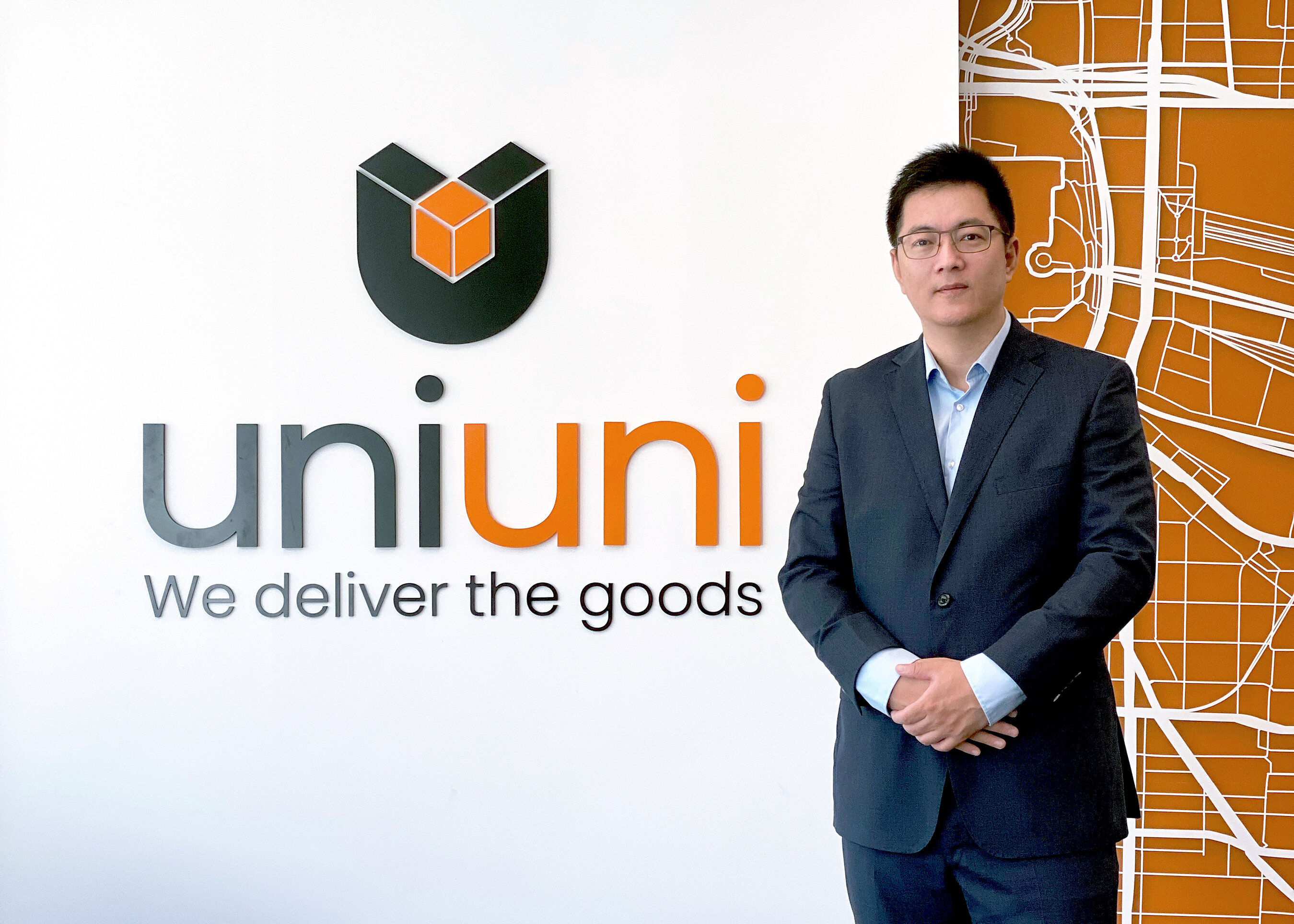
Before the parcel, the program
Lu came to this work through computing. He studied computer science at Shanghai Jiao Tong University. His career included software engineering at SCSK and Ericsson in Shanghai, followed by project management at PCCW GLOBAL in the Vancouver area. Later came IT consulting at Dataking and a business of his own, Save Online Enterprise Corp., before UniUni.
It is a career assembled over years of technical and organizational work. The progression is useful context for the company he eventually helped build: a delivery operation whose software has to coordinate activity outside a screen. A program can suggest the next stop. Someone still has to get there, find the address and finish the handoff.
He also returned to formal management study. In August 2022, Harvard Business School Online issued his Certificate of Specialization in Leadership and Management. His public credentials include an Oracle database certification dating to 2002. The distance between those two dates is a reminder that UniUni arrived well into a working life.
The right side of the street
One of the company’s revealing examples concerns which side of the road a parcel is going to. Wang described routing that increased the proportion of stops on a driver’s right-hand side from roughly half to more than 70 percent. Fewer crossings and turnarounds could save time. The improvement was small enough to picture and frequent enough to matter.
There is something pleasingly unceremonious about this measure. A company can describe its technology in elaborate language; a driver can ask whether the next address requires another trip across the road. Both are discussing the same system. The driver’s version is easier to audit.
Lu’s explanation of the market began with equally practical complaints. Small-volume businesses could face high shipping costs. Large-volume businesses could run into capacity limits. Those two problems gave him a commercial proposition: offer merchants a delivery option that could accommodate demand while keeping costs manageable.
From there, the founder’s job becomes less photogenic. Prices have to cover work. Available drivers have to match the parcels awaiting them. A route that looks efficient in an application has to remain efficient when it reaches the pavement. The useful thing about Lu’s early driving experience is the question it keeps near the discussion: what does this decision feel like to the person making the delivery?
A friend recommends the boring thing
As UniUni grew, Lu looked for ways to make process improvement part of the business. A friend and fellow entrepreneur recommended ISO 9001. Lu backed the certification effort while the team was also dealing with expansion. It is an anecdote about a founder accepting advice whose appeal lies chiefly in what happens after the excitement has worn off.
A growing operation has to repeat good work without requiring its chief executive to supervise each repetition. Quality management addresses that unglamorous ambition. There is no particularly seductive way to describe a consistent handoff. There is, however, a customer waiting at the other end of an inconsistent one.
The company’s public milestones became more conspicuous. UniUni placed fourth on The Globe and Mail’s 2023 Top Growing Companies list. Later, it ranked 11th on the 2024 North America Technology Fast 500. In 2025 it placed 17th on that North American list and fifth on Deloitte Canada’s Technology Fast 50. The rankings marked expansion; managing the expanding operation remained another assignment.
More room for other people
Lu’s story increasingly includes people brought in to carry parts of that assignment. UniUni acquired Toronto-based delivery service Shippie in 2025. Shippie’s chief executive, Jax Zheng, joined as director of strategic partnerships. The acquisition added local delivery experience as well as a team. Lu’s accompanying message included a compact qualification: “But growth alone isn’t the goal.”
“But growth alone isn’t the goal.”
Peter Lu · on the Shippie acquisition, March 2025
That year, UniUni also announced a partnership with Global Robotics Services, bringing robotic sorting systems into its warehouse plans. The proposed equipment included the 3D Sorting System and T-Sort. Here, the target was the work before the driver sets out: getting parcels sorted accurately and handling changing volumes with less manual intervention.
Venture investors supplied capital along the way. DCM led the US$50 million Series C round announced in April 2024. Bessemer Venture Partners led the US$70 million Series D announced in 2025, with DCM, Celtic House and LFX among the participants. Money raised expanded the list of possibilities. It also enlarged the obligation to turn those possibilities into a functioning business.
In March 2026, UniUni appointed Ali Irturk as chief technology and product officer. His remit included platform engineering, data, product development and information security. Lu highlighted his experience building platforms and integrating acquisitions. The appointment gave a named executive responsibility for systems that had become central to the delivery operation.
The route that did not close
The financing story requires some care with its verbs. In March 2026, UniUni announced US$30 million in equity investment led by Rockets Capital, alongside a US$55 million credit facility from Royal Bank of Canada. The combination was US$85 million of financing. Equity and a credit facility serve different purposes; adding the figures does not make them the same kind of capital.
Led by Rockets Capital
Royal Bank of Canada
Two forms of financing. The credit facility is not an additional equity round.
A proposed transaction with MAK Acquisition was intended to take UniUni public. It did not reach that destination. On September 24, MAK issued a breach notice. MAK said UniUni’s financial performance had deteriorated and alleged that the company had breached operating conditions that included a maximum cumulative pre-tax loss.
The next day, UniUni announced a term sheet for private funding led by an existing investor. That announcement described a proposed financing step. On October 20, MAK said the cure period under the purchase agreement had expired without resolution and that it had terminated the agreement. The proposed transaction would not proceed. MAK also withdrew the preliminary prospectus.
These developments change the ending of a profile written around a prospective listing. Lu’s company had built a larger network and attracted substantial backing. The route to public ownership through MAK nevertheless ended. Its next stage has to be judged through operating results and financing that actually closes.
The doorstep still gets a vote
The people doing the delivery work belong in that judgment. UniUni has faced lawsuits alleging driver underpayment and worker misclassification. Those are allegations, rather than findings of liability. They raise a question that sits beside every promise of low-cost delivery: how are the costs and responsibilities distributed among the company and the people carrying the parcels?
Lu publicly emphasizes integrity, empathy and positivity as company values. In 2023, more than 100 employees gathered at Chef Tony Seafood Restaurant in Richmond for UniUni’s fourth-anniversary celebration. Staff were recognized for their contributions. It is a human-sized scene within the expansion story: colleagues, dinner, and the recognition that parcels do not deliver themselves.
Lu’s stated ambitions remain practical ones: economical shipping, reliable service and a network that can support merchants as they grow. His path into logistics began with the willingness to put an existing operation to a different use. Continuing to earn that work requires attention to the people, routines and finances underneath it. A delivery company can take an unexpected turn. Every morning, it still has to work out the next stop.
Follow the route
Profiles, reporting & company updates
- Peter Lu on LinkedIn
- UniUni website
- The food-delivery pivot · BetaKit
- Routes and early expansion · New West Record
- March 2026 financing announcement
- September private-funding term sheet
- October 20 transaction termination · MAK
- Delivery workforce reporting · The Logic
- UniUni videos · company YouTube channel