At some point in every executive meeting, certainty becomes a luxury item. The facts are nearly complete. The risks have names. One more spreadsheet could still be commissioned, because one more spreadsheet can always be commissioned. Peter Hantman has a number for this moment: 80 percent. That is enough information to decide. The remaining 20 percent is often where caution changes costume and returns as delay.
The rule suits the career. Hantman, the Denver-based chief executive of Tungsten Automation, has spent decades in the rooms where a business has to stop describing its intentions and begin delivering them. He trained in corporate finance, moved through transportation and service businesses, and crossed from customer delivery into the CFO's office and then the COO's. In July 2025, he took the top job at Tungsten, formerly Kofax, a company old enough to remember when converting paper into pixels counted as the astonishing part.
Now the astonishing part is supposed to be artificial intelligence. Yet Tungsten's customers do not live in a keynote. They live amid invoices, insurance claims, government forms, onboarding packets, contracts and the odd fax that has survived every prediction of its death. The work must be extracted, checked, routed and remembered. When money, regulation or identity is involved, the clever answer is only useful if someone can explain where it came from.
“Enterprises don't need more AI demos, they need document automation that holds up in production, at volume, under audit.”Peter Hantman, September 2026
A career built in the engine room
The polished version of an executive biography is a sequence of titles. Hantman's is more interesting as a sequence of operating problems. Before enterprise software, he held senior finance and management jobs at Harima USA, Budget Truck Group and Ryder Truck Rental. He served as chief operating officer of Alpine Access, a provider of remote customer service, and as chief executive of Bankers Title. These are businesses of schedules, transactions, people and exceptions. Their products may differ, but all punish leaders who confuse a plan with its execution.
In 2009 he joined IQNavigator, working in global service delivery. The following year brought e2open, the supply-chain software company. There he moved through general management and global customer solutions, became CFO in 2016, and COO in 2018. The progression is almost diagrammatic: first understand the customer, then the economics, then the whole machine. Company accounts credited his finance tenure with improving profitability and the capacity to make acquisitions; as COO he helped steer organic and acquisition-led growth.
Finance and operational leadership across transportation, remote services and title services.
General management, customer solutions and then the CFO role at e2open.
COO of e2open, overseeing global business units and growth.
President and COO of Tungsten, responsible for sales, services, product, strategy and marketing.
Appointed CEO and joined Tungsten Automation's board.
His formal education carries the same two-part logic: a bachelor's degree in corporate finance from the University of Colorado Boulder, then an MBA with distinction from Harvard Business School. But the résumé's distinctive quality is range. Hantman has been CEO, CFO and COO. He has counted value, organized it and finally had to answer for all of it.
Five rules, no fog machine
Hantman has published five unofficial rules for how Tungsten should work. They are concise enough to fit on a card and specific enough to embarrass a meeting that violates them. Bad news cannot wait. Attack issues, not people. Own the outcome. Decide at 80 percent. Assume positive intent.
The first rule values candor over choreography. The second permits conflict while keeping dignity intact. The third closes the little escape hatches built into every organization chart. The fourth treats speed as a competitive choice. The fifth makes the others survivable. Taken together, the rules describe a brisk culture, but not a brutal one.
Colleagues publicly described Hantman at his promotion in similar terms: clarity, discipline, conviction and respect for people. He returned the courtesy by thanking Reynolds Bish, the longtime CEO who moved into the executive chairman role. The succession was presented as a handoff, not a purge. This matters because Tungsten's history is not scenery. It is the product.
The inheritance: 40 years of paperwork
Kofax began in 1985 as an image-products company. Across four decades and several owners, its family tree accumulated names from document capture, optical character recognition, invoice automation and workflow software. It became Tungsten Automation in 2024. By the time Hantman became CEO, the group served more than 25,000 organizations. Today the company says its systems process over 10 billion documents a year and support customers across more than 140 countries.
Scale changes the nature of an AI promise. A model that performs beautifully on a sample can become expensive, inconsistent or risky in production. A workflow that touches a bank, insurer or government department needs permissions, controls and a record of what happened. Hantman's language returns repeatedly to trust, governance and auditability. Those words are less fashionable than “agent,” but considerably more useful when an auditor is in the room.
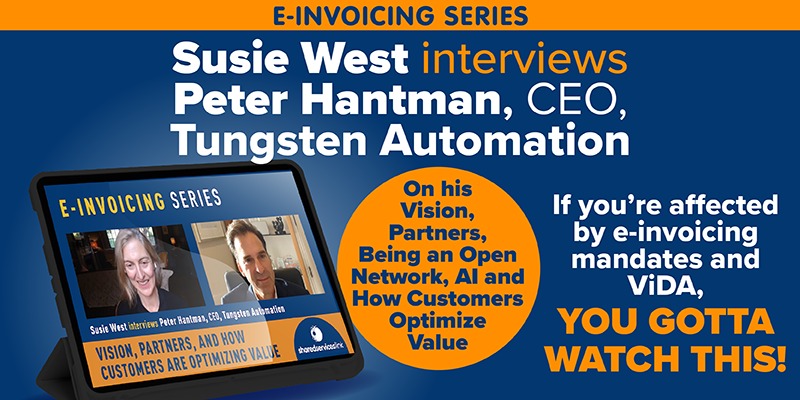
E-invoicing makes the point with almost comic efficiency. Around the world, tax authorities are replacing leisurely paper trails with continuous digital reporting and country-specific mandates. An invoice can no longer be treated as a PDF that wanders politely from one inbox to another. It is becoming a structured, regulated transaction, checked while the business is still trying to pay it. Tungsten's partnership with tax-compliance specialist Sovos joined those two jobs: moving the invoice and proving that it moved legally. In an interview about the agreement, Hantman framed automation and compliance as one operating problem. It is an unglamorous example, which is precisely why it is revealing. Enterprise AI earns its keep when a routine document crosses borders, meets a rule nobody in the room has memorized, and still arrives at the right ledger without causing a small international incident.
His strategy is to place newer AI capabilities on rails enterprises already use. Tungsten has invested in document intelligence, orchestration, knowledge discovery and agents while retaining cloud, hybrid and on-premises deployment choices. In early 2026, Hantman announced senior product, AI and research leaders, explicitly tying their roles to an AI-first transformation. The company also pursued government security authorizations and expanded its leadership bench. In September, it was placed in the leaders quadrant of Gartner's intelligent document processing assessment for a second year.
There is an acquisitive subtext, too. Hantman spent years at e2open as it expanded through both internal growth and deals. Tungsten itself is the product of a long consolidation. His job is to make the accumulated parts read as a platform rather than an attic.
The productivity question nobody owns
In a 2026 essay, Hantman drew a line between saving time and changing an organization. Imagine an AI tool cuts the work in a task by 30 percent. The arithmetic is easy. The management is not. Who reallocates that capacity? Does the employee take on higher-value work? Does service improve? Does the old job stay exactly as it was, only with a little air trapped inside it?
His argument is that AI programs can create the appearance of transformation while leaving outcomes untouched. Productivity becomes real only when leaders are willing to redesign roles, move talent and govern the capacity they have freed. This is the operator speaking. Technology can create an opening; an institution still has to walk through it.
“Technology may create the opportunity for productivity gains. But without workforce flexibility and clear capacity governance, many of those gains risk remaining theoretical.”Peter Hantman
The point also explains his preference for the 80 percent decision. AI is arriving faster than the tidy organizational structures required to absorb it. Waiting for the picture to become complete is tempting, especially in regulated enterprises. Moving without controls is foolish. The middle course is operational judgment: enough evidence to act, clear ownership of the result, fast disclosure when the plan goes wrong.
What survives the demonstration
Hantman does not present himself as the lone inventor in this story. His public refrain is the opposite: “You're only as good as your team.” The line can sound generic until set beside his decisions. He has added leaders across technology, AI, product, research, transformation and revenue. He has described curiosity, confidence, caring and communication as the cultural requirements for generative AI. The software may be autonomous; the responsibility remains stubbornly human.
That creates a useful tension at the heart of his tenure. Tungsten sells automation, but Hantman's central questions are organizational. Who owns the outcome? What happens to saved time? Can conflict remain respectful? Will a clever system endure scrutiny? Invoices and claims may be unlovely objects, yet they force philosophy into practice. Someone must approve the payment. Someone must explain the denial. Someone must be able to reconstruct the chain.
For Hantman, the next era of automation appears to be less about removing people than removing the fog around their work. Documents become data. Data becomes a decision. The decision keeps an audit trail. The executive meeting reaches 80 percent, and then, mercifully, ends.