Peter Finn gave his father a deadline. He would take the job, but he would stay for no more than a year. This was 1977. He had studied literature at Brown and Columbia, pictured himself in academia, and discovered that academic vacancies were inconveniently scarce. The research department at Ruder Finn had an opening. His father, David, happened to be the employer. A temporary arrangement seemed reasonable. Careers have a poor record of respecting such arrangements.
Nearly five decades later, Finn leads the communications and marketing firm he launched in December 2011. In Hunter, New York, he also chairs the Catskill Mountain Foundation, which he and his wife Sarah established in 1998. One organization operates internationally. The other has theaters, arts workshops and a piano museum within a small patch of the Catskills. Together, they suggest a recurring problem with Finn’s modest beginnings: he keeps finding reasons to continue.
A year became a career
His first employer within the family business was Research & Forecasts. The move into senior financial management followed in 1984. That progression matters. Finn arrived through research and learned to work with the machinery of an organization: its resources, its people, the decisions that make another month possible. The literature student acquired a second education, this one with payroll attached.
Eventually he became co-CEO and a quarter-owner of Ruder Finn. He spent 11 years in the shared chief executive role before leaving to establish FINN Partners. The family name went with him; the family firm continued separately. His subsequent account of the separation allows for different business philosophies without turning a complicated family transition into a simple contest between winners and losers.
David Finn remained a significant figure in his son’s understanding of the work. When Peter received an Individual Achievement SABRE award in May 2021, he thanked his father as a mentor and former business partner. He also recalled the lessons of kindness and justice he had learned from him. Independence, in this telling, left room for gratitude. Starting again did not require pretending that the first education had been wasted.
The arithmetic of starting again
FINN Partners opened with substance already behind it: 150 people, six offices and $24 million in fees. Clients and colleagues came from the earlier business. This was an agency taking a new organizational form, with existing work to deliver and existing relationships to maintain. The founding date marked a decision about how those people would work together.
It also came with debt under the separation agreement. Finn’s account of those early days includes worrying about making payroll. That detail puts a useful weight underneath the language of purpose. A company with principles still needs money in the bank when salaries fall due. The ambition was to make the principles survive that obligation.
Growth followed through client work and acquisitions. Within 18 months of launch, employees had voted FINN Partners the best PR agency to work for in North America. By 2020, fees were around $110 million. The agency now reports approximately $199 million in fees, with more than 1,300 colleagues. Those numbers describe a considerably larger institution than the one that opened in 2011. Keeping people working together becomes a different job at that scale.
Who gets invited in
Finn has made the selection of partners central to that job. In describing his acquisition criteria, he starts with shared values. The business case follows: a prospective agency should strengthen a practice, add a useful capability or bring the group into a strategically important location. Chemistry gets a place at the table before geography.
The expansion into Asia offers a concrete example. Ying Communications joined in Singapore in 2017, bringing technology and business-to-business expertise. CatchOn subsequently added travel experience and a presence in Hong Kong and Shanghai. Finn’s account of the region emphasizes the differences among its markets. An international office list would be a fairly expensive ornament if it did not also contain people who understood the places on it.
“Work hard, play nice.”
Peter Finn’s recurring instruction for the agency
There is evidence of that appeal from the other side of a deal. CatchOn founder Cathy Feliciano-Chon has described choosing FINN Partners because of its commitment to using professional abilities for a wider social good. Her account makes the attraction more specific than a founder’s claim about his own culture. Another owner had to decide whether she wanted her business inside it.
Finn’s own role leaves space for those owners and specialists. He describes his work as management and long-term building rather than leading client pitches. He recruits people whose abilities complement his. This is a practical admission for an agency chief: the organization needs skills its founder does not possess. Hiring well includes knowing where to stop volunteering oneself.
Luxury, with the specialists connected
His connection to FINN Partners Luxury runs through this parent organization. The dedicated FINN Luxe offering launched in July 2024, gathering expertise across travel, fashion, design, food and drink, art and other luxury categories. It arrived with a Luxury Playbook developed with Mintel. The structure gave work already happening across the agency a more coordinated home.
Travel had supplied some of the groundwork. Hawkins International and its affiliate Maverick Creative joined in November 2021. Jennifer Hawkins subsequently took charge of the New York travel practice in 2022. Building the luxury offer meant bringing specialist relationships and knowledge into contact with a wider set of colleagues.
For Finn, that makes luxury another test of the agency he has assembled. A hotel’s reputation can involve architecture, service, place and cultural life. Those subjects do not conveniently belong to a single professional discipline. A firm can buy expertise; getting experts to find one another and work together requires a further investment. The organizational question persists after the acquisition announcement has vanished from everyone’s inbox.
A different sort of return
The Catskills give his interest in culture a physical address. Peter and Sarah’s initial plans for an old movie theater were relatively small: improve the place, accommodate performances and screenings, employ a few people. By the foundation’s twentieth anniversary, the operation had grown well beyond that outline. A modest renovation had developed a rather demanding social calendar.
The buildings tell their own part of the story. The property bought in 1998 contained a cinema, grocery store and ski shop. Over time, the former grocery space became the Piano Performance Museum. The transformation has a pleasing literalness: a place once organized around provisions now makes room for instruments, concerts and close listening.
Doctorow Center
Film · performance · piano museum
Orpheum
Dance · theater · live performance
Sugar Maples
Studio arts · workshops · retreats
In Hunter, the Doctorow Center combines a three-screen cinema, the museum and the 165-seat Evelyn Weisberg Hall. Tannersville’s Orpheum has 245 seats and a sprung stage floor suited to dance. Sugar Maples, in Maplecrest, provides a setting for studio arts. These are different answers to the question of what a rural arts organization should provide. A visitor can be an audience member in one place and a participant in another.
Each answer also carries continuing obligations. A theater needs programming, technical knowledge and people who can run a performance. Workshops need teachers. Buildings need attention between events. The foundation’s work depends on the less photogenic business of keeping all those things available.
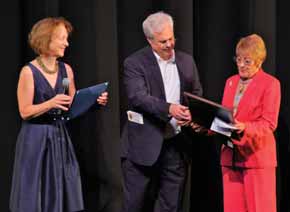
An archival moment from July 2013 catches Finn in that wider company. At the foundation’s gala, he and Sarah honored Kay Stamer for her work at the Greene County Council on the Arts. The occasion recognized an arts organizer whose contribution stretched across decades. The photograph is a useful companion to the agency milestones: here, the occasion is another person’s accumulated work.
The foundation’s leadership is shared, too. Peter is chairman; Sarah is president. Amy Scheibe serves as executive director, and Pam Weisberg directs performing arts. The names matter because an arts institution needs more than someone prepared to finance an idea. It needs people able to turn the idea into a program that audiences can actually attend.
By August 2026, the conversation had reached another set of plans, including dance studios expected to open in 2027. Such dates come with the usual uncertainties of building. They also show how the original decision continues to generate work. The cinema purchase was a beginning that kept presenting the Finns with another practical question.
Room for another chapter
Finn has brought the two organizational stories together in his book, Driven to Build, Guided by Values: Leading for Long-Term Success in the For-Profit and Nonprofit Worlds. Its subject is the work of sustaining institutions across those settings. Business and nonprofit leadership meet in the responsibility to keep something useful going beyond its first burst of enthusiasm.
He now divides his time between Hunter and New York City, with Hunter his primary base. At home there is a library of more than 3,000 books. The detail brings the literature student back into view. An academic career did not materialize; reading retained its room in the house.
The two institutions make a more revealing portrait than either could alone. An agency records growth in fees, colleagues and capabilities. An arts foundation can point to rooms where people gather and a calendar that gives them reasons to return. Finn has spent years accepting the obligations of both. Somewhere behind those commitments is a young graduate who thought he had found a job for twelve months. He was quite precise about the duration. Events appear to have negotiated an extension.