In 1994, Italy’s national football team came to New Jersey with an entourage, a tournament to play and particular ideas about dinner. Its base was the Somerset Hills Hotel in Warren. All 111 rooms were booked for the delegation. For the hotel’s public relations agency, the obvious subject was football. John P. Lonsdorf remembers a more useful angle: how the hotel was accommodating its Italian guests and their food traditions.
R&J pitched the hospitality story to The New York Times, which published a feature on June 29. Italy supplied the sporting drama; the hotel supplied the setting and the practical details that made another story possible. In October 2026, Lonsdorf returned to the episode in an essay about the World Cup. Thirty-two years later, he still remembered the angle. It is a revealing choice of souvenir.
His professional title now reads co-founder and CEO Emeritus of R&J Strategic Communications. The agency turned 40 in April 2026. A business that began before web browsers became an everyday habit has had ample opportunity to become a historical curiosity. Lonsdorf’s career offers a different kind of history: one of repeated adjustments, made by someone whose first paid audience was a classroom of middle-school students.
Founded April 6, 1986.
A new chapter in 2026.
An English teacher takes a different assignment
He graduated from William Paterson in 1979 with a bachelor’s degree in communication and teaching certifications. His first job was teaching English in Hope, New Jersey, for $10,500 a year. Freelance advertising and public relations work arrived through fellow alumni. Eventually, he joined Landmark Advertising, handling account services and business development.
When Landmark closed in 1986, Lonsdorf saw an opening. His wife, Lyn, was nearly nine months pregnant with their first child. “It was the worst possible time,” he later recalled. She supported the venture. He and Bob Gagauf assembled $50,000. On April 6, Lonsdorf, Gagauf and Bob Wille opened Roberts & John Advertising and Public Relations in Livingston.
The name had the pleasingly literal quality of a small partnership: two Roberts, one John, and the work they proposed to do. Early assignments included commercial real estate. The firm’s anniversary history places Prudential Real Estate Investments, Garibaldi Realty and Summit Associates among its initial clients. These were relationships to build one assignment at a time, with neither an anniversary campaign nor a Hall of Fame plaque yet available to assist the pitch.
“It was the worst possible time.”
John P. Lonsdorf, on starting the agency in 1986
A browser changes the brief
By the mid-1990s, the firm was expanding in Parsippany while the internet was beginning to alter the business around it. Lonsdorf’s recollections dwell on what browsers, online commerce and search would mean for a client’s communications. An organization could now be encountered in several places before anyone spoke to its staff. The website and the coverage had to make sense together.
His May 2026 account of those years describes a widening concern with where information would be found. Getting the words right was only part of the assignment. Search and online publishing were changing the route between an organization and its audience. A message could travel beyond the channels the organization controlled, picking up new readers and new responses along the way.
In 1999, Scott Marioni joined R&J. Lonsdorf singles out his arrival as a consequential event in the agency’s development. The business became R&J Group in 2001. Its names changed again as its work developed: R&J Public Relations, then R&J Strategic Communications. The stationery was doing its best to keep up with the job description.
The sequence matters because it shows a founder making room for a broader business. Advertising, media relations, digital work and creative services increasingly belonged in the same conversation. For a client, the communications problem might begin with a newspaper question and continue on a website or social platform. Organizing an agency around that journey required more than a new sign on the door.
- 1986Roberts & John opens in Livingston
- 2001R&J Group
- 2005R&J Public Relations
- 2015R&J Strategic Communications
- 2024Lonsdorf hands over daily operations
The CEO who collected mistakes
Lonsdorf’s management writing has a useful lack of ceremony. After participating in a New Jersey Technology Council CEO Forum, he began a series about errors executives recognized in their own working lives. The opening carried a small joke: he had been invited, he was assured, because he knew many CEOs, rather than because he had personally accumulated an exceptional collection of mistakes.
He grouped the discussion into personnel, planning, product and general business. In his personnel essay, he warned about being dazzled by a résumé and neglecting the person who would actually arrive at work. He also argued for developing a bench: people already inside the organization who could grow into larger responsibilities. The sports analogy is familiar; the managerial obligation behind it takes longer to fulfill.
The planning installment begins with an equally ordinary problem. Executives agree that a plan matters, then become too occupied with running the company to make one. Lonsdorf wants leaders to state what success means, put the plan in writing and return to it. His comparison is a board game: before moving the pieces, people need to know what winning involves.
There is room in that account for uncertainty and for peers. He encourages executives to consult people who have faced comparable decisions and to make adjustments as conditions change. The voice is conversational, occasionally teasing, and directed at practical behavior. You can imagine the former teacher recognizing a class that understands the lesson perfectly and has still neglected its homework.
Preparation rarely gets the applause
His writing about crisis communications follows a similar logic. Asked for examples of good crisis management, he favors the incidents that never become famous. Preparation may prevent an organizational problem from turning into a public spectacle. The absence of spectacle leaves a communications adviser with rather less to put in the trophy cabinet.
In a 2017 essay, he sets out the work behind that outcome: identify vulnerabilities, assign responsibilities, train spokespeople and keep communication channels ready. Someone senior must also keep the ordinary business functioning while others handle the problem. Employees need information, too. It is an account of reputation grounded in responsibilities, rehearsal and the unglamorous task of knowing who can do what.
The same preference for advance work appears in his advice on presentations. In 2018, he argued that greater dependence on electronic communication made speaking clearly in person more valuable. Preparation helps organize thought and gives a speaker confidence. He treated presentation training as an investment in employees, with applications extending from a formal speech to a meeting or client conversation.
And when economic warning signs caught his attention in 2019, he wrote about preparing a business before a downturn arrived. His suggestions included examining revenue sources, building reserves and managing debt. He openly acknowledged the self-interest of a communications executive arguing against indiscriminate marketing cuts. The admission makes the argument easier to inspect: here is the advice, and here is the adviser’s stake in it.
“The best crisis management cases are the ones you never hear about.”
John P. Lonsdorf, 2017
A publicist’s name on the plaque
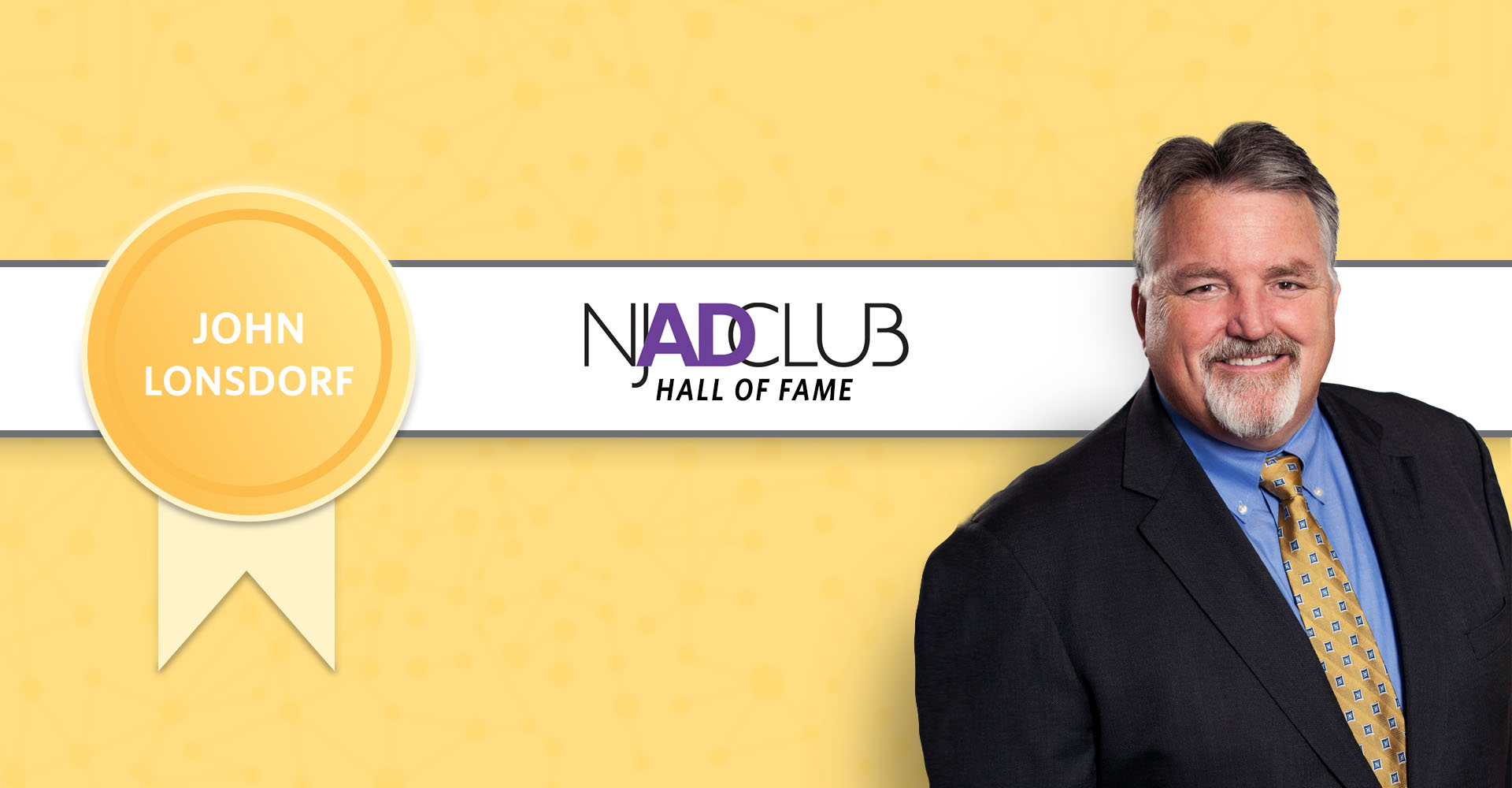
In 2019, the Advertising Hall of Fame of New Jersey inducted Lonsdorf alongside Patrick Brightman, Gary Denburg and Jerry Kaulius. The New Jersey Ad Club’s register records the class. For a career spent drawing attention to clients, the recognition put his own name in the foreground.
The following year brought an NJBIZ ICON Award, presented at a virtual ceremony on August 18. The award recognizes business leaders over 60 for their careers and leadership. Those two honors provide dates and independent institutional context for a reputation that otherwise lives largely in client relationships, agency work and colleagues’ recollections.
One such relationship appears in the Hall of Fame announcement. James E. Hanson II of The Hampshire Companies described more than 25 years of working with Lonsdorf. He praised the way Lonsdorf conducted business as well as his creative contribution. Endurance is particularly legible in a client relationship: it means someone kept choosing to have the next conversation.
His agency’s community service program also put people to work beyond client assignments, including Habitat for Humanity, Clean Ocean Action and Jersey Cares. That gives the firm’s mission of making a difference a tangible setting. A phrase acquires more weight when colleagues can point to somewhere they went and something they did.
Leaving room for the next voice
In 2024, Lonsdorf stepped back from active involvement in the business, leaving day-to-day operations to Marioni and Tiffany Miller. Their histories with the firm ran well beyond that handoff. Marioni had become his partner in 2005 and president in 2018. Miller joined in 2006 and became a partner and executive vice president in 2019.
The transition gives a practical example of the bench Lonsdorf had urged executives to cultivate. By the 40th anniversary, the agency was based in Somerville, and its history was being told through a year-long series of reflections. Lonsdorf contributed memories; colleagues contributed their own perspectives. A founder’s account had become one voice in a longer conversation.
His April 2026 essay about the founding years returns to personal service, honest advice and the satisfaction of seeing colleagues develop into leaders. These are the ambitions he names when looking back. The account gives relationships as much space as growth. Forty years creates plenty of material for an anniversary, but it also offers a founder time to decide which achievements still matter to him.
There are lighter details in the older portrait. In 2002, he was coaching youth sports and playing guitar for pleasure after his band days. The executive who writes about developing a bench had spent time beside actual playing fields. The former English teacher still had a use for an audience, a little timing and a story worth telling.
Which brings the career back to that hotel in 1994. A football team’s visit created an occasion. The telling detail was waiting elsewhere, in the work of making guests feel at home. Lonsdorf remembered to look there. Decades later, with the operating responsibilities passed on and another World Cup essay published, he was still interested in how an ordinary detail becomes the part people remember.
Follow the conversation
More from Lonsdorf and the agency:
- R&J Strategic Communications
- John Lonsdorf on LinkedIn
- Lonsdorf’s essays and commentary
- The World Cup hotel story
- R&J at forty - New Jersey Business Magazine
- New Jersey Advertising Hall of Fame
- William Paterson alumni magazine - Fall 2002 (PDF)
- The founding years
- The agency’s digital expansion
- CEO mistakes: planning
- CEO mistakes: personnel
- Preparing for a crisis