Heather Hoopes-Matthews had a problem familiar to anyone whose face has ever filed a report before their mouth was ready. She could keep a thought to herself. Her expression was less cooperative. Years after working in television news, she offered that habit as one explanation for why she had been a field reporter rather than an anchor. It is an unusually candid admission from someone who makes a living helping other people decide what to reveal.
Her advice was wonderfully unglamorous: pause, prepare a sentence that buys time, and get the face under control. “Discipline your face,” she wrote. There are communications manuals with hundreds of pages that never quite reach the eyebrows.
The admission also gives a useful way into her career. Hoopes-Matthews has spent it on both sides of the request for comment. She was the journalist seeking information. Then she became the adviser helping organizations answer. Along the way, she co-founded NP Strategy and led it from its 2013 launch until a leadership transition in 2025. The questions have changed ownership. Their power to make a room uncomfortable has survived.
The reporter who kept asking
At the University of Missouri-Columbia, Hoopes-Matthews studied journalism; her education dates run from 1988 to 1992. By 1994, WIS-TV had hired her as its education reporter. She would later recall that arrival while recommending Marcia Purday, a communications professional she met through the education beat, for a university teaching position. The relationship eventually extended into work at NP Strategy. A reporting assignment could become a connection that lasted decades.
Her newsroom experience included work with CNN’s The Capital Gang and live hurricane reporting. Investigative work brought a more enduring consequence: reporting that helped change a South Carolina law protecting children. Each demanded a different kind of clarity. A live report has little room for wandering. An investigation needs enough patience to establish what happened before anyone has agreed on how to describe it.
In 1999, that work placed her in a dispute over a confidential source. After she reported on a secretly recorded conversation between a murder defendant and his lawyer, federal authorities sought testimony from her husband, Jim Matthews, about the source. The Radio-Television News Directors Association protested the effort. This was a reporter’s professional obligation reaching into her own household, with consequences well beyond a broadcast deadline.
- 1994Joins WIS-TV as education reporter
- 2002Moves to Nexsen Pruet
- 2013Helps launch NP Strategy
Across the interview table
In 2002, she joined Nexsen Pruet as marketing and public relations director. The Carolinas business law firm had eight offices and roughly 200 lawyers. Her experience translating complicated material became useful to business development and to clients facing crises. The audience had changed, and so had the obligation: she was now helping an institution explain itself while its lawyers considered what an explanation might expose.
That setting matters. Lawyers and reporters can bring very different expectations to the same question. One wants time to examine the facts; the other has a story to finish. A carefully qualified statement can sound evasive outside the room where it was drafted. A quick answer can create difficulties inside it. Hoopes-Matthews’s subsequent work repeatedly returns to preparing both groups to operate within the same reality.
In 2013, she helped launch NP Strategy with Leighton Lord. The firm took on messaging and stakeholder engagement for organizations facing change. Its work extended to community relations around economic development projects and training executives and government leaders to speak in public. The business gave her reporting experience a practical application: anticipate the question, understand who needs an answer, and make the answer comprehensible.
Two words she would rather replace
Consider her treatment of “no comment.” It is short, familiar and tempting when a reporter calls about an unwelcome subject. Hoopes-Matthews argues that it also leaves room for an audience to assume the worst. Other participants will keep talking. The story will acquire detail from somewhere, even if the organization at its center contributes only those two words.
Her example is deliberately ordinary: a former employee files a lawsuit and contacts the media. A journalist calls the company for its response. The first step, in her account, is to reach the lawyer or executive and establish the facts. A brief statement can then explain that the company has received the lawsuit and is reviewing it. There is no need to improvise a defense before that review is complete.
The distinction is one of precision. A company can describe what it knows and what process is underway without making a promise about what comes next. That gives the public something concrete to understand. It also respects the reporting process enough to offer a usable answer. Nobody has to enjoy the telephone call for it to be handled sensibly.
When public relations becomes public business
The work can itself become a matter of public interest. In late 2023, the City of Cayce engaged NP Strategy after a WIS-TV reporter requested police employee exit interviews. The initial agreement covered $12,000 in video work and media relations. The arrangement later drew questions from council members about costs and how fully they had been informed.
Records showed the firm discussed the response to the records request and helped draft messaging. City officials said NP Strategy advised releasing the documents promptly. Hoopes-Matthews later told officials the work was about $1,400 beyond its hourly estimate and asked whether to continue; the city authorized further work. The mayor said video production was a capability the city needed.
The episode exposes an additional audience for this profession. A public client must account for the communications bill as well as the underlying controversy. The decision to hire help, the scope of the work and the cost can all become questions in their own right. For an adviser who began in reporting, the possibility of scrutiny is part of the assignment.
Building a room full of experience
Growing NP Strategy meant recruiting people who had encountered pressure in different settings. In 2022, the firm hired Denada Jackson, whose communications work in Charlotte included supporting the mayor and city council. In 2024, Charleston County public information officer Kelsey Barlow joined as a senior adviser. Her arrival made her the eighth former journalist on a team then numbering 25.
Those dated hiring announcements offer a clearer picture than an undated headcount. Newsroom experience mattered, alongside local government knowledge and relationships. Barlow had worked through both newsroom crises and difficult periods in government. Jackson brought years of municipal communications. The firm was assembling people who could understand the institutions behind an announcement, as well as the announcement itself.
There was evidence of commercial momentum early on. In September 2019, NP Strategy reported revenue growth of 400 percent over the previous four years. “We never expected this kind of quick growth,” Hoopes-Matthews said. The same announcement named Amanda Loveday associate director. Expansion required somebody to help manage recruiting, business development and the growing administrative workload. Success had brought its own stack of unfinished business.
“We never expected this kind of quick growth.”
Heather Hoopes-Matthews, September 2019
A founder changes seats
On February 19, 2025, NP Strategy announced Loveday as chief executive and Jean Cecil Frick as chief operating officer. Hoopes-Matthews would remain with the firm working directly with clients. Loveday’s leadership responsibilities had been developing for years; the 2019 associate director appointment makes the later succession easier to understand.
The transition gives her story a different ending from the familiar founder narrative that stops at expansion. She had led the firm from its beginning. Now operations and long-term direction belonged to a new chief executive, while she continued the advisory work. The distinction between founding CEO and current CEO is small on a business card and substantial in an organization.
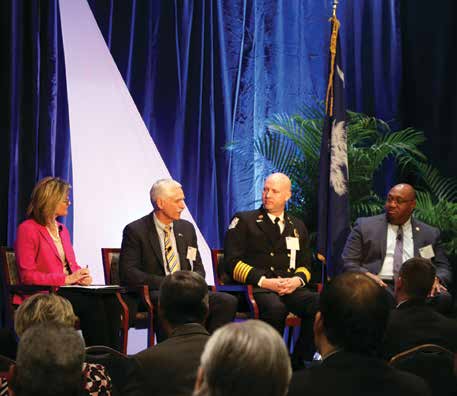
Her public work continued. In May 2026, she presented at DRI’s Employment and Labor Law Seminar in Boston on crisis communication for companies facing litigation. The session concerned preparation, response teams and disciplined public messaging. More than two decades after joining a law firm, she was still working at the point where legal strategy and public explanation meet.
The face, the faith, the fishing boat
Outside work, Hoopes-Matthews enjoys fishing off the South Carolina coast with her husband. Faith is another public part of her life: she leads community Bible studies, serves on the board of Crossover Global and is a trustee of Columbia International University. These commitments place her in communities beyond the client meeting and the training session.
Her humor is most apparent when she turns her own instruction inward. In writing about reactions, she admitted she sometimes spoke too quickly and regretted it afterward. The adviser was included in the lesson. That makes her insistence on preparation easier to hear: even someone who teaches communication can need a moment before answering.
Across reporting, firm building and client counsel, the recurring task has been deciding what can responsibly be said under pressure. Her most memorable reminder is almost comically small beside that career. Before the statement, before the interview, before the carefully organized explanation, there is a face. It would be helpful if it waited its turn.