Kristin Cowart Pierce had spent years helping companies explain themselves. Then her children wanted an explanation. Where did she go every morning? What happened in that office? Why did people keep calling? A public relations executive can prepare a spokesperson for television and still find herself searching for the right words at the front door.
The questions eventually became Mommies Work, a children's book published in 2020. Its author was already the founder of BRAVE Public Relations, the Atlanta agency she had started in 1999. She understood audiences, messages and the peculiar distance between knowing something yourself and helping someone else understand it. Her children supplied a rather exacting test of those skills.
There is a familiar professional biography here: college, international agencies, a company of her own. But the interesting part is what happened when the experienced communicator had to make her working life legible to the people waiting for her at home. A client can approve a presentation. A small child may reasonably want to know whether your office has games.
That question deserves an answer, too.
Three internships before the opening
Pierce grew up in Florida and went north to Boston College. A college PR class supplied an early glimpse of another possible life. The instructor worked in public relations during the day, then arrived in the evening with accounts of campaigns, press events and client problems. The work sounded lively, demanding and worth investigating.
Atlanta offered an occasion to do exactly that. The 1996 Olympics were approaching, and Pierce wanted to take part. Getting into the profession required three unpaid internships before a paid opportunity arrived. She joined a business whose clients included Olympic sponsors, gaining an education in work that had a very public deadline.
At Golin in Atlanta, her accounts included Starbucks, McDonald's, Chick-fil-A and Sara Lee, with Olympic sponsorship programs among her responsibilities. Later came London and Edelman, where she worked as a director leading campaigns across Europe. Her eventual agency would have a small-team identity, but her training involved large organizations and brands with plenty at stake.
- BostonA PR class opens a door
- AtlantaGolin and Olympic sponsors
- LondonEuropean campaigns at Edelman
- Atlanta · 1999BRAVE begins
In 1999, she returned to the United States to start her own firm. The ambition was practical: a closer relationship between agency and client, with experienced people staying involved. Knowing how to handle an account did not automatically make her comfortable owning a business. “It was terrifying!” she recalled.
The candor helps. Entrepreneurship is often narrated backward, with later success making every early decision appear inevitable. Pierce remembers the gap between being able to do the work and knowing how to run the company.
A smaller table, with the senior people at it
BRAVE's proposition gives that early ambition a concrete form: a senior person on every account. It is a staffing decision with consequences for the person paying the bill. Experience remains close to the daily work, including the uncomfortable conversations that can accompany a launch, a reputation problem or a plan that needs rethinking.
Pierce leads an all-female team. The agency works across media relations, influencer programs, events, social media and crisis communications. Its services also include preparing spokespeople and arranging partnerships between brands. That range puts the firm at several points in a company's public life, from finding an audience to deciding what to say when attention becomes awkward.

The event work reveals a useful distinction between a public occasion and the labor that supports it. BRAVE describes a process that includes choosing the date, assembling the guest list and managing the running order. Someone has to consider what happens before the photographs. Glamour has an administrative department.
Its crisis practice includes response advice, screening media inquiries and preparing messages for employees and consumers. Those duties require an executive to be useful when a client would rather the phone stopped ringing. Pierce's career has made room for both kinds of attention: the kind a brand invites and the kind it needs help answering.
“Raise your hand, speak up and share your ideas - even when it feels uncomfortable.”
Kristin Cowart Pierce
Her advice to other leaders includes disagreeing when a proposed idea seems wrong or a strategy could backfire. For a business built on relationships, that is a consequential position. Keeping a client close sometimes requires saying something the client did not particularly want to hear.
The audience waiting at home
At home, the difficulty was more intimate. Her children saw their mother's departures without necessarily seeing the purpose behind them. The author biography for Mommies Work describes the book as a response to that recurring curiosity. It also identifies another audience: mothers trying to hold on to professional ambitions while raising a family.
The project makes room for affection and ambition in the same conversation. Pierce wanted children to understand that a mother could care about her work and remain devoted to them. She also wanted women to feel supported in continuing careers that mattered to them. The explanation travels in both directions, from parent to child and back again.
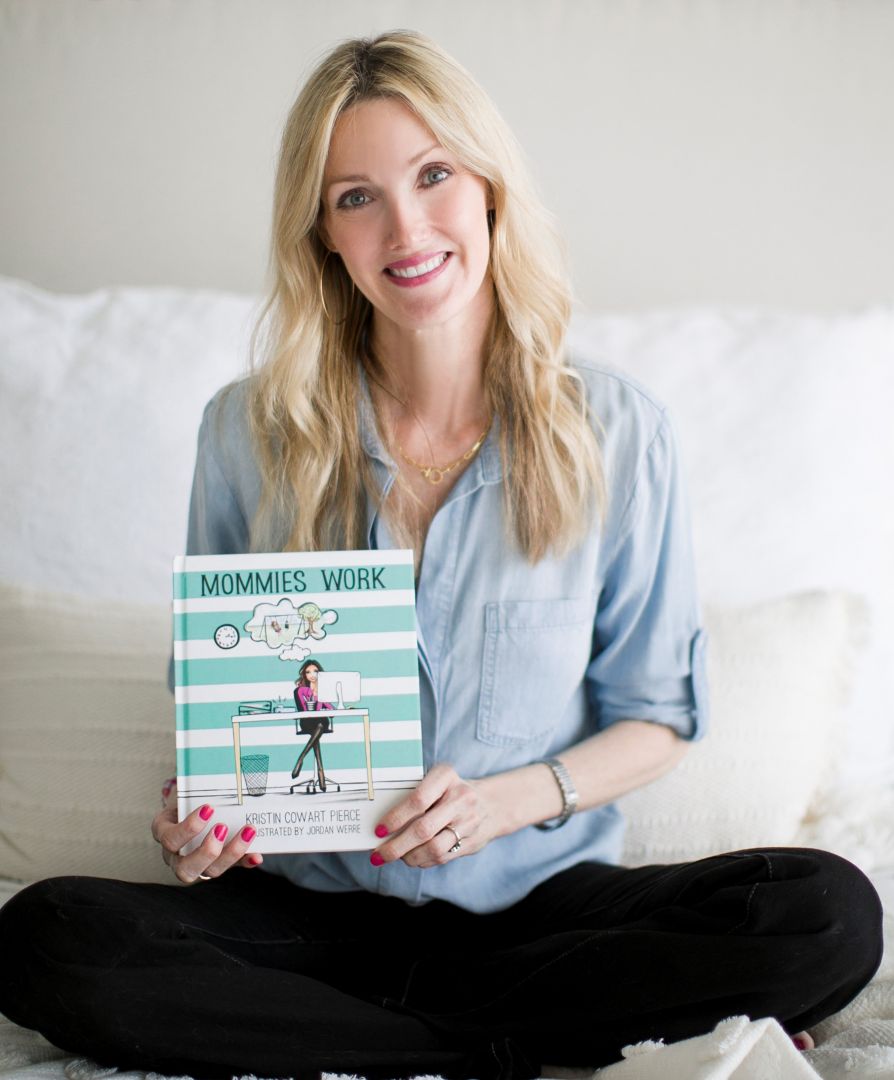
The finished book is a compact object: 28 pages, published by Lanier Press, with illustrations by Jordan Werre. Its subjects include mothers who travel, mothers who go to offices and mothers who work at home. A child can begin with the visible details of a day and gradually attach meaning to the hours a parent spends working.
Its brevity suits the assignment. An adult's explanation of a career can disappear into abstractions: responsibility, contribution, fulfillment. Children start with the observable facts. Someone puts on shoes. Someone leaves. Someone comes back. The book offers a way to talk about what happens between those moments.
Mommies Work · Lanier Press · 2020
Illustrated by Jordan Werre
Pierce had begun writing years before publication. Work and family delayed bringing the manuscript into the world. There is something apt about a book on working motherhood having to wait its turn in a working mother's schedule. Even its production history belongs to the subject.
The calendar gets a supporting role
Pierce has also described borrowing practices from client work and applying them to family life. Her suggestions are satisfyingly ordinary: a shared calendar, preparation, delegated chores and a place to put the list of things otherwise circling in your head. Nobody needs to announce a household transformation to prepare tomorrow's lunch.
She recommends giving children manageable responsibilities early and making the day's plan visible to the family. There is an agency owner's instinct in that approach. A plan kept in one person's head is rather difficult for everyone else to follow. Sharing it distributes both information and responsibility.
One of her more enjoyable recommendations is to schedule fun. Even a simple ice cream outing can give children something to anticipate. The calendar, so often cast as the household villain, gets to carry good news. Her advice also makes use of car journeys as a place to talk with older children, when sitting alongside each other can make conversation easier.
In her account of family life, her husband receives explicit credit for sharing the children's arrangements and making room for her professional responsibilities. That acknowledgment changes the picture of the founder who somehow manages everything. She describes participation, help and coordination. The business has a team; the household needs one as well.
Room for another voice
The same interest in participation appears outside her home and company. Pierce is a founding member of The Women's Collective, which brings executive women together around workplace issues, education and mentorship. Her volunteer record also includes the marketing committee for Children's Museum of Atlanta, connecting her professional skills to a place devoted to young audiences.
In a 2025 Creativity Camp session for girls, she worked with participants on finding their voices and telling their stories. She described discussing the decision to speak when silence feels easier, trusting one's instincts and sharing a story while it is still developing. For someone employed to help brands communicate, it was a chance to apply the work much earlier in a person's life.
Recognition has followed her own. Atlanta Magazine included Pierce among its 2026 Women Making a Mark honorees, with the awards event scheduled for June 5 at the Atlanta Botanical Garden. Her career also appears in the magazine's 2026 Atlanta 500. The business remains based in the city that first drew her south for the Olympics.
Her recent reflections on an early-career photograph return to the people who taught her. Looking at herself talking with her first boss, she remembered the value of someone listening, challenging her thinking and allowing her to learn. Now she occupies the other side of that exchange. Experience brings a different assignment: making room for the next person to speak.
That is a useful place to leave Pierce: a founder whose work keeps returning to the listener. The client deciding whether to trust an agency. The girl considering whether to raise her hand. The child wondering where a mother goes all day. Each needs an explanation they can use. Her children's questions became a book because she took them seriously enough to answer.