The baseball game was supposed to be the easy part. In 2022, the Hirons team went to an Indianapolis Indians game for Founder’s Day. Then a summer thunderstorm arrived. Play was canceled. Many of the people who had left work for an afternoon together got drenched. Deana Haworth later recalled the outing with affection anyway. An agency can schedule a celebration; Indiana weather reserves the right to edit it.
For Haworth, the afternoon still had a purpose. People had been given time together, on the clock, because their work deserved appreciation. The score was beside the point. It is a small episode in a career that now spans more than a quarter-century at Hirons, but it helps explain her attention to the people around a business. Who is participating? Who feels included? What does the organization actually do to show them they matter?
Those questions run from her childhood in rural southern Indiana to the Indianapolis agency she now leads. They connect a communications program built for overlooked audiences with a workplace whose employees have an ownership stake. Her career offers a way to think about influence that starts well before someone takes a microphone: find out who the message, the meeting or the opportunity is failing to reach.
A hometown becomes a method
Haworth was raised in an entrepreneurial family and became a first-generation college student. Her route into communications included a journalism degree at Franklin College and a master’s in public relations at Ball State University. The place she came from remained useful after she entered the profession. It gave her a reference point against which to test the assumptions in an outreach campaign.
As her agency career developed, she saw organizations struggle to communicate with rural communities resembling her hometown. An audience could be present on a map and poorly understood in a plan. She worked with colleagues to bring their professional experience and knowledge of rural life together. The resulting program, Rural Reach, was designed for companies, government agencies and organizations trying to make those connections.
Hirons announced the program in November 2018. Its early emphasis included people in rural poverty, a population conventional advertising and public relations could have trouble engaging. The approach called for strategies and tactics customized to the community. Haworth had already presented the work at the Public Relations Society of America’s international conference in 2017. A familiar place had become the basis of a professional method.
The program’s current description insists on differences within rural America: access, habits and the way communities form trust vary. Local identity matters. A generic message can create resistance. Channel selection matters too, because a campaign’s availability to its creators says little about its availability to the people who are supposed to receive it.
This is where Haworth’s origin gives the story its weight. She recognized a problem in professional work because she knew something outside the professional setting. A hometown can supply knowledge that a planning document has failed to ask for. Turning that knowledge into a repeatable service required colleagues, research and a willingness to treat a broad audience label with caution.
Twenty-three years before the corner office
On May 15, 2000, Haworth joined Hirons as a public relations specialist. The agency had been founded by Tom Hirons in 1978. Her career developed within that business through account leadership and, eventually, responsibility for the operation itself. Before becoming chief operating officer, she served as senior vice president and director of account services, leading its Communications Management department.
The COO appointment came in 2018. It expanded her remit across the agency’s departments. By the time she became CEO in 2023, she had spent years handling operations, business development and strategic planning while remaining a senior adviser on key accounts. Her promotion made her the first woman to lead the firm in its then 45-year history.
- 2000Public relations specialist
- 2018Chief operating officer
- 2023Chief executive officer
A long tenure can look tidy when reduced to three dates. Haworth’s own reflection on reaching 25 years was more populated. She credited Tom Hirons with making room for different perspectives, including hers. James Parham, her boss for the first 23 years, supplied mentorship and collaboration. Ann Kneifel, the retired CFO and board chair, and longtime media executive Rose Sandefur Durbin were role models too.
That is a career told through people rather than a procession of titles. The relationships provided examples, encouragement and space to assume greater responsibility. When Parham moved out of the CEO role, he continued as a board member and turned toward academic work. Haworth’s arrival at the top therefore carried an element of continuity: she knew the business, and the people who had helped build it knew her.
The company belongs to the people doing the work
Haworth also helped Hirons transition to an employee stock ownership plan. The agency is employee-owned, placing a financial stake in the company’s future with the people who work there. For a communications business, where the product depends on judgment and collaboration, that arrangement makes responsibility tangible. Colleagues have a shared interest in what the work earns and how the business is run.
She has taken that experience beyond the agency, presenting to employee-ownership organizations. Her speaking engagements included The ESOP Association’s Indiana spring conference and the National Center for Employee Ownership’s annual conference in 2023, followed by the NCEO Forum in 2024. By 2025, she was also discussing ownership culture in community conversations and at a Great Lakes regional conference.
“engagement begins with recruitment.”
Deana Haworth, on building a workplace people want to join
The point of a structure is partly what people do inside it. Haworth’s approach to engagement begins with choosing coworkers carefully and continues through recognition. At Hirons, appreciation has included weekly high fives, monthly kudos and quarterly Bat Awards. The last of these comes with a custom Louisville Slugger. Baseball metaphors, at least, are permitted to finish their innings indoors.
Her advice also includes asking people what they want. That brings the story back to audience knowledge. An employee celebration and a public campaign are different assignments, but both can fail when the organizer assumes too much. The rainy Founder’s Day outing makes sense in that context: the value lay in time and attention, even after the entertainment disappeared.
A taste for the difficult conversation
Haworth’s professional interests include crisis communications and issues management. She volunteers time to train organizations on those subjects. In a 2025 interview, she offered an unusually cheerful introduction to the specialty: “I love chaos. So crisis communications is my favorite thing.” Some people want a quiet day at the office. Others have found a useful occupation for the days that refuse to cooperate.
Her comments addressed crises generated on social media, including incidents with no corresponding event in everyday life. Some claims are fabricated; others contain partial or substantial truth. The distinction matters. Before an organization can decide what to say, it has to establish what happened and what people believe happened. Those may be very different starting points.
Her earlier work ranged across public-facing assignments: voter education and cybersecurity for the Indiana Secretary of State’s Office, the launch of Indianapolis International Airport’s ParkIND service, and outreach associated with the revitalization of Speedway’s Main Street. Such projects place communications in the middle of practical decisions. People need to understand a change, use a service or participate in a public process.
She has described herself as a news junkie, monitoring local and national coverage. That habit suits a job in which the conversation keeps moving after the campaign plan is approved. It also makes her interest in tradition more endearing. Haworth enjoys family traditions and events. A person can welcome a familiar ritual at home and still have an appetite for a complicated assignment at work.
Making room at the next table
Her firsts extend beyond Hirons. In January 2024, Haworth was elected the first woman board chair of Crossroads of America Council, which oversees Scouting programs across 26 central Indiana counties. She set out goals of widening opportunities regardless of ZIP code and increasing the number of young women in local troops. Geography and participation were again part of the same conversation.
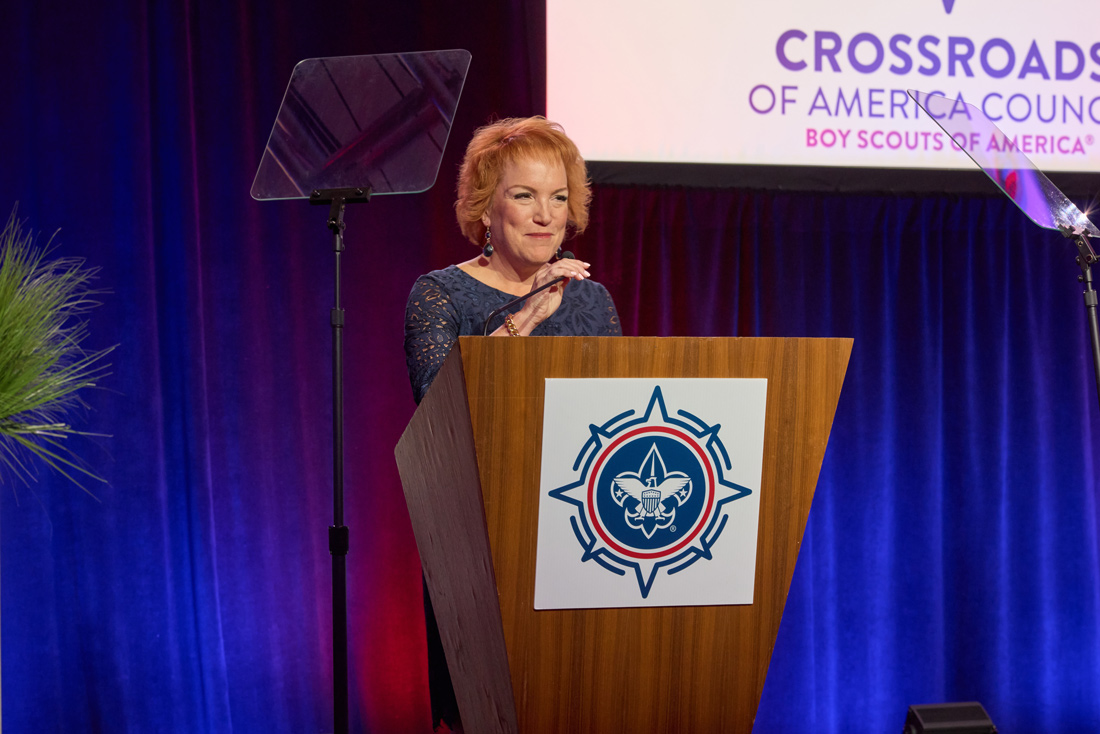
During her chairmanship, the council appointed John Cary as Scout Executive and CEO in 2025. Haworth welcomed his experience and plans for expanding the organization’s reach. At Franklin College, her connection to younger people has taken another form: she led the PR program in an adjunct capacity from 2020 to 2023 and serves as a trustee. Her education has become an institution she helps support.
The public recognition has followed several strands of that work. Ball State named her an Outstanding Journalism Alumna in 2022. She received the May Wright Sewall Leadership Award in 2024 and the Great Lakes Women’s Business Council’s Excellence in Engagement Award in 2025. In 2026 came the Elmer Davis Award and recognition as a Friend of the Indiana High School Press Association.
Her civic commitments continue through business and women’s leadership organizations. She joined OneZone Chamber’s board in 2025, describing Hamilton County’s business climate as connected to the fortunes of central Indiana. For the September 2026 Stepping Out in Style event, Dress for Success Indianapolis named her an executive leadership team co-chair alongside Akilah Darden. The settings change; her participation keeps moving between business, education and community life.
Haworth’s story returns, finally, to the people outside the first version of a plan. Rural residents whom a campaign has misunderstood. A young professional who needs someone to invest time. A girl who should see room for herself in a troop. An employee whose work deserves a stake in the business. Her career has repeatedly made those questions part of the assignment. The practical next step is to invite people in, then let what they tell you change the work.