Chas Withers was worried about telling Henry Eaton he wanted to leave. Eaton had co-founded Dix & Eaton, the Cleveland communications firm where Withers worked, and had become an important mentor. An opportunity elsewhere had arrived. Withers expected an uncomfortable conversation. Eaton listened, then encouraged him to take it. Experience outside the firm could give him more to offer when he returned.
It is an appealing piece of career advice because it contains so little career possessiveness. The founder could imagine a future in which a colleague’s departure helped both of them. The relationship had room for an absence. For a business built around advising other people through consequential decisions, this was a fairly consequential example of taking its own medicine.
Withers went to Answerthink, then returned to Dix & Eaton in 2000. Fifteen years later, he became its third CEO. Today, as chairman and chief executive, he leads a firm whose next chapter asks a related question: how much can an institution change while keeping the relationships that made it worth returning to?
The sportswriter takes a different assignment
Before there was an executive title, there was a journalism student looking for an internship. At Kent State University, Withers hoped for sportswriting. He found public relations instead and discovered that he liked the work. He graduated in 1987. By 22, he had been asked to run a marketing office in Columbus. Roles at Case Western Reserve University and, later, Dix & Eaton widened his experience.
The detour has a pleasing symmetry. A prospective sportswriter ends up working with organizations whose difficult moments rarely come with a final score. A game supplies a result and a deadline. A corporate decision can leave several audiences waiting for different answers long after the announcement has been written.
His journalism training remained useful. Withers has emphasized writing and the ability to synthesize information as foundations for communications work. The task is to assemble an explanation that other people can follow. That sounds modest until the material includes a transaction, a shifting organization and several groups whose interests do not conveniently agree.
There is useful advice in a career that changed direction before it had properly started. The internship gave him an opportunity to test an interest through actual work. The subsequent jobs expanded what he could recognize, explain and take responsibility for. A plan supplied the starting point; experience supplied the edits.
A briefcase, three CEOs and a promise
Dix & Eaton began in 1952. Its history makes Withers’s place in the succession unusually visible: Henry Eaton, Scott Chaikin, then Withers. Three chief executives make a small cast for a business story stretching across changing media, markets and expectations. The new leader receives the accumulated benefits of those relationships along with the duty to keep earning them.
In June 2023, Withers added chairman to his responsibilities. Chaikin became chairman emeritus, remaining a board member and adviser. Lisa Rose joined the board. The change distributed roles among people with long experience of the firm, rather than turning succession into a clean break. Continuity had names, responsibilities and a place at the table.
“What got us here won’t get us there.”
Chas Withers, on becoming chairman, 2023
That sentence prevents institutional memory from becoming a prohibition on new ideas. Withers’s stated responsibility includes carrying the firm’s legacy forward while anticipating clients’ changing needs. Both obligations matter. Preserving a reputation requires judgment about which parts of a business are principles and which parts are merely familiar habits.
The memory has physical objects, too. Henry Eaton’s briefcases passed to Chaikin and then to longtime colleagues. One eventually reached Ann Lentz, who wrote about keeping it in her office. Its hard shell, brass clasps and monogram belonged to an earlier executive wardrobe. The meaning survived the wardrobe: listening carefully, keeping confidences, helping someone think.
A briefcase is an agreeable corporate heirloom. It occupies less space than a statue and has already proved it can carry something useful. Its passage through the firm also gives the inheritance a wider cast. The history belongs to colleagues as well as to the person holding the chief executive’s title.
The colleagues get a stake
Under Withers, the firm’s growth has included a change in who shares its future. Dix & Eaton’s conversion toward a wholly employee-owned ESOP began in 2014. When it acquired Standing Partnership in November 2023, the St. Louis consultancy’s associates were brought into that ownership arrangement. The combination retained both operating-group names and both headquarters locations.
The firms had already worked together for more than a decade through Worldcom. Their introduction therefore preceded the transaction by years. Dix & Eaton brought its established communications and reputation work; Standing Partnership added complementary marketing capabilities, including sales enablement. Withers became chairman and CEO of the combined enterprise.
Employee ownership gives the integration another dimension. A deal changes reporting lines and the range of services available to clients. Here, it also brought new colleagues into a structure intended to connect employees with the value of the business. The people delivering the work became part of the ownership story being told about it.
The organization continued to evolve. In July 2025, Melissa Lackey became enterprise president and Julie Steininger became chief people officer. Gregg LaBar took the presidency of the Dix & Eaton operating group; Ashlyn Brewer became president of Standing Partnership. Lisa Zone became executive vice president of the Cleveland operating group. Rose retired from her full-time position while remaining an adviser and board member.
Those appointments show the work after an acquisition closes. A larger enterprise needs people to look across its operations and people accountable for the individual groups. The announcement put responsibilities around that distinction. For Withers, leadership now includes overseeing an organization with more ways to contribute and more relationships to coordinate.
Two verbs for the next chapter
In January 2026, the combination acquired a short explanation: Grow and Protect. Standing Partnership anchors the Grow platform, with marketing, sales enablement and partner ecosystems. Dix & Eaton anchors Protect, including risk intelligence, reputation and stakeholder engagement. The firm presents them together as a way to build enterprise value while managing exposure.
Two verbs are easier to remember than an agency’s complete menu of services. They also invite a conversation about how opportunity and risk interact. A company entering a new market gains potential customers and fresh expectations. A new partnership can extend its reach while adding dependencies. Growth decisions give communications advisers more to explain and more to watch.
Marketing strategy
Sales enablement
Partner ecosystems
Risk intelligence
Reputation management
Stakeholder engagement
For Withers, this gives the earlier acquisition a clearer purpose. Complementary capabilities can remain a list, or they can inform how a client’s problem is considered. The framework proposes the latter. Its practical value rests in bringing the growth question and the protection question into the same discussion early enough to affect the decision.
A Cleveland address with a memory
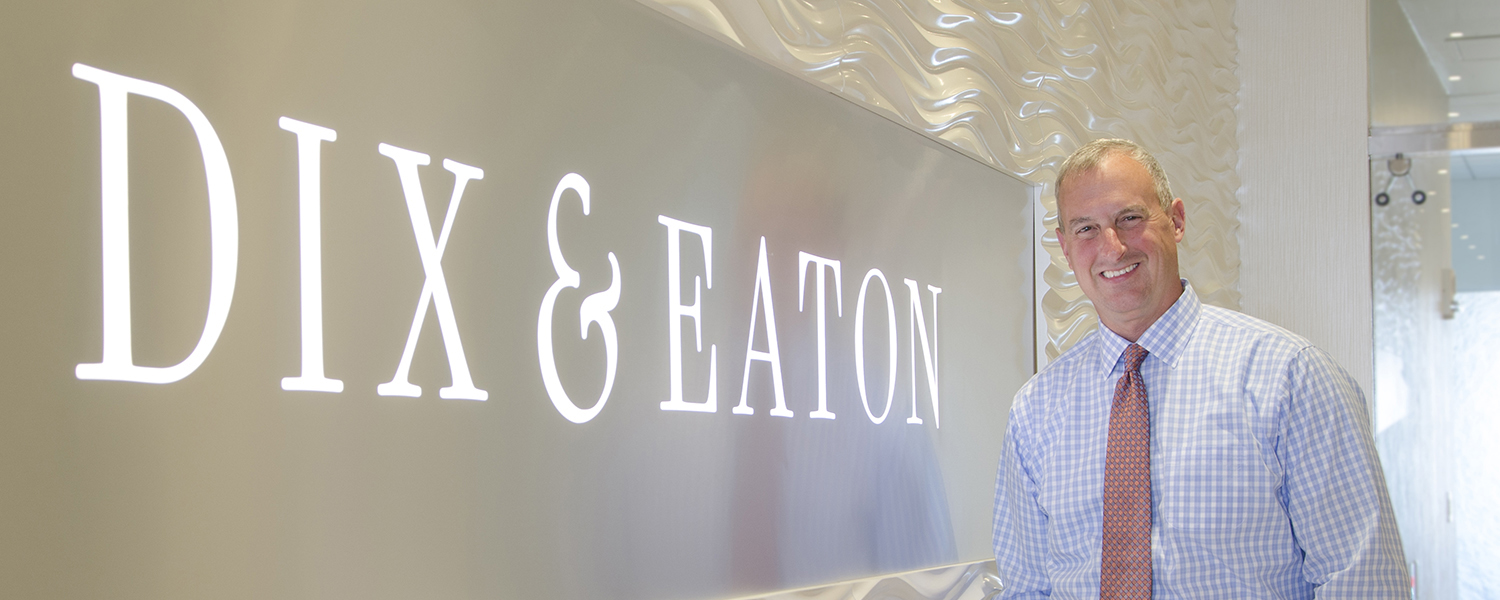
The firm’s Cleveland setting became part of its recent change, too. Its move to the Bulkley Building in Playhouse Square connected a new workplace to an old relationship. Henry Eaton had served on Playhouse Square’s board for nearly two decades. Withers said the co-founder would have welcomed the move to the theater district.
The office planning was more practical than nostalgic. Employees contributed input. The design included collaborative areas and rooms that could close for confidential discussions. Withers wanted a workplace people would choose to visit, with space for colleagues to work and spend time together. Architecture has an opinion about company culture, even when the company has already written its own.
That mix of openness and privacy suits the business. Colleagues need to exchange ideas; clients need sensitive matters handled discreetly. A useful office has to accommodate both. The firm’s current Euclid Avenue address places that everyday work in a neighborhood with which its history is already entangled.
Withers’s civic involvement extends to DigitalC. The firm’s 2024 social impact report describes its work on Cleveland’s digital divide as a longstanding interest of his, spanning more than 15 years. It connects his board involvement to efforts to expand internet access and digital literacy. Communication acquires a very concrete meaning when the question is whether people can get connected at all.
His other public affiliations include the Greater Cleveland Partnership and the Greater Cleveland Sports Commission. The personal interests are recognizably local, too: Cleveland teams, alongside exploring new places and listening to and playing music. The sportswriting ambition found a different career, but the interest in the teams stayed.
Confidence has homework
Withers began 2026 by calling for greater discipline in how organizations understand their surroundings. His January essay argued that uncertainty requires leaders to validate assumptions, interpret signals and prepare before a problem becomes a crisis. Information is abundant; judgment about what deserves attention remains work someone has to do.
There is a writer’s concern underneath that argument. An explanation can be clear and still rest on a weak assumption. A confident conclusion can travel farther than the evidence that supports it. Better communication starts before the wording, with a closer examination of the decision being communicated and the information behind it.
In his 2024 conversation about leadership, Withers offered a compact rule: “Don’t react, respond.” It fits a career spent dealing with situations in which several audiences can read the same action differently. The pause is useful when it creates room to consider consequences. It still has to lead to a decision.
The return to Dix & Eaton gives this story its shape. A mentor made room for learning elsewhere. A colleague came back. The firm eventually became his responsibility, and its future now includes people and capabilities acquired beyond its original home. Leaving once helped Withers find more to contribute. Keeping that possibility open is a fitting challenge for the organization he leads.
Keep the conversation going
Interviews, essays and the firm’s next chapter.
- Dix & Eaton: Withers’s biography
- Chas Withers on LinkedIn
- Listen: Lay of the Land conversation
- Kent State: the journalism graduate’s route
- The Standing Partnership acquisition
- Grow and Protect announcement
- Withers’s January 2026 essay
- The Playhouse Square office move
- 2024 social impact report
- The 2025 leadership appointments
- The chairman appointment
- Henry Eaton’s briefcases
- Dix & Eaton on Instagram
- Dix & Eaton on Facebook
- Dix & Eaton on X