On his first day running a business, Ron Sachs tried out the receptionist’s desk. There was no receptionist. He tried the colleague’s desk. There was no colleague either. He played solitaire on his computer, then called his three clients to ask whether anything needed doing. For someone whose trade was communication, the office on Jefferson Street in Tallahassee offered an unusually comprehensive supply of silence.
That small scene is worth keeping in view as Sachs Media reaches its thirtieth year. Firms acquire polished histories as they age. The awkward furniture arrangements disappear. The early uncertainty gets edited into destiny. Sachs’s beginning resists that treatment. It has an empty room, a card game and a sensible next step: find someone who needs your work.
The later story is crowded with people. Michelle Ubben helped build the business. Five longtime partners became the intended stewards of its ownership and operation. Drew Piers became president in January 2026. Sachs, identified in that announcement as Founder/Chairman Emeritus, now occupies a different place in the firm he created. The interesting question is how he made that place possible.
The empty desks on Jefferson Street
Before opening the doors in 1996, Sachs had been communications director for Governor Lawton Chiles. He had statewide relationships and experience explaining consequential decisions. His mother saw another qualification, conspicuous by its absence: he had never even had a paper route. She questioned whether he knew enough about running a business. A maternal reference check can be admirably brisk.
He went ahead. Money from unused state vacation time gave him roughly four months in which the experiment could fail. The first office was 600 square feet. Those three early clients gave the venture a foothold, but a foothold is an appropriately modest thing. It keeps you from falling; it does not tell you how far you will climb.
There is a useful distinction between being experienced and being established. Sachs brought the former to the room. The latter depended on people deciding that he was useful, and then deciding it again. A governor’s office could supply knowledge and relationships. It could not supply tomorrow’s invoice. The telephone call after solitaire belongs in the history for precisely that reason.
A teacher’s rules, a reporter’s habits
Sachs grew up in Miami wanting to become a journalist. At the University of Florida, he edited the Alligator during 1971-1972 and graduated with a journalism degree in 1972. Student journalism gave him responsibility for an actual newspaper and actual readers. Later, his career took him to government and investigative reporting at The Miami Herald and to the editorial director’s job at Miami’s ABC affiliate.
A high-school teacher, Dorothy Massey, supplied the compact set of instructions he still recalled decades later. Accuracy, punctuality and interest were her requirements. Sachs made clear that errors and habitual lateness irritated him. There is something pleasantly unglamorous about this inheritance. The adviser with government experience and an expanding business still carried a teacher’s rules into the office.
“Be accurate, be on time and be interesting.”
Dorothy Massey’s advice, recalled by Ron Sachs
The three demands keep one another honest. An interesting mistake remains a mistake. An accurate story delivered too late may miss its reader. A punctual bore has met the deadline and lost the audience. For a person working across newspapers, television and public relations, the same small checklist can travel remarkably far.
A newsroom with a different address
Sachs’s work for Reubin Askew and Lawton Chiles placed him on another side of the public conversation. He had been a reporter asking institutions questions. Government communications required him to help an institution answer. His eventual firm joined those experiences: knowing what makes news, understanding how public decisions are made and helping clients find language people will understand.
In 2013, Ron Sachs Communications became Sachs Media Group. The announcement described an organization built around former reporters, editors and producers, with staff creating content, managing audiences and making multimedia work. It was a response to readers and viewers acquiring more control over what reached them. A familiar name on a press release could no longer do all the work.
Sachs argued that organizations needed to operate like newsrooms. The idea carried a practical burden. A newsroom has to produce something people want to read or watch, repeatedly. It cannot simply admire its own message. For a communications firm, that means attention must be earned in the piece itself, through its usefulness, clarity or interest.
Ubben brought her own journalism background to that work. When she became president in 2017, the firm described their partnership as a storytelling team that had grown from three employees to thirty. Sachs credited her with finding and developing talent. The business had become large enough that its capacity depended on people he did not personally recruit or direct at every turn.
That admission matters in a founder’s story. Once a firm carries someone’s surname, it can become tempting to read every achievement as an extension of that person. Sachs’s own account gives Ubben a central role. Her contribution helps explain how the empty desks became a working organization, rather than a permanent audience for the founder.
The rhinoceros in the room
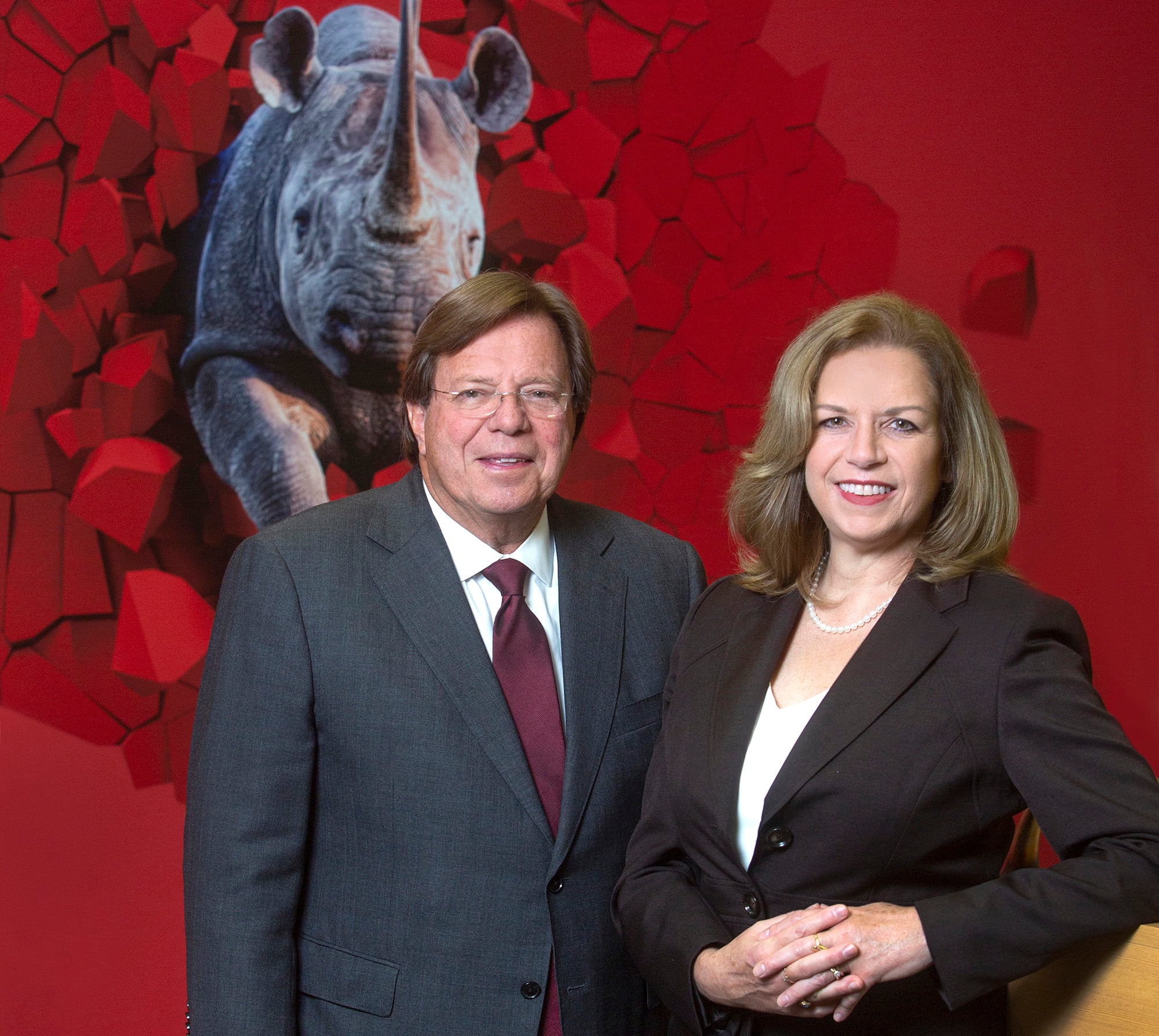
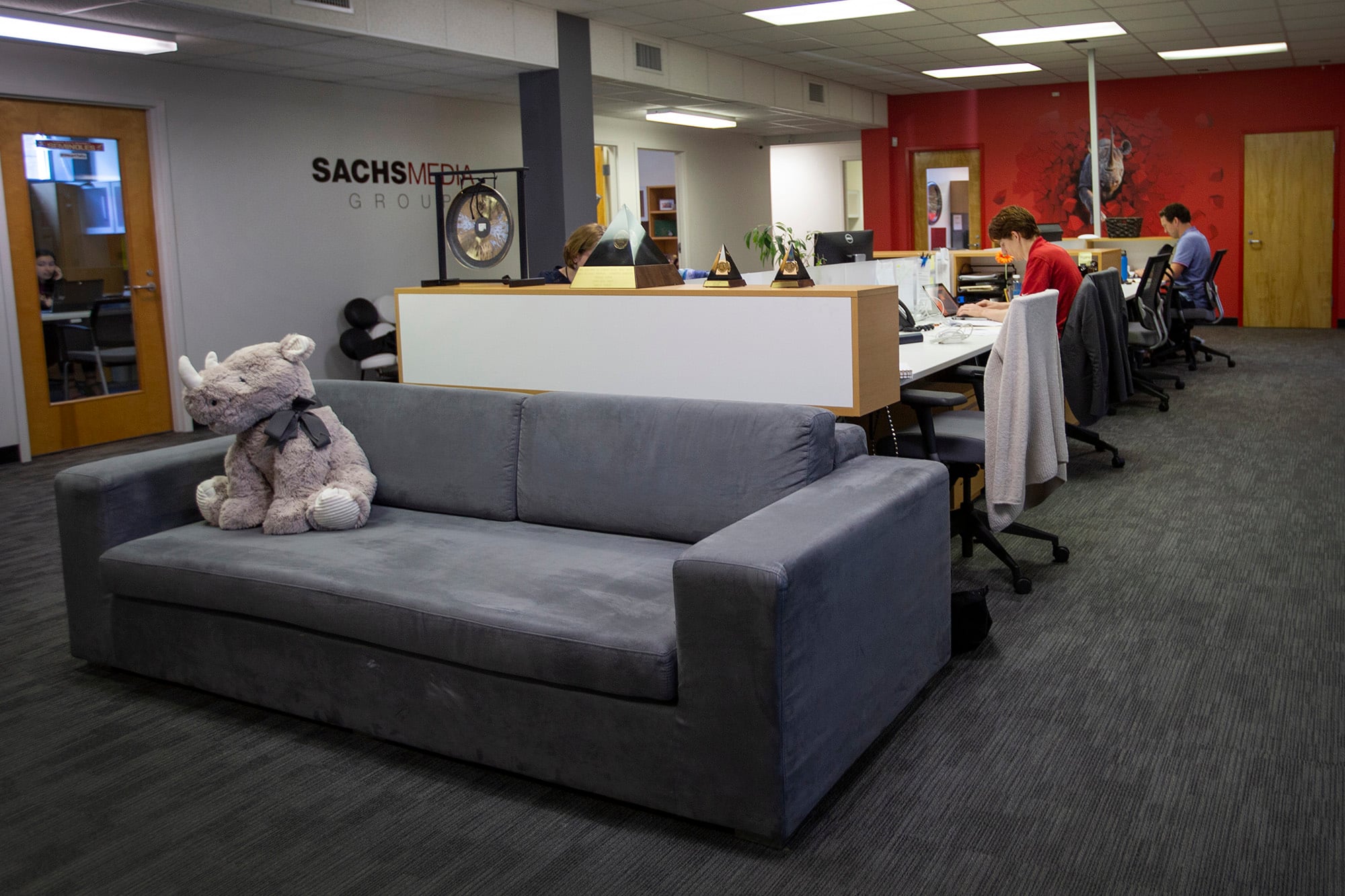
The office acquired a mascot with rather less interest in understatement. A 2019 feature counted at least seventy rhinoceroses in plush toys and artworks around Sachs Media. A mural showed one breaking through a wall. It is difficult to mistake the intention. Even the soft furnishings seem prepared to make an entrance.
Sachs associated the animal with strength, stamina and steadiness. The firm’s breakthrough imagery gave those qualities an exuberant visual form. In the photograph of Sachs and Ubben, the rhino looms behind them like a third partner who has declined the dress code. In the office picture, a smaller version sits on a couch, where its ambitions appear more manageable.
The joke has a serious use. Communications can sound terribly abstract when reduced to services on a website. An animal crashing through a wall makes the desired action visible. It also supplies a shared office language. People can disagree about strategy while remaining fairly clear about why there is a rhinoceros near reception.
A spotlight for people still in school
Outside the firm, Sachs directed attention toward people who had barely begun their working lives. In 2006, he founded the Best & Brightest Awards in Leon County. His childhood experience of a Miami community celebrating young achievers helped inspire the idea. He wanted Tallahassee students to receive recognition that could stay with them after graduation.
The program honors high school seniors across fifteen categories and looks beyond grades to initiative and service. Its history now includes more than $1 million in scholarships. Schools, sponsors and community partners have sustained it. Sachs supplied the founding idea; the continuing work belongs to a larger group of people and institutions.
In his writing about the program, he has emphasized service as a lasting ethic. That makes the awards an interesting project for a public relations founder. A spotlight can teach its audience what deserves applause. Here, the audience includes younger students watching older students receive recognition for what they have done for other people.
A town’s account of success is partly written at ceremonies like these. Which achievements get called out? Who is invited onto the stage? What will someone in the back row remember? Best & Brightest gives service a visible place alongside ability. The scholarships make that recognition practical, while the public attention tells students that their community has noticed.
Scholarships awarded over the Best & Brightest program’s history.
Founded 2006 · Leon County · 15 award categoriesThe newsroom gets something back
The former student editor also put money into student reporting. The University of Florida’s 2021 Dean’s Report records a $50,000 donation from Sachs to Fresh Take Florida, a student news service producing investigative and political coverage of Tallahassee. He was helping fund people learning to ask the kinds of questions he had once asked.
There is a pleasing circularity to that gesture. Sachs’s professional life moved through journalism, government and public relations. Supporting a reporting service gives the next generation tools to examine institutions, including the kinds of institutions a communications adviser may represent. Those roles do not always agree. A functioning public conversation needs room for each of them.
His civic service has included chairing Leadership Florida, the Tallahassee Chamber and United Way of the Big Bend. Leadership Tallahassee recognized him with its Lifetime Leadership Award in 2023. The list places him in the community’s organized work, where ideas require meetings, fundraising and people willing to keep showing up after an announcement.
A company with room for its successors
In February 2022, Sachs and Ubben announced a prepared succession of ownership and operation to five longtime partners: Lisa Garcia, Herbie Thiele, Ryan Cohn, Drew Piers and Karen Cyphers. Each had been at the firm for about a decade or longer. The plan depended on colleagues already trusted by clients and staff, with the transition unfolding over multiple years.
By January 2026, Piers was president and Ubben was CEO. Sachs welcomed Piers’s appointment as the firm marked thirty years in business. The titles provide a concrete answer to the question hanging over that first office: what happens when the company becomes bigger than the person whose name is on it?
- 1996Sachs starts the firm
- 2017Ubben becomes president
- 2022Ownership succession announced
- 2026Piers named president; Ubben is CEO
In a 2021 public-radio interview, Sachs spoke about family, faith, friends and the need for a more civil tone. The sentiment adds a quieter register to a career associated with messages under pressure. In a later interview about retirement, he anticipated continuing to help the company and developing projects outside it. Leaving daily leadership need not mean losing his appetite for an idea.
The first day offered several empty chairs and one person trying them. Thirty years on, other people have jobs, authority and a stake in what follows. Sachs’s career has left a company, a student awards program and support for a newsroom. Each asks other people to take part. For a communicator, that is a useful way to let the conversation continue.