The founding accident at the center of Vistra Communications is that Brian Butler was eminently employable and, for a while, no one employed him. He had spent 22 years in the Army. He had commanded troops, worked at the Pentagon, advised U.S. Central Command and served in a policy role at the White House. He knew how to brief a room in which bad phrasing could become tomorrow's problem. Then he returned to Tampa and could not find the right job.
So, in April 2007, Butler filed paperwork for a company in his house in Lutz, Florida. The first calculation was not mystical. He had a marketing degree. He knew reporters. He understood how large institutions make decisions and how quickly their messages can unravel. His early clients included small nonprofits such as Positive Spin, which helped local families. Vistra was less a grand entrepreneurial thesis than a sober answer to the question, What do you already know how to do?

The first thing that failed was the job search
This matters because many agency stories begin with aesthetic rebellion: a creative director tires of boring work and opens a cooler shop. Vistra began with forced inventory. Butler counted his transferable skills. Military public affairs had taught him that a message is never merely a sentence. It has an audience, a chain of command, a timing problem, a risk profile and, eventually, an action attached to it.
“I started the company, because I couldn't find a job, from my house in Lutz in 2007.”Brian Butler, speaking to PRSA Tampa Bay
The firm moved out of the house in 2009. Over five locations it grew into an operation that, by early 2026, described itself as nearly 100 people, with headquarters in Lutz and a second office near Washington. More than 30 percent of its staff are veterans. This is not decorative biography. It helps explain why an agency known for media relations and brand campaigns is also comfortable around doctrine, policy, cyber planning, knowledge management and federal procurement.
The agency with two dialects
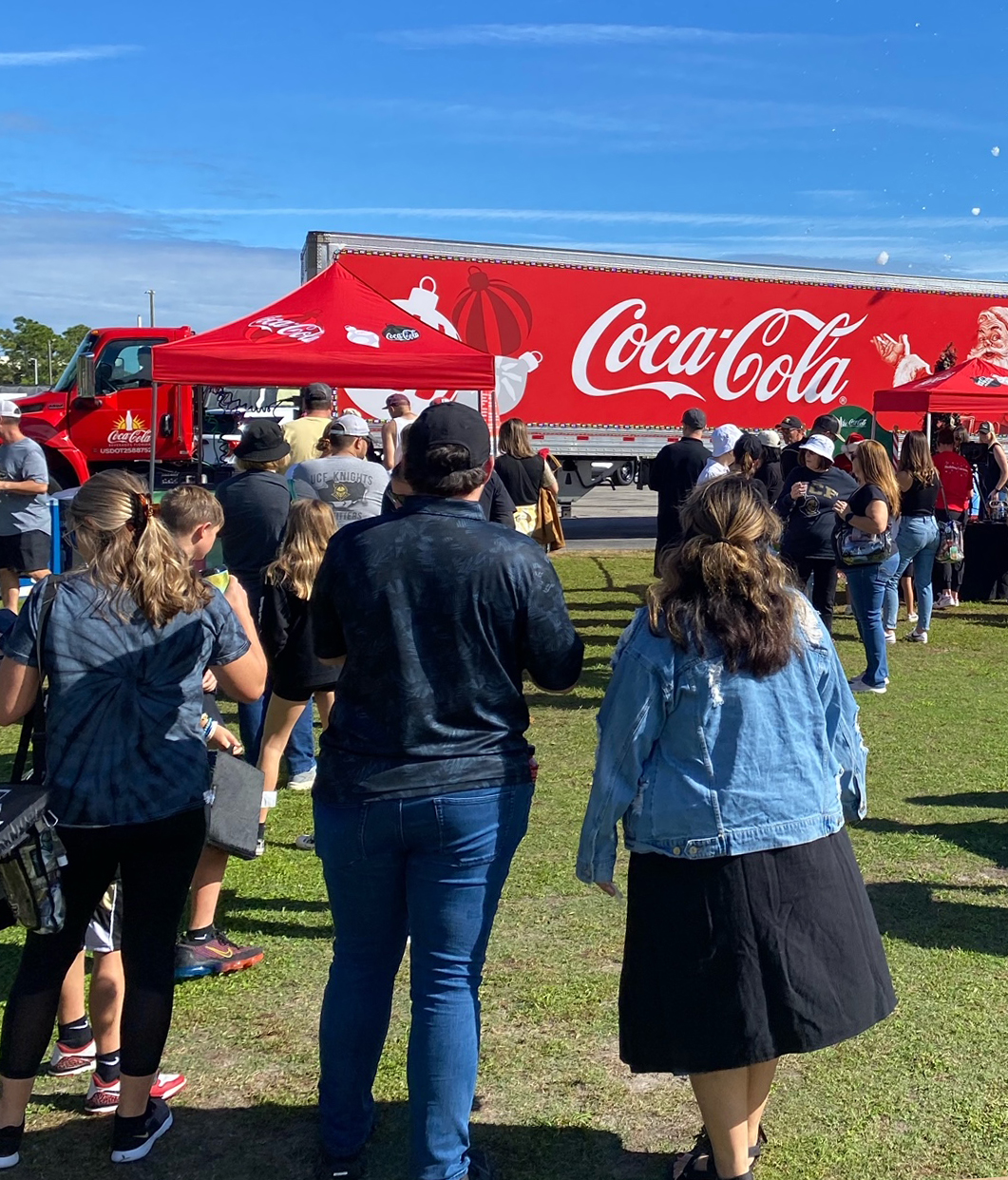
On one side, Vistra looks like a full-service agency. It develops brands, buys media, builds websites, trains executives, plans events, handles crises and runs social campaigns. For Coke Florida, it has managed a holiday caravan since 2016: more than 50 stops in 18 days, a 35-foot illuminated trailer, a custom Santa throne and bilingual talent in selected markets. For Hillsborough County's 2020 voter education effort, the mix stretched across television, radio, buses, theaters, airports, streaming video and gas-pump screens. Vistra reported 121 million impressions and 18,000 placements.
On the other side is Vistra Federal Solutions. Its menu includes organizational transformation, SharePoint and knowledge management, Section 508 accessibility, cyber operational planning, research, healthcare communications and administrative support. In 2015, a federal award notice named Vistra on a U.S. Central Command joint cyber planning services contract with a total potential value of $12.575 million. A 2022 Navy order for web-based digital marketing was worth $183,246. In 2025 the company joined ReefPoint Group's team on the Department of Veterans Affairs' IHT2.0 healthcare transformation initiative.
The Vistra operating loop
The apparent mismatch is the point. Vistra's commercial practice understands attention; its federal practice understands systems. The two meet wherever a complicated institution needs people to understand something and then do something. That is why a cancer center, a beverage distributor, a county elections office and a combatant command can plausibly shop at the same firm.
The room without a loudest person
The company's most revealing product is V-Lab, an online workshop created after its researchers grew frustrated with traditional focus groups. Those sessions were expensive, geographically narrow and easy for one confident participant to dominate. V-Lab requires everyone to contribute, allows anonymous responses, and lets a group brainstorm, sort, rate and rank ideas in real time. Vistra says it can deliver a transcript within 24 hours.
For the Defense Department's Sexual Assault Prevention and Response Office, the firm ran three V-Labs with service members ages 18 to 35. The task was unusually delicate: understand attitudes toward male victims of sexual assault and barriers to reporting. The findings informed messages, branding, animation and the emotional register of videos. This is what “integrated” means when the word earns its keep - research changes the creative work before money is spent distributing it.
The contract that changed the map
Butler has said the crystallizing moment came when Vistra won its first prime federal contract. On a separate state and local track, subcontracting taught him a second lesson: “we don't have to do this by ourselves.” Those realizations changed the company's map. A small agency did not need to wait until it had every capability in-house. It could lead where it had standing, team where a partner had access, and turn past performance into eligibility for larger work.
What did it cost?
Vistra does not publish a universal price list for commercial projects or V-Lab. Public contracts reveal the scale instead: $183,246 for one Navy digital-marketing order; up to $12.575 million for the 2015 joint cyber-planning award. A Florida state term contract prices work hourly and on demand. The honest answer is that clients are buying labor, judgment and delivery over very different scopes - not a single boxed subscription.
The business model follows. Corporate and nonprofit clients buy campaigns, retainers, research and creative projects. Government clients buy through competitive awards, schedules, task orders and teaming arrangements. Certifications as a Service-Disabled Veteran-Owned Small Business and Small Disadvantaged Business provide lanes into procurement, but do not replace performance. In July 2025, the Government Accountability Office denied a protest over an Army communications-planning award to Vistra, finding the evaluation consistent with the solicitation.
This is also where the limits become visible. A generalist menu is useful only when an organization has enough experienced people to integrate it. Without procurement fluency, contract vehicles and patient relationships, the federal half is inaccessible. Without researchers who can challenge a brief, “integrated” becomes cross-selling. And V-Lab's structured anonymity is an advantage when candor and consensus matter, but a poor substitute when body language, individual diagnosis or spontaneous group chemistry is the actual subject.
What is worth copying
Inventory before you invent. Butler began with skills and relationships already earned. A founder's most credible first product is often hiding in the last job.
Turn repeated friction into a product. V-Lab came from specific focus-group failures: cost, geography, dominant voices and slow synthesis. Name the friction before naming the software.
Use partners to change the size of the room. Subcontracting was not an admission of weakness. It gave Vistra past performance, reach and a route into work it could not credibly win alone.
Measure action, not applause. The better case studies connect communications to registration, enrollment, perception or operational change. Impressions are a waypoint, not the destination.
Butler's recurring word is “listen.” That sounds soft until you notice what it has to replace: the founder's instinct to prescribe, the moderator's temptation to fill silence, the agency's desire to sell its favorite service. Vistra's range makes sense only if listening happens before staffing the answer. Its unusual advantage is not that it can do everything. It is that it can translate between rooms that usually misunderstand one another.
“We don't have any templates for service delivery. We simply listen to our clients, understand their needs, and consult with each other before delivering.”Brian Butler
In other words, the publicist learned to speak Pentagon. More importantly, the Pentagon hand learned to ask what the audience heard.