Peter Adderton once explained the phone business by pointing to a drinks fridge. Pepsi, different flavours, different bottles: plenty of choices for people who were all, at some level, thirsty. Mobile carriers seemed to have missed the merchandising lesson. They were putting customers of wildly different ages and habits into the same bundles. He had been working in marketing, with Optus as a client, when he noticed the opportunity. Before he built a wireless company, he had spotted a failure of imagination.
That was Australia in 1999. More than a quarter of a century later, the Sydney-born entrepreneur is still worrying at the same question: why should everybody buy their connection in roughly the same shape? His answers have included a youth brand, a mobile entertainment company, a technology platform and, now, software that tries to work out how much data a customer actually needs. The businesses changed. The irritation proved remarkably durable.
Adderton is the founder and CEO of MobileX, based in Orange County, California. He also co-founded the Digital Turbine business acquired by NeuMedia and led the company that became Mandalay Digital. Those corporate names suggest a career spent in conference rooms. His other public habitat is the racing paddock, where opinions travel almost as quickly as the cars.
A phone plan with somewhere to belong
Boost Mobile began in Australia in 2000 and expanded into the United States. Adderton brought a marketer’s attention to the people using the service. Young customers were a distinct audience with their own interests, language and expectations. Selling them connectivity meant understanding the world around the handset, too.
The brand’s association with action sports and, later, motorsport fits that approach. A network is difficult to make visible. A racing car is rather less shy. Sponsorship puts a name into a shared experience, something people choose to watch and argue about. For Adderton, the audience’s attachment has repeatedly been part of the business proposition.
Nextel acquired Boost Mobile USA in 2004. The Australian business continued separately, eventually moving onto Telstra’s network and becoming wholly owned by Telstra in December 2024. The distinction matters when following Adderton’s career: the name travelled across borders, while the ownership histories took different routes.
Orange County became his American base. In 2023, as he prepared to bring MobileX staff together around Irvine, he described the area as lucky for him. He had already lived there for more than two decades. Returning to the place where he had built businesses was a practical decision with a little founder superstition attached.
Australia, then the US
Entertainment on a handset
Digital Turbine assets
Plans shaped by usage
The entertainment bet, and its reckoning
Amp’d Mobile took the relationship between a handset and its owner in another direction. Adderton founded the business in 2004. It targeted young adults with voice service and a catalogue of entertainment: music, games, video and streaming content. The phone could fill the awkward intervals of a day, the stretches spent waiting somewhere with very little to do.
By May 2006, the company had raised more than $250 million, with investors including Qualcomm, MTV, Universal Music Group and Intel. Its ambitions were expensive and thoroughly of their moment. Mobile video was becoming a commercial possibility, and Amp’d wanted to make entertainment central to the service rather than a small extra on the bill.
“We are building the foundations of a mobile media company,” Adderton said in 2006. The ambition was clear. The outcome was much harsher: Amp’d filed for Chapter 11 bankruptcy in 2007. His tenure as CEO had ended that May. An account of his career that skips this business would leave out a substantial failure alongside the successful exits.
The episode also complicates the easy story about a founder who simply understands what people want. Wanting a product, financing it and operating the business around it are different tests. Amp’d’s entertainment proposition belongs in the same history as Boost’s youth marketing, but its collapse prevents the two from being folded into a comfortable victory lap.
Inside the handset, behind the brand
Digital Turbine brought Adderton further into the machinery of mobile distribution. He was a founder and manager of the venture from March 2010. Its technology concerned multimedia management and mobile browsing. Here the customer-facing question involved the relationships between media businesses, carriers, handset makers and the person holding the device.
In May 2011, NeuMedia announced its intention to acquire the platform. The proposed fit was a system that could work across operating systems and networks while allowing partners to retain their branding and customer relationships. The cast included entertainment executive Peter Guber, a NeuMedia director, and Adderton’s Digital Turbine partner Fred Goldring.
The transaction became concrete on December 28, 2011. NeuMedia acquired substantially all the venture’s assets through a subsidiary, and Adderton became its CEO and a director. He had already been serving as interim chief executive since July. The precise sequence is useful: he brought a business into an existing public company, then helped run the combined enterprise.
The company became Mandalay Digital. Adderton later moved from CEO to chief innovation officer in October 2014 and resigned from its board effective January 16, 2015. Today’s Digital Turbine carries that earlier venture’s name, but his chapter in its management belongs to that period. His working life has moved on.
In May 2015, he became CEO of 360fly, a company developing a camera that recorded in every direction. An avid mountain biker, he was selling a device intended to capture the sorts of experiences he enjoyed himself. Once again there was a technical product, a consumer audience and an invitation to make the technology feel like part of somebody’s life.
The paddock is a very public meeting room
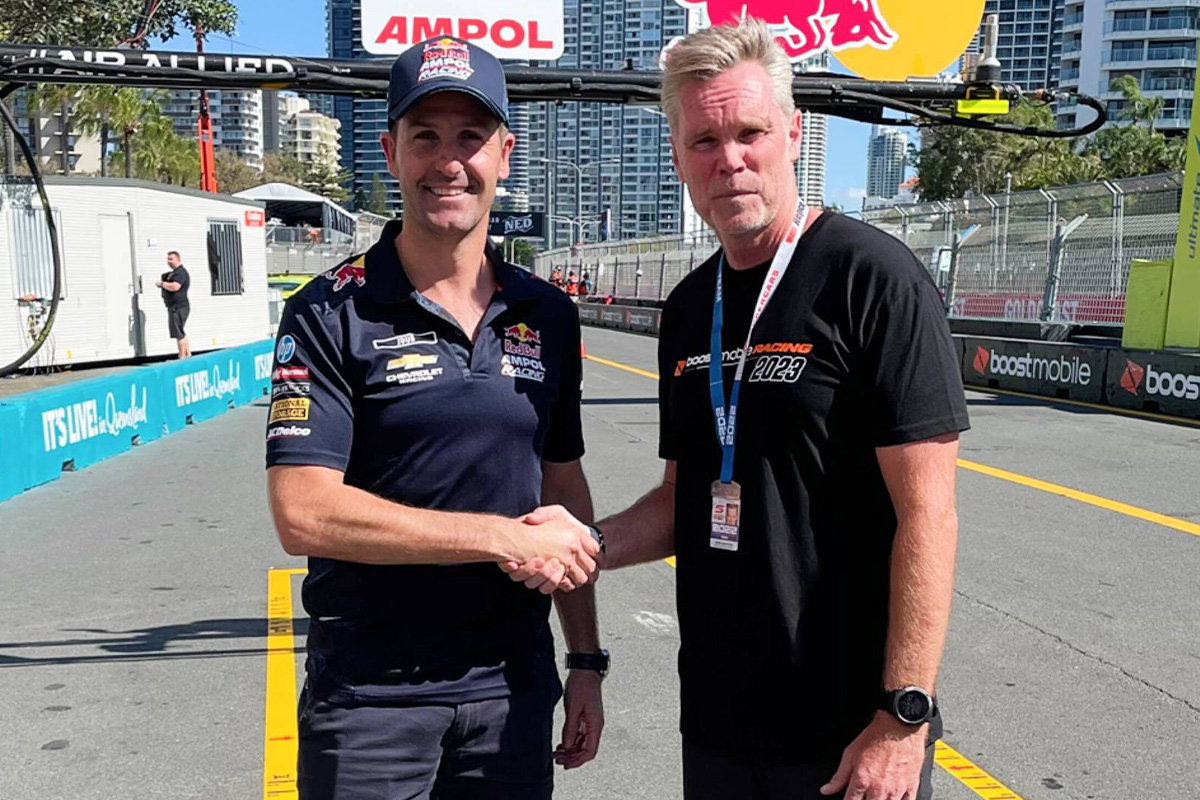
In motorsport, Adderton’s interest reaches beyond a logo on a car. In 2018 he spoke about wanting a Supercars team of his own, pointing to Red Bull’s Formula 1 ownership as an example. Owning the team would give a brand more control over the experience and the name fans remembered.
He also supplied a succinct explanation of his negotiating temperament: “I’m a terrible loser.” Sponsors, in his account, should pay for performance. He wanted teams to demonstrate speed before asking for more money. One suspects this made some sponsorship lunches more memorable than the menu.
“I’m a terrible loser.”
Peter Adderton, discussing Supercars in 2018
A 2021 Instagram exchange showed another side of the method. Responding to a rival sponsor’s Bathurst wildcard plans, he floated an entry for Greg Murphy and Richie Stanaway. Fans piled in. What began as a cheeky marketing response became a project he felt obliged to pursue because of the enthusiasm it generated.
He even invited the person behind a Murphy-and-Stanaway fan account to run the entry’s social channels. There is a familiar pattern here: notice a group that cares, listen to the response, then give it a place inside the brand. In this case, the customer research arrived with considerably more engine noise.
How much of “unlimited” do you use?
MobileX grew out of another argument, this time about the Sprint–T-Mobile merger. Adderton challenged the proposed combination and sought to buy back Boost. He said in 2019 that he was prepared to pay up to $2 billion. The bid did not bring him back into ownership of the American brand.
In a January 2023 interview, he described the frustration that led to MobileX. Customers could buy too much data and leave some unused, or buy too little and face extra charges. Technology could help customers choose more accurately. The same industry that knew so much about usage could put that knowledge into the customer’s hands.
MobileX launched service in early 2023 using Verizon’s network. Its app-based approach uses a learning period to observe data consumption and recommend a plan. The point is easy enough to explain across a kitchen table: find out what you use before deciding what to buy. Convincing people to reconsider the comfort of an unlimited plan is the harder job.
THE MOBILEX PROPOSITION
- ObserveLearn the customer’s data habits.
- ForecastEstimate the coming month’s needs.
- RecommendSuggest a plan that fits that use.
A service model, rather than a promise of savings for every customer.
In a 2024 interview, the discussion became a small demonstration. Asked whether MobileX might suit the host, Adderton first asked how much data she used. She did not know. That gap between a familiar monthly payment and an unfamiliar consumption figure is precisely where he wants his company to work.
Distribution still matters. By April 2025, he was describing availability in approximately 3,700 Walmart stores. Selling a service through an app does not remove the need to be found. His retail strategy gives a software proposition a place on a physical shopping trip.
An argument can become a partnership
In August 2026, a proposed controlling investment by Charlie Ergen’s CONX introduced a twist. Adderton had spent years criticising the handling of Boost, a business associated with Ergen’s companies. Now they were preparing to work together through MobileX, with Adderton continuing to run its daily operations. The transaction remained subject to approval in the reporting describing it.
He presented the relationship as a way to give MobileX more room to explain its offer and grow. Criticism, apparently, need not disqualify a future business partner. A founder who has made so many public arguments has good reason to leave that door open.
On October 7, 2026, Adderton was among the Orange County Business Journal’s Innovator of the Year winners. It was a local recognition for a career spent crossing between Australia and America, consumer brands and infrastructure, phone bills and racing grids.
For all the movement, his original question remains unusually recognisable. The drinks fridge offered different choices because people wanted different things. MobileX asks customers to consider that possibility when the next phone bill arrives. Adderton has built, sold, lost and started again around variations of that idea. He is still trying to make the industry answer it.