The most important PetDesk product decision happened before PetDesk existed. Aaron Bannister, Taylor Cavanah and Ken Tsui had built Locai, a location-based communications app in the Foursquare mold. Bannister later said it failed “miserably.” There was no heroic rescue, just a backend looking for a better reason to exist.
The reason appeared at a veterinary conference. Cavanah walked onto the vendor floor, surveyed the available software and called his co-founders within ten minutes. This was it. The trio did not throw away Locai’s machinery. They repurposed it for appointment reminders, confirmations, requests and client messages, then made it work with the practice-management systems veterinary teams already had.
“So we pivoted to pets.”Aaron Bannister, PetDesk co-founder
That plain sentence hides the useful move. PetDesk did not ask a clinic to migrate its patient histories, billing records and medical workflows into an unproven database. It offered a friendlier layer around the old one. Staff could send fewer repetitive messages. Pet owners could reach the clinic without joining a phone queue. The software met a conservative industry where it stood.
The front desk is the product map
PetDesk calls itself a veterinary client-engagement platform. In less polished language, it sells relief from interruption. A phone rings because somebody wants an appointment. Another call asks whether a prescription is ready. A third owner needs a vaccination record. Staff chase confirmations, copy messages into patient files and discover that a no-show has left a valuable hole in the day.
The original Communications product attacks that pile with automatic reminders, confirmations, two-way texting, mass messages, forms, payments and a mobile app. The pet-parent app is free. The clinic pays for the business software, and its clients receive a self-service front door for records, refill requests, appointments and messages.
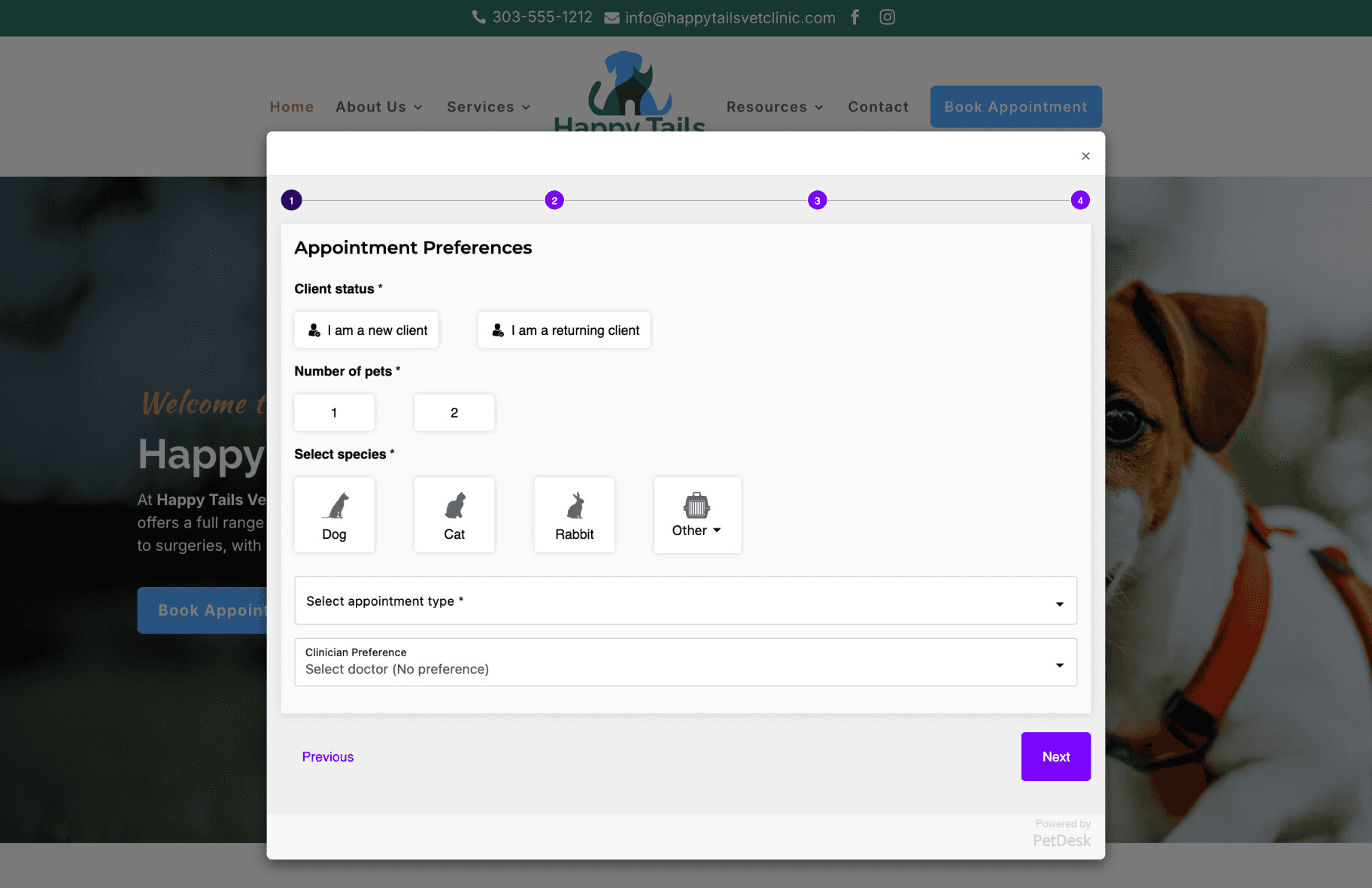
Direct Booking goes further than an appointment request. It reads real availability, applies rules set by the clinic and writes a confirmed slot back to a compatible PIMS. PetDesk says the product supports more than 25 management systems. A newer Reserve with Google connection puts a “Book Online” route on Search and Maps, useful precisely when the clinic is closed and the owner finally remembers the overdue exam.
Phones brings caller and patient context onto the screen before a staff member answers. In 2026, PetDesk began folding calls, texts, voicemail, transcripts and AI summaries into the Communications workspace. Marketing is the service-heavy branch: custom sites, search optimization, paid ads, social campaigns and reputation work for clinics that would rather not become miniature media agencies.
Then there is Scribe, released in 2025. It records a veterinary conversation and drafts a structured SOAP note and client summary. The veterinarian must still review the result. That caveat is not fine print; clinical documentation is a high-consequence workflow. The attraction is obvious, though. A tool that turns the exam-room conversation into a usable first draft competes against after-hours typing, missed lunches and hurried memory.
One appointment, two sides, one integration layer
The business is a subscription, not a download
PetDesk is vertical SaaS with a two-sided experience. Veterinary practices buy monthly packages; pet owners download the app at no charge. The company says it uses month-to-month agreements rather than long-term contracts and asks for notice before cancellation. Official pricing is quote-based because a clinic may choose Communications, Phones, Direct Booking, Scribe, Marketing or a combination. Software Advice listed a starting price of $249 a month in 2026, but a real proposal depends on the bundle.
The sensible buying calculation is not “Do we want an app?” It is “What does avoidable friction cost?” Count staff hours spent answering routine calls, the revenue lost to no-shows, the appointments missed after hours and the labor required to copy conversations into records. Then compare those costs with the full subscription, implementation effort and the likelihood that clients will self-serve. PetDesk publishes striking customer results, including major reductions in call volume and no-shows, but those are examples, not a guarantee for every practice.
The company’s broader market position became more complicated as it grew. PetDesk is now part of the Petvisor family assembled with Vetstoria, Kontak, WhiskerCloud and Groomer.io. In November 2023, parent platform Petvisor announced more than $100 million in investment led by Apax Digital, with Frontier Growth, PeakSpan Capital and management participating. Petvisor said its revenue and client count had more than tripled since Frontier’s 2021 investment. The capital was earmarked for research, product improvements and acquisitions.
Before that, PetDesk raised $2.1 million in a 2017 Series A led by Canal Partners and $12 million in a 2019 Series B from PeakSpan. The money helped turn a single communication wedge into a suite. It also placed PetDesk in a crowded field. AllyDVM, Otto, Weave and Vet2Pet compete for engagement workflows. Digitail, ezyVet, DaySmart Vet, Shepherd and Covetrus Pulse enter the conversation when a clinic considers a broader PIMS change.
What makes it different - and what can be copied
PetDesk’s strongest distinction is architectural and commercial at once: it is willing to sit on top of many systems of record. A clinic can preserve the medical and financial core while modernizing the part clients touch. That lowers the psychological cost of adoption. The consumer app creates another advantage. One paid clinic account can put a useful tool in the hands of thousands of owners, and every completed self-service task reduces work for the buyer.
Reuse the machine
The Locai product failed, but its communications backend still had value. Separate a bad market bet from useful technical assets.
Integrate before replacing
Meet data where it lives. A compatible layer can be easier to buy than a heroic rip-and-replace migration.
Follow interruptions
Reminders led to messages, booking, calls and notes. Adjacent pain created the roadmap, not a generic feature checklist.
Serve the buyer’s customer
Give the end user a free convenience that also saves the paying business time. Both sides gain a reason to participate.
There is a service lesson too. Early PetDesk paired intuitive software with onboarding, setup and proactive customer-success check-ins. That matters in veterinary medicine, where a technically elegant integration is worthless if a busy receptionist does not trust it on Monday morning. The company’s current pitch still emphasizes implementation specialists, training, technical support and ongoing success reviews.
Its culture language is unusually on-theme. PetDesk publishes “Three Laws” that prioritize improving pets’ lives, then providers’ lives, then employees’ lives. The company also lists vulnerability, curiosity, fulfillment and unexpected joy among its values. The playful framing is memorable; the operational test is whether product priorities actually reduce work without degrading care.
Where the playbook breaks
- A clinic needs a new medical, inventory and billing system, not an engagement layer around the current one.
- Its PIMS is unsupported or the integration cannot write back the records the team depends on.
- Internet reliability is poor, staff bypass the workflow, or clients strongly prefer phone-only service.
- The clinic cannot identify enough call time, no-show loss or after-hours demand to justify the package.
- Leaders expect AI-generated clinical notes to be final without veterinarian review.
A modest insight at large scale
PetDesk’s story can look inevitable from the far side of 12,000 clinics. It was not. It began with a product that did not work, a family suggestion to inspect veterinary medicine and a short walk through a trade-show hall. The founders noticed an industry where consumer expectations had moved faster than business software. Then they resisted the temptation to rebuild everything.
That restraint is the part worth keeping. The company began with communication, proved that clinics would pay, made adoption safer through PIMS compatibility and expanded into the work surrounding each interruption. Some of the platform is software, some is managed service, and some is the unglamorous labor of getting a clinic live. The result is not a robot veterinarian. It is a quieter reception desk, a calendar that can fill while the lights are off and a draft note waiting for a doctor to check.
It also explains where PetDesk fits in the market. This is not consumer wellness software wearing a clinic badge, and it is not simply a database for diagnoses and invoices. It occupies the busy territory between those worlds, where a medical business meets a person holding a phone and worrying about an animal. Its expertise is translating veterinary schedules, records and communication rules into actions ordinary clients can complete. That position can be defensible because every integration adds work, but it carries a burden: when synchronization breaks, the convenience layer becomes one more place for staff to check.
For founders, the copyable idea is not to hunt for a veterinary niche. It is to look for a market where the system of record is entrenched but the customer experience is plainly behind. Build the bridge. Charge the business for recovered time. Let its customers cross for free. And if the first app fails miserably, inspect the backend before holding the funeral.