CEO & Co-Founder, Edge
Paul Puey
He builds crypto for people who would rather not trust anyone, including him. Especially him.
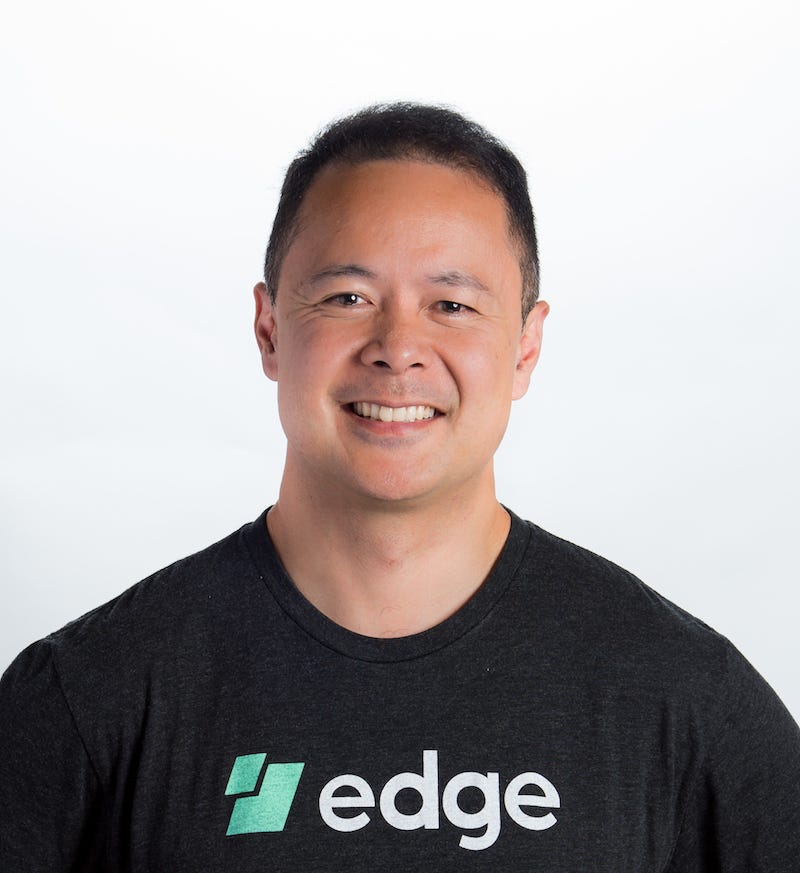
Paul Puey. Holds the keys for nobody, and means it as a compliment.
He builds crypto for people who would rather not trust anyone, including him. Especially him.
Paul Puey. Holds the keys for nobody, and means it as a compliment.
Most CEOs want more of your data. Paul Puey built a company designed to never touch yours.
Edge stores none of your private keys. No copy on a server, no backup in a vault Paul could be subpoenaed for, no master switch in San Diego. If a regulator knocked on the door tomorrow and demanded every customer's funds, the honest answer would be that the company physically cannot comply. That is not a bug Paul is apologizing for. It is the feature he has spent more than a decade defending.
The pitch is older than the buzzwords now wrapped around it. Get a crypto wallet that buys, stores, sends and trades dozens of coins, and do it without handing the keys to a custodian who might freeze, lose, or quietly gamble with them. "If you don't own your keys, those are not your coins," Paul says, and he has been saying it since before the phrase became a bumper sticker for the industry.
Edge supports 50-plus cryptocurrencies, plugs into fiat onramps, and runs as open-source software so the curious can read exactly what it does. The encryption happens on your device. The recovery happens with a username and a password instead of a 24-word phrase scribbled on a hotel notepad. It sounds small. It is the whole argument.
The conviction underneath it is geographic. Paul's thesis, repeated in interviews and on conference stages, is that "digital security will take place on the edges" - not in the fortified center of some company's data warehouse, but at the endpoints, in your pocket, encrypted before it ever leaves your hand. The company is named after the idea.
What makes the position interesting is that it costs him something. A custodial model would be easier to build, easier to support, and far easier to monetize - you can do a lot with money you are holding. Paul gave all of that up on purpose. The company that cannot touch your funds also cannot earn the float on them, cannot upsell you out of a jam it created, cannot quietly become the thing it was built to replace. The discipline is the product.
Digital security will take place on the edges.- Paul Puey, on why the company is named what it is
The resume does not run in a straight line, and that is the interesting part. Paul came out of UC Berkeley with a degree in electrical engineering and computer science, then went to work where the hard math lived: low-level 3D graphics at Nvidia and Chromatic Research, the kind of engineering where milliseconds and pixels are matters of pride.
Then he detoured. Before founding a crypto company, he owned and operated several non-technical small businesses around California. It is an odd line on a Silicon Valley resume - the engineer who went and ran actual storefronts. But it may explain why Edge has always been obsessed with the part of crypto that engineers usually wave away: whether a normal person can actually use the thing without losing everything.
In 2013 the Bitcoin bug bit. He saw a tool that promised people control over their own money and an experience that practically dared them to lose it. That gap - between the promise and the panic of a misplaced seed phrase - became the company.
It is worth sitting with how early that was. In 2013 Bitcoin was still mostly a curiosity argued over in forums, the wallets were unforgiving, and "self-custody" was not yet a slogan anyone printed on a hoodie. Paul did not arrive after the narrative was safe. He helped write the part of it that says ordinary people deserve tools that do not punish a single mistake with total loss. A decade of the industry's worst headlines - frozen withdrawals, vanished deposits, founders perp-walked - has mostly argued his side for him.
Co-founds Airbitz in San Diego - a Bitcoin-only wallet famous for username/password backup and a directory of brick-and-mortar shops that would actually take your Bitcoin.
Crypto outgrows Bitcoin. Airbitz becomes Edge, broadening to many coins while keeping the user-first, self-custody model.
Edge raises a Series A; reported total funding lands around $2.45M.
Leads Edge as a non-custodial, open-source wallet and exchange for 50+ cryptocurrencies, with fiat onramps and in-app trading.
For years, self-custody was the inconvenient sermon nobody at the party wanted to hear. Custodial exchanges were slick, easy, and handled the scary key-management part for you. Paul kept making the unfashionable case anyway: convenience that depends on trusting a stranger with your money is a loan, not ownership. When you hand your coins to an exchange, you are betting that the people running it are both honest and competent. History keeps settling that bet.
Then the collapses arrived. When custodial giants imploded and froze withdrawals, the line Paul had been repeating for the better part of a decade stopped sounding like ideology and started sounding like a warning that had already come true. He has shown up on crypto talk shows to dissect the wreckage and the personalities behind it, offering the view of someone who built the alternative before the alternative was obviously necessary.
The argument is not that exchanges are evil. It is narrower and harder to dodge: a tool that cannot lose your money for you is structurally safer than one that can, no matter how trustworthy the people running it claim to be. Edge is the product version of that sentence.
The technical heart of Edge is where it decides to put the lock. Most software keeps your data on a company server and guards the gate. Edge encrypts your data on your own device first, so that even the company hosting the backup cannot read it. The keys live with you. The encryption is client-side. The recovery runs on credentials you choose rather than a phrase you have to babysit forever.
It is open source, which in this world is less a marketing line than a dare: read the code, check that the company is doing exactly what it says, trust the math instead of the brand. For a product whose entire value proposition is "you don't have to trust us," shipping the source is the only consistent move.
None of this is accidental minimalism. Removing the company from the middle of the transaction is the design goal, not a side effect. The fewer points where Edge could be compelled, hacked, or tempted, the stronger the promise gets.
The hard part was never the cryptography. It was the human layer - making a username-and-password recovery feel as normal as logging into email while quietly doing something far less ordinary underneath. That is the tension Paul's whole career circles: take genuinely difficult machinery, whether it is real-time 3D rendering or client-side encryption, and hide every sharp edge from the person holding the phone. Get it right and it feels like nothing happened at all. Getting it to feel like nothing is the entire job.
Paul's mix of embedded-software pedigree and early-Bitcoin conviction made him a reliable booking on the conference and podcast circuit. He has taken the stage at the North American Bitcoin Conference in Miami, World Crypto Con in Las Vegas, Blockcon, and BlockShow Europe, and turned up on shows ranging from the Bitcoin Takeover Podcast to Liberty Entrepreneurs to a string of interview series where the topic is always some version of the same thing: how to make self-custody safe enough, and simple enough, that ordinary people will actually use it. The talks tend to circle one stubborn idea - that real digital security does not live in a fortress at the center, it lives at the edges, with you.
Paul Puey on Edge Wallet and privacy, from the Bitcoin Takeover Podcast.
His public Twitter bio reads like a personality quiz, not a resume: keto, rock climbing, bitcoin, crypto, and latte art. The handle is @paullinator.
Airbitz was so early that one of its headline features was a map of physical stores that would take your Bitcoin - back when that list was short.
While the industry told users to guard a 24-word phrase with their lives, Edge let people recover a wallet with a username and a password. Quietly radical.
He shipped low-level 3D graphics before he shipped encryption. The same instinct shows up in both: make the hard machinery invisible to the person using it.
Encryption happens client-side, on your device, before anything leaves your hand. Not an upsell, not a premium tier - the default setting.
Between big-tech engineering and crypto, he ran several small non-technical businesses across California. A useful education in what regular customers actually tolerate.
Make crypto insanely easy to send, receive and store - while keeping the highest level of privacy.- the goal, distilled