Paul Eschen’s career can be read as a long experiment in the distance between seeing something and doing something. First came words on screens: search copy, web content, digital communications. Then came growth marketing, where attention had to become interest and interest had to become revenue. Now, as chief marketing officer of BizLibrary, he works one turn farther along the chain. A lesson has been watched. A quiz has been passed. The dashboard glows with completed courses. What, exactly, happens next?
His answer is increasingly blunt. Information is abundant. AI can manufacture a plausible training outline while the coffee is still hot. The hard part is no longer putting knowledge within reach. The hard part is helping somebody use it when a direct report is upset, a customer is impatient or a decision refuses to become obvious. Eschen has built his recent public work around that gap - the stubborn interval between knowing and performing.
Content informs. Practice transforms. The gap between those two is where performance lives.Paul Eschen
It is an executive’s line with a copywriter’s economy. It also explains why a marketing career belongs in a conversation about learning. Marketers know distribution is not persuasion. Learning teams are discovering the parallel truth: distribution is not development. A course can arrive perfectly and still leave the recipient unprepared.
The boomerang route to the C-suite
Eschen studied strategic communications at the University of Missouri from 2005 to 2009. His campus record included leading recruitment for Phi Kappa Theta, an early rehearsal for the business of making a case, reading a room and persuading people to join. After college came SEO and web-content work. In 2010 he spent several months in business development at Business Training Library, the company that would later be known simply as BizLibrary.
Then he left. The detour became the education.
At Ansira Engagement Marketing, he managed web content for Coca-Cola North America. In 2013 he joined Maritz, the St. Louis company whose business sits at the intersection of motivation, incentives and experience. His titles chart a fast-changing marketing era: digital communications strategist, digital marketing manager, senior director of marketing, then vice president of growth marketing for Maritz Global Events. By the time he moved on in 2021, he had spent more than eight years inside a company devoted to the mechanics of motivation.
Studies strategic communications at the University of Missouri.
Works in business development at Business Training Library.
Moves through digital, senior marketing and growth leadership roles at Maritz.
Returns to BizLibrary as vice president of marketing.
Becomes chief marketing officer.
The return to BizLibrary has the satisfying geometry of a boomerang. He came back in May 2021 as vice president of marketing and became CMO in August 2022. The company he rejoined was still selling access to learning, but the market around it had changed. Corporate libraries were larger. Platforms were common. The argument could no longer stop at having useful content. It had to reach the workplace.
A marketer gets interested in behavior
Eschen describes behavioral science as a professional passion. The attraction makes sense. Marketing and learning both court a famously unreliable creature: the person who understands a message, agrees with it and then carries on as before. The field asks why intention so often fails to survive contact with habit, pressure and context.
His role at BizLibrary stretches beyond promotion. Company descriptions of his work include aligning sales and marketing, shaping offers around client needs and helping learning teams demonstrate return on investment. This is where behavioral interest meets executive arithmetic. If L&D wants a seat at the executive table, attendance and completion are weak conversational currency. Retention, capability, performance and reduced risk travel better.
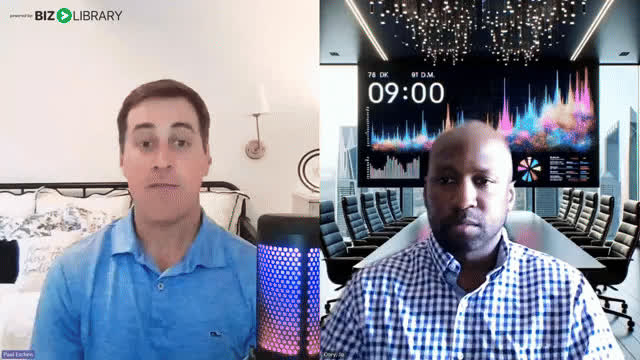
The same curiosity appears in L&D Unlocked, the video and podcast series Eschen hosts with BizLibrary executive Chris Elliott. The guest list wanders productively across the modern workplace: generational researcher Kim Lear on multigenerational teams; technology leader Jo Otey on generative AI; HR thinker Dave Ulrich on human capability; learning executives on onboarding, trades and empathetic leadership. Eschen’s role is part interviewer, part translator. The episodes take large changes and ask what an HR or learning professional should do on Monday.
When access stops being the problem
In early 2026, Eschen gave his argument a name: the performance paradox. Organizations have more tools, more speed and more content, yet confidence and results do not rise automatically beside them. His diagnosis is not anti-technology. It is suspicious of technology without a theory of application.
For years, he writes, learning programs measured what was easy to count: courses completed, hours watched, programs launched. Those measures were sensible when access was scarce. AI has made access radically cheaper. A library can grow overnight; an explanation can be summoned in seconds. The resulting surplus creates a new problem. Workers do not need another mountain of material so much as a route through it and a place to test what they think they know.
The alternative he promotes is applied practice: simulations and role-plays in which an employee must respond, receive feedback and try again. BizLibrary’s own product direction naturally sits inside the case, and Eschen is its marketer. Still, the idea survives outside the sales presentation. Watching a video about delegation and delegating a troubled assignment are different cognitive weather. The first offers recognition. The second demands judgment.
The shift in what workplace learning rewards
In the first month after BizLibrary launched its AI role-play product, Eschen shared 6,415 sessions and more than 704 hours of interaction, with an average session lasting six minutes and 35 seconds. The numbers are early adoption figures, not proof of lasting behavior change. Their interest lies in what people chose to do: rehearse conversations, adjust tone, structure messages and repeat. The learner was no longer merely receiving.
The accidental manager, with jokes
Eschen’s public style is lighter than the phrase “performance infrastructure” might suggest. In 2025 he introduced a BizLibrary campaign called Real Legends of Learning with a parody salute to the individual contributor turned accidental manager. The unfortunate hero excels at one job, receives a promotion into a completely different job and finds himself consulting YouTube before a one-on-one meeting.
The bit works because the joke is already sitting in thousands of org charts. Companies routinely treat promotion as evidence of preparation. Eschen lets the comedy carry a serious point: management is a skill, not a ceremonial hat placed on the best spreadsheet owner. The new manager needs somewhere to fail softly before failing in front of a team.
That combination - playful packaging around a sober operating problem - fits descriptions from people who have worked with him. One former colleague called him energetic and creative, noted how quickly clients trusted him and singled out his competitive nature and quest for knowledge. His older public social bio supplied less corporate texture: craft-beer drinker, youngest of four, Missouri journalism graduate. The picture is of someone comfortable moving between a boardroom case and a knowing workplace gag.
In a world drowning in information, practice is the advantage.Paul Eschen
The test comes after “complete”
Eschen’s five-part framework for future-proof learning - innovation, personalization, curation, creation and iteration - sounds at first like a tidy conference slide. Its more useful feature is the final word. Iteration assumes the first attempt will be incomplete. It treats learning as a loop instead of a delivery.
This is also why his recent work gives managers such weight. AI may save time, but a manager still translates strategy into priorities, decides what good looks like and provides the feedback that turns motion into progress. A weak manager with faster tools can simply produce confusion more efficiently. Practice offers a controlled setting for building the human judgment that automation cannot volunteer to own.
There is an appealing modesty in this vision of learning. Nobody becomes a leader because a video ended. Nobody gains judgment because a quiz briefly approved of them. Improvement arrives through attempts, correction and another attempt - the ordinary mechanics of getting better. Eschen’s contribution is to bring a marketer’s eye to that process and insist it can be made visible to the business.
His career began with the problem of attracting attention. It now circles a harder one: earning evidence that attention mattered. The answer will not fit as neatly in a course-completion column. It may appear in a manager who handles a tense exchange with more clarity, an employee who tries a better question or a team that makes a sound decision before speed makes it a poor one. For workplace learning, that is the moment after the click. For Eschen, it is where the story finally begins.