Pascal Henry wanted to get back to work. The difficulty was that work kept getting in the way. Running a young business in Singapore meant dealing with the small, insistent jobs that accompany employing people: payroll, records, leave, claims. Each had a perfectly reasonable claim on his attention. Together, they were consuming the attention he needed to build the business.
It is an unglamorous starting point for a technology company, which is part of its appeal. A payslip rarely gets a standing ovation. It does, however, have to arrive. Henry went looking for software that suited him, found the available choices wanting, and began discussing the problem with the people who would become his co-founders. Their decision to proceed, he recalled, came over a beer. HReasily emerged in 2015 with a promise contained in its name.
From Kota Kinabalu to the monthly payroll
Henry grew up in Kota Kinabalu, in Sabah on the island of Borneo. London followed in his early twenties, along with a recruitment business, after jobs and internships in Asia and Europe. He eventually returned to Asia and settled into Singapore’s business world. His background included founding Bridge Resourcing Consulting. Before he sold tools to employers, he had been one himself.
That experience gives his founding story its particular scale. The problem was personal enough to feel every month, yet ordinary enough to recur across many businesses. His own frustration supplied a question worth investigating: how much of running a company was being swallowed by administering it? The answer would have consequences for what he built and whom he tried to reach.
The early product concentrated on payroll and leave. By 2018, HReasily offered seven modules. A customer could begin with a recurring administrative need, then add other functions. There is a certain courtesy in that approach. A business with a modest headcount should be able to buy for the business it actually has, while leaving room for the one it hopes to become.
A bank account becomes a front door
Henry’s expansion story becomes more interesting when a bank enters it. UOB Payroll, launched in 2015, combined a UOB business operating account with HReasily software. By the bank’s 2016 reporting, more than 600 business banking customers in Singapore had used the service. UOB said it reduced payslip management costs by at least 40 percent. That figure described the service’s stated benefit, rather than a universal result for every HReasily customer.
This placed payroll software beside something business owners already needed: a way to pay people. Distribution followed the job. The customer did not have to develop a separate enthusiasm for human resources technology before encountering the product. A banking relationship could introduce the software at the point where its purpose was immediately comprehensible.
Singapore business banking customers had used UOB Payroll, which bundled HReasily with a UOB operating account.
In August 2016, UOB launched BizSmart, putting payroll into a broader collection of business tools. The original combination included Vend for inventory, Deputy for scheduling and leave, Xero for accounting, HReasily for payroll and MobileIron for security. The assembly was instructive. A small company’s working day crosses the boundaries that software companies put around their products.
A sale becomes an accounting entry. A shift becomes part of a pay calculation. Money leaves a bank account. Henry’s company occupied one necessary part of that sequence. Being useful alongside other services offered a practical route into an owner’s routine, with fewer separate purchasing decisions and fewer introductions to make.
The accountant on the other side of the table
Mazars added another route. Its Thailand partnership with HReasily brought cloud HR compliance and payroll services onto a common platform for Thai and regional clients. The relationship encompassed employee records, new arrivals and departures, leave, timesheets, expenses and stored documents. Payroll information could also become a monthly accounting entry posted into Xero.
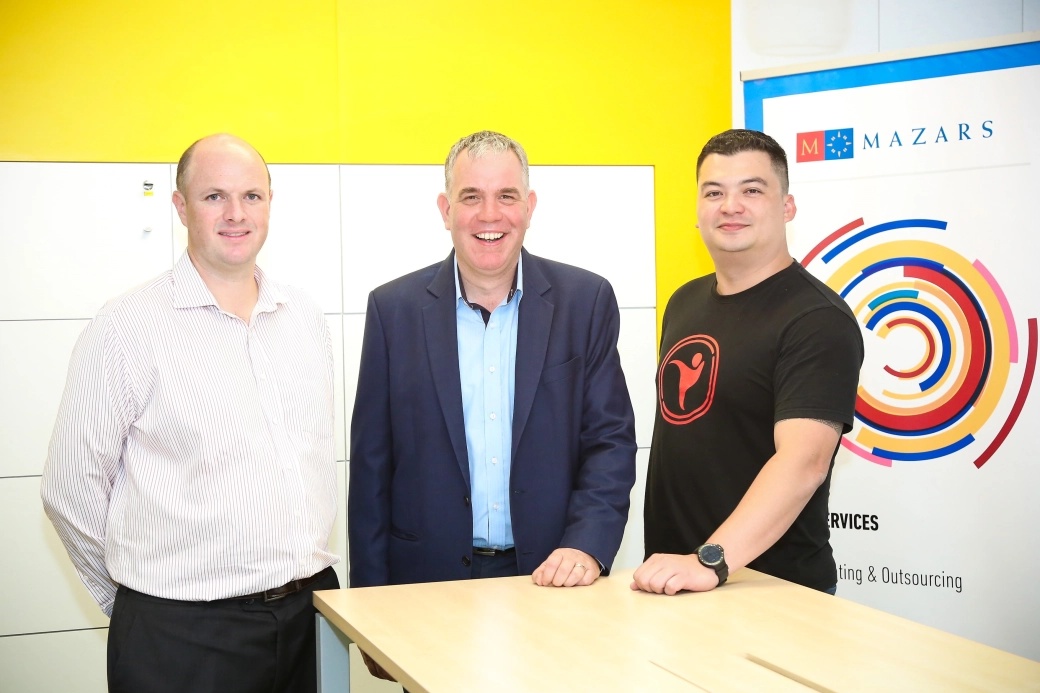
Look at the people in the photograph and the business logic becomes visible. Jonathan Fryer brought accounting and payroll outsourcing expertise; Rob Hurenkamp led Mazars Thailand; Henry brought the software company. Different responsibilities met at the same client. The partnership made an existing professional relationship a place to introduce a different way of doing the work.
Outsourcing firms could use HReasily themselves. That is a useful complication in the usual story about automation replacing intermediaries. An intermediary also has repetitive work to do. Giving its staff better tools can make the firm a customer and a distributor at once. Henry’s approach allowed for that overlap, rather than requiring every relationship to fit neatly into a competitor column.
“There’s strength in numbers.”Pascal Henry, discussing business partnerships
Eight markets, eight sets of details
By September 2019, HReasily said it had 30,000 companies on its platform across eight Asian markets. Those markets were Singapore, Malaysia, Thailand, Hong Kong, Indonesia, the Philippines, Cambodia and Vietnam. The count is a historical platform figure. It should not be read as a current total or as a count of paying subscriptions.
For a payroll company, regional reach brings a particular obligation: the details must work locally. Henry described putting teams on the ground and adapting the product to the market being served. A shared platform can offer familiar navigation while still having to accommodate different payroll requirements. The administrative promise becomes harder to keep with every additional jurisdiction.
Eight markets. Local payroll requirements in each.
Expansion plans then included China and other markets beyond that footprint. Those were ambitions, and belong in the story as ambitions. What had already taken shape was a method: bring the product into a market with partners who understood its businesses, then make the offering useful on local terms. Geography was only the beginning of the assignment.
When the customer writes a different cheque
In September 2019, Envy Capital invested US$5 million in HReasily. Its parent, Envy Asset Management, had used the platform since 2015, when its team numbered three. By the announcement, that team had grown to eighteen. The investor had already experienced the product through several years of operating a business.
Henry said it was especially meaningful to receive backing from a customer. The practical attraction is easy to understand. A demonstration can show a feature working for a few minutes. A customer has lived with the product through repeated payroll runs and changing needs. In this case, a commercial relationship had developed into a financial one, with money intended to accelerate product development.
The episode fits the broader pattern of Henry’s work at HReasily: relationships could acquire additional purposes over time. An accountancy firm could become an investor and an expansion partner. A bank could provide a route to customers. A software user could become a backer. The company’s network was part of how it operated, beyond the familiar collection of logos on a sales presentation.
The warehouse is a useful reality check
There is a more concrete way to understand the product than a funding announcement. Apparel company Love, Bonito needed to manage people across offices, stores, e-commerce operations and warehouses as it expanded. It used HReasily’s facial recognition attendance software in its warehouses, connecting attendance records to payroll.
The significance sits in the connection. Recording attendance in one place and calculating wages somewhere else creates a handover. Connecting the two removes a repeated transfer of information. For an employee, the process ends in something specific and personal: a payslip. For an administrator, it means one fewer opportunity to copy a number incorrectly.
HReasily also involved customers in product roadmaps and offered training through HReasily Academy. Those details matter because purchasing software and using it comfortably are separate achievements. The interface may be digital; the change still involves people learning a new routine. Henry’s original frustration would be poorly served by a replacement system that simply found more inventive ways to occupy the owner.
In May 2020, Prudential announced a regional partnership giving its SME customers access to HReasily’s payroll, leave, claims, time and attendance, and HR management tools. At that point, the platform described more than 50,000 SMEs across Asia. The agreement extended the same distribution idea into another established customer network.
A more complicated next chapter
The later history also includes financial difficulty. HR Easily Pte Ltd was acquired by HRIG Pte Ltd in early 2023. A 2024 Singapore High Court judgment concerned a former employee’s unpaid salary claim and application to wind up the company. Henry, its CEO at the relevant earlier time, provided affidavit evidence about company expenses he had paid with his credit card.
The court dismissed the winding-up application. That outcome concerned whether to wind up the company; it did not establish that every disputed salary payment had been made. These events complicate the growth story and underline how demanding the underlying business became. A software platform that helps employers administer pay still has its own obligations as an employer.
Henry’s public LinkedIn profile now lists an affiliation with a stealth HR technology company in Asia and locates him in Singapore. The recurring interest remains the machinery of employment: how businesses organise work, and what gets in the way. His advice to entrepreneurs in 2018 was to keep the customer clearly in view. After all the partnerships and platform counts, the original customer is still easy to picture: an owner with a business to build, and payroll waiting patiently for its turn.