Benjamin Croc’s route to running an HR software company included a badminton court. The French founder has said that the sport helped bring him to Malaysia, where he trained with the Sidek brothers in the early 2000s. It is a rather more interesting introduction to a country than a spreadsheet of expansion opportunities. Years later, he would build a business there around the difficulties of managing people. First came the attraction to a place. The business problem arrived through work.
Today, Croc is the co-founder and CEO of brioHR, which he started with Nabil Oudghiri in 2018. The company brings recruitment, onboarding, payroll and employee development into one platform. That description is accurate, although it leaves out the useful part of the story: Croc had spent years inside organisations, discovering how much effort it could take to help a team do its job.
A racket before a business plan
His professional route began at PwC. In early 2011, he moved to Malaysia to lead a global finance division for a French multinational. That company was CMA CGM, where he headed the global finance shared services centre. Finance operations offered a close view of how a large team actually functions: the recruiting, coordination and management work that sits behind a department’s output.
He later earned an MBA at INSEAD, graduating in 2016. The school remains a point of connection in his story. Both brioHR co-founders are INSEAD alumni, and Croc has described admission to the programme as a career milestone. After the MBA, he returned to Malaysia and joined McKinsey. Early in 2018, he moved to Lazada, where his work included heading strategy.
The employers changed. So did the perspective: finance operator, consultant, internal strategist. Together, those roles gave him experience of teams from several angles. His management responsibilities had included groups of more than 200 people. Long before he was selling HR software, he had reasons to care about what happened when the tools for managing those people were awkward or incomplete.
The work between the boxes
An organisation chart makes management look unusually tidy. People appear in boxes. Lines explain who reports to whom. The chart seldom offers much advice about a vacancy that needs filling, an interview awaiting feedback or a new recruit whose first day is approaching. Those are the jobs that turn the diagram into an organisation.
Croc and Oudghiri recognised similar frustrations in their separate professional lives. In Croc’s account, the initial concern went beyond processing payroll. It included seeing the recruitment pipeline clearly and helping new employees settle in. The founders wanted tools suited to the people doing that work. They also wanted dependable support when those people needed help.
The pair took those frustrations into conversations with HR professionals and managers. Their own experiences gave them a starting point; other people’s experiences helped establish whether a business could grow around it. The recurring complaints included tools that lacked flexibility and support that disappointed customers. A company could already own HR software and still struggle to manage people efficiently.
Their division of labour reflected two different jobs inside the same venture. In an early interview, Croc described his focus as sales, marketing and investor relationships, with both founders involved in recruitment. Oudghiri handled technology and support. Croc’s commercial work therefore stayed close to the people being asked to trust the product. Their feedback had somewhere direct to land.
He found another expression of the problem in regular meetings with company owners and CEOs. Their businesses included manufacturing, logistics and sewage cleaning. Croc recalled that the conversations repeatedly came back to attracting, developing and retaining people. These were employers with different products and customers, describing a familiar difficulty. For someone building HR software, the meetings offered a useful reminder of the audience beyond technology companies. The working vocabulary might vary, but the questions about finding people and helping them stay were recognisable.
“HR is more than admin”
Benjamin Croc, LinkedIn, 2024
The first week is part of the product
Onboarding became a recurring subject in Croc’s discussions of brioHR. It is easy to see why. Hiring a person involves considerable effort before they arrive. Then comes a quieter test: whether the company is ready for them. Recruitment and employment may belong to different workflows, but the new employee experiences one continuous sequence.
In a 2023 conversation with SEA of Startups, that transition was important enough to receive its own discussion: onboarding as an entry point to a broader platform. The interview followed the company from deciding what to build through finding early customers and setting product priorities. It put the emphasis on choices. An all-in-one product still has to begin somewhere.
By 2024, Croc was discussing another point in the employee journey: training. Customers wanted to manage budgets, attendance and learning paths without isolating that information from the rest of HR. His explanation of brioHR’s dedicated training module began with those requests. Course discovery, registration and records were practical parts of a larger promise to develop people.
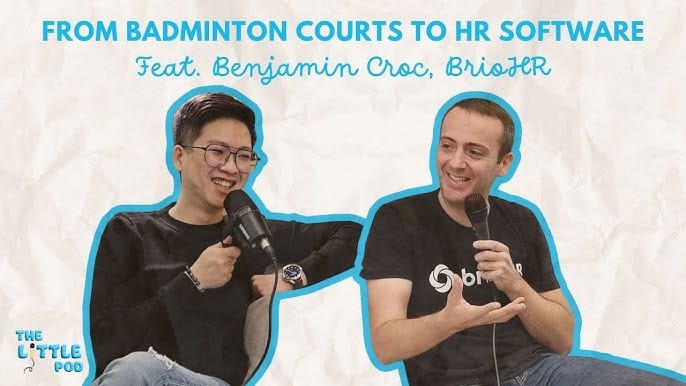
The partnership with LittleLives put that interest in another setting: preschools. In May 2024, brioHR described the collaboration as a way to bring HR and management tools to preschool operators. Croc’s appearance on The Little Pod connected his own career story with that work. A preschool and a finance operation have different daily rhythms, but both need to bring people into an organisation and help them work together. The setting changes the requirements a software company must understand.
That detail matters to the portrait of the founder. Croc returns to development through operational questions. Can employees see the courses available? Can HR follow attendance and spending? Can completed learning appear in an employee’s record? A commitment to development has a better chance of surviving a busy week when somebody has made the arrangements workable.
- 01Recruit
- 02Onboard
- 03Manage
- 04Develop
Four connected stages in Croc’s account of people management.
A company gets larger. The questions stay practical.
brioHR joined Y Combinator’s Winter 2021 batch. In May 2025, it announced a US$6.5 million Series A led by Openspace Ventures, with participation from Taiwania Hive and other regional investors. The announcement described more than 1,000 customer companies globally. That is a different scale from persuading a first customer to put a young company’s product to work.
The round also gave a clearer view of the next ambitions: regional expansion, further product development and AI capabilities. Singapore featured prominently in the expansion plans. A June 2025 BFM conversation examined the company’s growth with more than 100,000 users across roughly 1,000 companies, and returned to localisation, usability and customer relationships.
Those figures describe different things. A company is a customer organisation; a user is a person using the system. Keeping the distinction matters in a business whose product reaches employees as well as HR teams. The software has to make sense to someone who manages it frequently and to someone who simply needs to complete an occasional task.
Croc’s public comments about AI have also kept a practical emphasis. In 2021, he questioned how freely the label was being applied to existing automation and stressed the need for useful underlying data. By the 2025 funding round, AI development was part of the company’s stated plans. The relevant test remained what the technology would let an HR team accomplish.
At HR Tech Penang 2025, he returned to recruitment visibility, onboarding and regular conversations about performance. His argument placed ordinary administrative accuracy alongside a broader responsibility for developing people. Getting the routine work right creates expectations; making progress on people management requires attention beyond the routine. Software sits inside that relationship between the two.
Who gets to disagree with the CEO?
A founder selling better management tools has a management question of his own: how should colleagues work with him? Croc has said he wants independent thinkers who take initiative and challenge decisions. He values a team willing to speak plainly. The stated preference is useful because a CEO’s access to information depends partly on what other people feel able to say.
His public appearances have continued to involve the practical work of managing. In April 2026, brioHR advertised a workshop with ACE.SG in Singapore where he would help participants improve job descriptions. A September 2026 conversation on Reaching Lives with Kathrina turned toward the founder’s own development, including mentors, respect and authenticity in leadership.
There is room for a less formal Croc too. An office visitor, Sim Ling KU, joked in a 2026 LinkedIn post about teaching him a Gen Z hand sign. Croc replied that he needed to check new signs while trying to connect across generations. It is a small exchange, but a welcome interruption to the usual founder vocabulary. Sometimes learning at work is delightfully unrelated to a training catalogue.
In a 2022 interview, he compared startup leadership to steering a ship while also dealing with a burst pipe in its engine room. He named the first brioHR customer among his memorable career moments. His leisure interests include badminton, squash and poker. Asked for an ice cream preference, he chose vanilla. The career has supplied enough variety without requiring it from dessert.
Croc’s story remains rooted in that earlier experience of being responsible for a team. He came to the problem through work that required him to recruit, coordinate and develop people, then chose to build a company around improving those arrangements. The next stage gives him a larger version of the same responsibility: helping brioHR grow while keeping its product useful to the people whose working days it enters.