Priyang Shah's company began with a piece of arithmetic most people meet at the worst possible time: during benefits enrollment, with too many PDFs open and patience leaking by the minute. In a dual-income household, there may be two employers, two menus of plans and one family budget. Yet the systems around those choices have traditionally examined the employee in isolation. The spouse's plan sits across the kitchen table, administratively invisible.
Shah looked at that omission and saw more than a clumsy process. He saw money stranded between two organizations. An employer could spend heavily to cover a worker whose family already had another credible option. The family, meanwhile, could make a reasonable-looking choice without seeing the full cost of either path. A benefits decision that should have been comparative had become a ritual of separate logins and optimistic guessing.
Healia, the Columbus company Shah founded in 2021, makes the comparison explicit. Its software models the plans available through both members of a working couple. Its Total Care Option lets an employer reimburse eligible out-of-pocket costs when an employee enrolls through a spouse. The company says the arrangement can save an employer about $10,000 per enrolled family while improving the benefit available to that household. A tidy sentence now carries a great deal of machinery.
Two unusually early seats
Shah did not arrive at the idea from a distant perch. He had spent a decade close to the awkward join between software, insurance and operations. After Duke University and a 2015 Venture for America fellowship, he joined Olive AI as its 20th employee, working on the company's mobile product. It was an early view of a Columbus healthcare technology company while the machinery was still being assembled.
He next joined Root Insurance as its 15th employee and first product manager, later becoming a product director. Root grew from that small Columbus team to roughly 1,500 people and a public listing. For a first product manager, scale would have arrived as a daily succession of specifics: which customer problem deserves engineering time, how a decision changes when thousands of people depend on it, and which numbers are signal rather than corporate weather. Shah later distilled the experience into a preference for big aspirations supported by rigorous decisions and careful hiring.
Olive offered the healthcare operator's view. Root offered the insurer's view. Together, the two unusually early seats gave him the founder's equivalent of standing behind the curtain while the scenery was still being painted.
“The lesson I carry into Healia from those years is the same one: big aspirations, backed by rigorous, data-driven decision-making, and hiring an incredible team top to bottom.”Priyang Shah
This is the useful shape of Shah's apprenticeship. He did not collect startup logos at a safe altitude. He joined when an individual could still alter the grammar of the organization. Product, operations and culture were not departments so much as arguments happening within earshot. By the time he started Healia, he had watched two ambitious companies try to turn complicated promises into repeatable systems.
The family is the unit
The conceptual move behind Healia is small enough to miss. Instead of treating an employee's plan as the entire universe, the company treats the household as the decision-making unit. That changes the input. A spouse's benefits guide, previously somebody else's paperwork, becomes essential data.
The software accepts a spouse's benefits guide and uses language models to parse the document, allowing options to be modeled together. Around that comparison sits the less photogenic work that makes a benefit usable: setup, education and claims reimbursement. Shah's idea is clever partly because it gives the software a concrete job. Artificial intelligence is not invited to deliver a keynote about the future. It reads the paperwork.
The pitch also has a pleasing alignment. The employer wants lower benefit costs. The employee wants a clearer choice and stronger coverage. The broker wants another way to solve a renewal problem. Healia gets paid to coordinate an option that may already exist but has not been examined as a system. The opportunity lives between the boxes on an org chart.
When a market looks crowded, inspect the handoff between participants. The neglected value may be sitting between two existing products, waiting for someone to compare them.
A round with an Ohio address
Healia joined Y Combinator's Winter 2024 batch. Its public update the following year reported more than 50 customers across the country and over 40,000 employees using the product. By 2026, Columbus Business First reported that sales had increased more than twentyfold over two years.
In July 2026, the company announced $18 million in funding, including a $14 million Series A led by 111° West Capital. Y Combinator, First Round Capital, Pioneer Fund, GoAhead Ventures and North Coast Ventures also participated. Healia said it had by then enabled employers to provide $33 million in additional family coverage.
Shah's handling of the round reveals something about his ambitions for place as well as product. He wanted an Ohio-based fund involved so that a successful return could send capital back into Ohio and the Midwest. He also saw a practical advantage: a local investor could help recruit people who already understood its name and network.
When West Coast investors considered the Columbus location, Shah said he did not need an elaborate defense. He showed them the data. Ohio has deep insurance institutions, a large university in the company's backyard and a generation of operators trained inside fast-growing local companies. His phrase for the desired mixture is “Silicon Valley ambition” with “Midwest humility.” It is a neat bit of civic chemistry: the appetite of one coast, the manners of a neighbor with a snow shovel.
“We wanted an Ohio-based fund so that when we have a successful exit, that capital is guaranteed to go back into Ohio and the Midwest.”Priyang Shah
The office as operating system
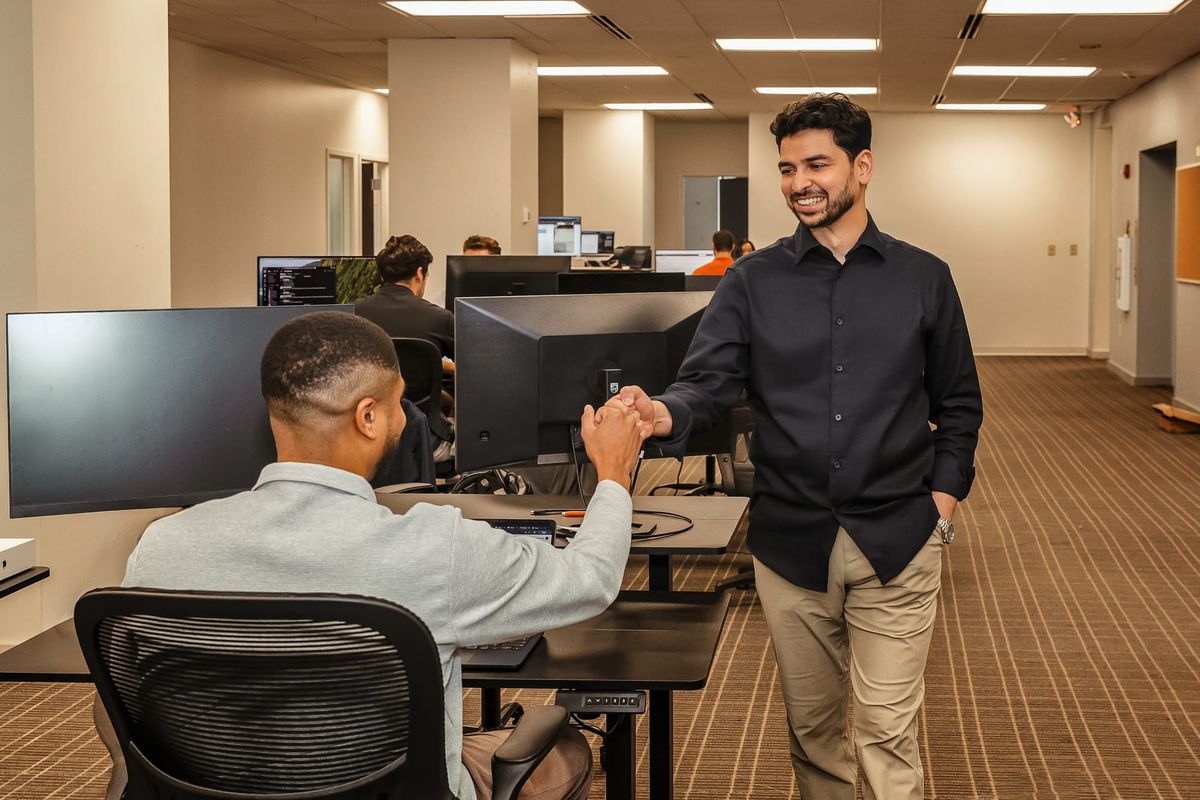
Healia is building its team in Central Ohio and works together in person five days a week. Shah's explanation is bluntly operational: against companies with more money and people, speed is the advantage, and proximity shortens communication. Instead of waiting on a message thread or arranging a call, someone can turn and ask.
The policy will not suit every talented person, and Shah does not present it as a universal doctrine. It fits the company he intends to build. Benefits work crosses engineering, sales, brokers, employers and claims operations. Ambiguity moves sideways all day. In that environment, a chair swivel can function as infrastructure.
His hiring language favors resourcefulness, grit, clarity, curiosity and ownership. A recent operations post welcomed new graduates and pointed to an employee promoted within eight months. Another hiring post described the operations team as a place where customer experience, process design and the product roadmap meet. The pattern is familiar from Shah's own career: put capable people near consequential work before their titles become too grand to touch it.
The alumni loop
Shah talks openly about a possible Root-and-Olive “mafia” in Columbus, using the friendly startup meaning: alumni who found, fund and staff the next set of companies. His own route makes him a clear specimen. He learned inside two early teams, stayed in the city, raised money and began hiring the next cohort.
He says he can already see would-be founders among Healia's employees. The aspiration is for Healia to give them what Root and Olive gave him: a close view of how a company is made, including the inelegant parts. This is how an ecosystem stops being a slogan. Experience becomes locally renewable.
There is an appealing symmetry here. Healia's product asks families to consider resources that were present but disconnected. Shah's regional strategy does something similar with talent and capital. The people already live in Ohio. The operators already learned at scale. The investors already understand the terrain. Connect the pieces, and value that looked absent becomes visible.
Plans competing for families
Shah's five-year vision is more provocative than the product's administrative surface suggests. He expects families to see both plans together, understand the costs and receive support for choosing well. At a large enough scale, he argues, plans would have to compete for families instead of families simply accepting the available default.
That ambition gives Healia a useful tension. Its daily work is procedural: compare documents, explain options, process reimbursements. Its larger wager is about market behavior. Make household choices legible and millions of private decisions could become a public signal.
For Shah, the path to that future runs through Columbus, a growing team and the stubborn discipline of making complicated work feel ordinary. He has seen what happens when a few early employees learn to build at scale. Now he is arranging the next set of desks, with a $10,000 question pinned above them.