Company Benefits & HR Tech / The Invisible Layer
How a 1999 Perks Startup Became the Discount Engine Inside Half the Fortune 500
BenefitHub has spent 25 years quietly aggregating other people's deals into one company login. It says it has never had a down year - and most of the millions of people who use it have never heard the name.
There is a good chance you have used BenefitHub and never once said its name. It lives one click deep inside a company benefits portal, wearing your employer's logo, offering discounted movie tickets, cheaper phone plans, an auto-insurance quote, a hotel deal for the long weekend. You click, you save, you move on. Behind that click is a 25-year-old New York company that has quietly become one of the largest employee-perks operations in the world.
BenefitHub bundles employee discounts, voluntary benefits, insurance and rewards into a single branded marketplace that employers hand to their workforce. By its own count it reaches more than 14 million employees across in excess of 20 countries, serving roughly 17,000 client organizations and a sizable share of the Fortune 500. The offers come from a network of over 300,000 vendors. Almost none of them are BenefitHub's own products. That is the whole point.
01The aggregation bet
The company was founded in 1999 by Seif Saghri, an entrepreneur who had already taken several startups to exit. His observation was simple and slightly annoyed: the big perks - the negotiated discounts, the group rates, the buying power - flowed to employees at giant corporations, while everyone else got nothing. Smaller employers had no way to offer the same thing on their own.
His fix was the aggregation model. Instead of asking each company to negotiate its own deals, BenefitHub would negotiate once, pool the offers, and let any employer plug in. As Saghri tells it, there was no template to copy.
The frustration was specific. Saghri has described watching smaller employers get shut out of the buying power that came automatically with a big corporate badge, and deciding the gap was a distribution problem more than a pricing one. The offers existed; there was simply no single place to put them.
Worldwide, we were the first in the industry to launch an online perks solution for employers, globally. The only alternative was for companies to manage their deals and offerings themselves. Seif Saghri, Founder
Being first is a nice line for a press release. It is a harder thing to survive. BenefitHub had to win clients who had never bought this category before, then keep them, then do it in country after country without a roadmap. The payoff is that once an employer's entire workforce lives inside your portal, switching becomes a genuine chore - which is a large part of why the company reports a 99.2% seven-year client retention rate.
02What you actually get
Open a BenefitHub portal and the front door is the Discount Marketplace: national brand offers, local deals, event and movie tickets, travel and hotel rates, restaurants, and reduced prices on the boring essentials like cell-phone plans and insurance. There is a mobile app for iOS and Android, a browser extension that surfaces deals where you already shop, and cash-back features. The company says the average active user saves more than $4,900 a year - on purchases they were going to make regardless.

Sitting behind the discounts is the part that matters more to employers: the Voluntary Benefits Suite. These are the insurance and benefit products - auto and home coverage, and other voluntary lines - that employees can shop and enroll in through the same portal, alongside their core benefits. Layered on top are rewards and recognition tools, and, since 2023, AI-driven personalization that tries to show each employee the handful of offers actually relevant to their life rather than the full firehose of 300,000 vendors.
The expertise that is hard to see from the outside is the plumbing: keeping 300,000 vendor relationships current, wiring a portal into an employer's HR systems, standing up the whole thing in a new country with different carriers and different rules, and doing it thousands of times over. That operational grind is the actual moat. Anyone can build a page of coupons; very few can run one that a Fortune 50 payroll trusts.
The free discounts are the front door. The voluntary benefits and insurance are the business. Get an employee in the habit of logging in for cheaper movie tickets, and enrolling them in an insurance product becomes a much shorter walk.
03Who is on the other end
The customer list reads like a directory of American work. BenefitHub's first Fortune 500 client, Citi, signed in 2004. Walmart followed in 2010. Public materials tied to the company name Amazon, Lowe's, Johnson & Johnson, American Airlines, UPS, AT&T and Target among enterprise clients. The reach spans the United States, Canada, India and the United Kingdom, among other markets.

For the employer, the pitch is engagement and retention: a benefit that costs them little to deploy but shows up in an employee's inbox with real, spendable value. For the employee, it is buying power they would not have alone. For BenefitHub, each new employer is a fresh audience of thousands, delivered pre-verified and ready to shop.
Figures are BenefitHub's own reported reach and are approximate.
04The business behind the discounts
The model is business-to-business-to-consumer. Employers deploy a BenefitHub-powered portal, usually at no cost to the company or its employees. BenefitHub makes its money on the marketplace itself - through relationships with the vendors and the voluntary-benefit and insurance carriers whose products flow through the platform, rather than by charging users a subscription. Vendors get distribution to a captive, verified audience; employers get a retention tool; BenefitHub sits in the middle as the aggregator and the system of record.
It is an unglamorous place to sit, and a durable one. Saghri has repeatedly pointed to a record that most software founders would trade a great deal for.
We are very fortunate that we never had a down year, even during the 2008 recession or the COVID pandemic. Seif Saghri, Founder
05New owners, new chair
In April 2024, the Philadelphia-based private-equity firm Inverness Graham announced its acquisition of BenefitHub. Terms were not disclosed. Later that year, Balance Point Capital made a follow-on investment. The deal marked the company's shift from founder-run business to institutionally backed platform.
The leadership followed. In May 2024, BenefitHub named Jeff Litvack - former chief executive of Adweek, with earlier CEO roles at Robb Report, ALM and the Associated Press - as its new CEO. Saghri stepped into the role of Vice Chairman of the Board.
I am excited to hand the reins over to such an accomplished CEO, and I have great confidence in Jeff. Seif Saghri, on the CEO transition
Founders rarely stay close after selling. Keeping Saghri on the board reads as an attempt to hold onto the institutional memory of a company that grew up with no competitors to imitate.
06Where it fits in the market
BenefitHub competes in the employee-perks and voluntary-benefits category against platforms like Abenity, PerkSpot, Fond and Corestream, and European players such as Benify. Its real competition, though, is inertia: the employer that decides to cobble together its own discount program in-house, or offer nothing at all. The pitch against both is scale - a network of 300,000 vendors and 25 years of negotiated relationships that a single HR team cannot replicate on its own.
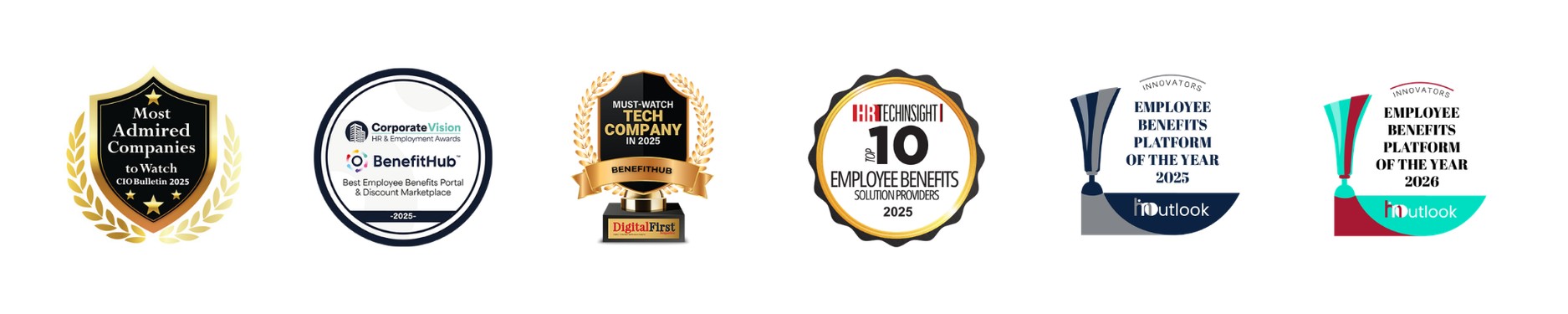
The recent recognition tracks the story: Corporate Vision named it Best Employee Benefits Portal & Discount Marketplace for 2025, Digital First Magazine tagged it a Must-Watch Tech Company, and HR Outlook handed it Employee Benefits Platform of the Year for both 2025 and 2026. None of that changes the underlying position, which is quieter and stronger than an award: BenefitHub is less a coupon site than a piece of infrastructure that a very large number of employers have decided not to build themselves.
The lesson in the BenefitHub story is not a slogan. It is a structure. Find the thing only the biggest companies can offer, aggregate it once, private-label it, and let everyone else rent it. Do that for 25 years without a down year, and eventually the flashy startups are chasing you.