The first time Pablo González sent Bitcoin to a friend, he felt something he would later describe as magic. He had spent years working with images, making unlikely things look convincing on a screen. Now a transfer of money was giving him the same feeling. There was no script to finish, no audience to persuade. The money had moved.
At the time, González was working in Canada. His creative work included the science fiction film Ender's Game, and his professional world ran through film, animation, advertising, and videogames. Technology was already part of his working vocabulary. Finance would require more study. A payment, however, was a fairly direct demonstration. You could spend an afternoon explaining a system, or you could send a friend some money.
That small experience led toward Bitso, the cryptocurrency company he co-founded with Ben Peters and Daniel Vogel. It also offers a useful way into González himself. His career keeps returning to the encounter between an elaborate idea and the person expected to use it. How much explanation should that person need? What makes them stay? What happens when they finally understand?
The apprenticeship before the exchange
González studied at Emily Carr University of Art and Design in Vancouver from 2003 to 2007, earning a Bachelor of Media Arts. His LinkedIn profile lists him as class valedictorian, president of the animation program's student body, and a teaching assistant in 3D animation. Before he was explaining digital money, he was learning how to make digital work legible to an audience.
His first attempt at a company was in animation and special effects in Canada. It proved difficult enough that he and his partner went back to work at a larger business to gain experience. The decision is a pleasingly practical detail in a founder's biography: sometimes the next move is another job. He later worked in an advertising business specializing in videogames, producing campaigns and trailers for clients including Warner Bros., Electronic Arts, and Microsoft.
His professional record includes a directorship at Goldtooth Creative from 2008 to 2013 and subsequent motion design work at Artifex. A contemporary conference biography describes more than a decade in entertainment, with responsibilities spanning direction and production. The skills were varied, but they belonged to the same trade: getting people to feel and understand something through an experience somebody had deliberately made.
Bitcoin arrived in that working life through Peters. González became absorbed in it and began teaching himself about finance. He was comfortable being a beginner. Curiosity, in this case, had a browser and a great many follow-up questions.
“You can learn a lot from Google.”
Pablo González, 2016
A way back to Mexico
There was a personal reason to look south. González had lived abroad for 15 years and wanted to return to Mexico to do something there. Bitcoin presented a technical possibility; Mexico supplied the purpose. He saw opportunities in remittances, international payments, and access to financial tools. An exchange could connect pesos with the digital currency and give other businesses infrastructure to build upon.
By his account, he and Peters spent six months working 16-hour days before opening the company. Bitso began operating in April 2014. In those early conversations, the vocabulary itself needed explaining. A prospective customer first had to understand what Bitcoin was, then why an exchange might help. Selling the service meant teaching the subject. Even a well-designed button has trouble competing with a question mark.
The early years tested more than their ability to explain. González later discussed losing savings, business losses, and difficulties working with banks in a conversation with Platzi. His lesson was about having greater control over the company's own future. It is easy to praise an open financial network; building a business that still depends on other institutions makes the argument rather more complicated.
He acknowledged that the team had considered giving up. They persisted partly because they could see the service helping someone. That is a more intimate measure than a funding announcement. It also helps explain why his account of Bitso returns so frequently to the customer at the other end of a transaction.
The mother at the end of the transfer
In a 2019 essay about design, González recalled seeing a customer use Bitso to send money from the United States to his mother in Mexico. The transaction confirmed the premise, while making the remaining awkwardness obvious. His response was to put more effort into design. Success had produced a useful complaint: this should be easier.
He described a progression from the original exchange to a mobile app and then Bitso Alpha, the trading platform launched in early 2019. Different audiences needed different experiences. Someone making a transfer and someone studying a trading screen might use the same underlying infrastructure while wanting very different things from it.
In 2018, he was already talking about the industry's difficult interfaces and the need to understand users through research. A recipient might collect pesos without knowing that cryptocurrency had been involved in moving the money. That possibility interested him. The technology could do its work without demanding that every beneficiary become an enthusiast.
Illustrative flow from González's remittance example. No price or speed claim.
This was a designer's way of approaching adoption. A system can be intellectually exciting and still make an ordinary task exhausting. González's interest in usefulness allowed him to talk about crypto without making the price chart the entire conversation. In a 2019 interview, he warned against approaching it as a shortcut to wealth and stressed the risks of speculation. Enthusiasm for a technology did not remove its volatility.
The numbers got bigger. The task stayed human.
As Bitso grew, González's titles changed. He was its founding CEO; by 2020, his conference biography identified him as co-founder, chief design officer, and chairman. Daniel Vogel was CEO. The distinction matters to the story because Bitso's growth involved a team whose responsibilities developed along with the company.
In May 2021, Bitso raised $250 million in a Series C round co-led by Coatue and Tiger Global, valuing the company at $2.2 billion. A venture financing figure attracts attention for good reason: it measures how much investors are willing to commit to a particular future. It also leaves much of the daily work offstage, including the years spent getting customers comfortable enough to try the product.
The company continued to expand. Its 2024 report described local operations in Argentina, Brazil, Colombia, and Mexico. A 2025 report counted more than nine million customers and more than 1,900 institutional clients. By September 2026, Bitso was reporting more than ten million retail users. Those are company milestones, and González's contribution belongs within that collective history.
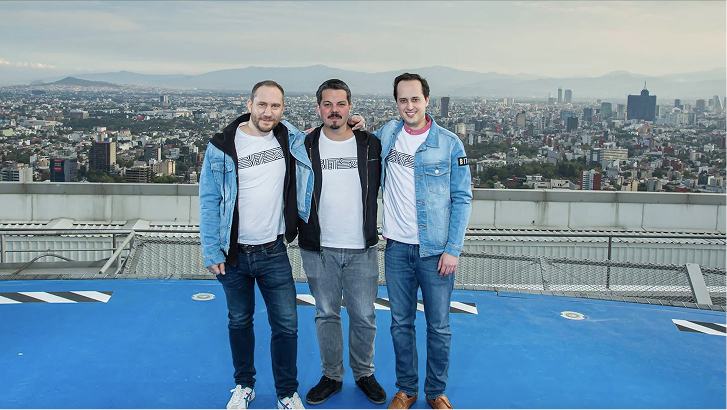
The scale changes the photograph: three founders on a rooftop, then millions of people using financial software. But the original design question survives the change in numbers. Can a person complete the task they came to do? Growth supplies more people to answer it.
Then came the drums
González's next public chapter returned him to a more familiar medium. After years at Bitso, he took a month to play drums in the jungle. He later recounted the episode with laughter. It is a much better career-transition image than a fresh set of business cards.
The project that followed was Los Dos Uno, a storytelling initiative and festival. Its November 30 to December 2, 2023 gathering in Tulum brought together film, music, theatre, cooking, and workshops. González described himself as its founder and curator. Earlier, smaller gatherings had tested the idea, including an event in Bali that combined spoken word, a documentary, and musicians making something together live.
The location was part of the work. A cinema could be placed beside the sea; a performance could happen in the jungle. The 2023 program was planned around experiences rather than a conventional sequence of bands. Meals and workshops could carry stories too. A chef, a filmmaker, and a musician had different materials, and González wanted them in the same conversation.
In his own announcement, he emphasized the community he hoped to assemble and the possibility of bringing creative people into closer contact with one another and with nature. This was an aspiration with a guest list and a program attached. He wanted participants to help make the experience, giving them a role beyond watching from a seat.
“It all starts with design.”
Pablo González, 2019
A different kind of gathering
His later public affiliations include HEARTHWORLD, which lists him as a founder, investor, and advisor and connects his work with culture, the arts, and environmental responsibility. The range is consistent with a career that began in media and never entirely left it. A financial interface and an outdoor performance ask different things of their makers, but both depend on how an unfamiliar person is welcomed into an experience.
That connection is a reading of his work, rather than a grand theory he has announced. The specifics are more persuasive anyway: the animation classroom, the videogame trailer, the transfer to a mother, the musicians improvising together. Each gives the audience something to do with the idea.
González wanted digital money to become usable enough for ordinary life. With Los Dos Uno, he turned toward occasions deliberately removed from the ordinary. Both projects required attention to the people arriving, their expectations, and what would happen next. After all the explanations, financing rounds, screens, and stages, that remains an engaging place to find him: working on the experience.
Keep the conversation going
Read his writing, watch an interview, or explore the projects.