The money could leave Canada without much ceremony. Collecting it in Guinea was another matter. Oumar Rafiou Barry could support his family from abroad, yet a relative might still have to travel for an hour to reach the agent holding the cash. A transaction had been completed somewhere. Someone else still had a journey to make.
Barry dates his encounter with that problem to 2011. He would go on to build a career in remittances, but the inconvenience has remained a useful measure of the work. A transfer has two ends. The person pressing send enjoys rather more attention than the person arranging transport to collect it.
Today, Barry is the co-founder and CEO of Cauridor, which connects international money transfer companies to African payment networks. The language around the business has grown more technical: interoperability, payment rails, last-mile distribution. The original question survives the vocabulary. How much effort does a family need to spend getting hold of money that already belongs to them?
His route into this business is unusually literal. Before working on the connections that carry money, Barry worked on the lines that carry electricity. He knows a few things about the distance between a well-drawn system and one that behaves itself outdoors.
A different kind of line problem
Originally from Guinea, Barry completed his engineering education in Canada. He earned a bachelor’s degree at Ryerson University in 2008, followed by a master’s in mechanical engineering there in 2010. In 2014, he completed a mechanical engineering doctorate at the University of Toronto.
Alongside those degrees came industrial experience. From 2008 to 2015, he worked as a design engineer at Hydro One. His work involved transmission lines and towers, including the troublesome effects of wind on suspended cables. An electricity network may look reassuringly still from a passing car. To an engineer responsible for vibration, it is a less peaceful sight.
Then came teaching: Central Michigan University from 2015 to 2018, followed by Virginia Tech. He became an associate professor in 2022. The sequence complicates any tidy account of an academic abandoning engineering to become an entrepreneur. His businesses developed during years that also contained research, teaching and technical work.
That overlap matters. The habit of asking how components behave together was already part of his professional life. Payments would give him another set of components, each with its own inconvenient rules.
A robot on the wire
In 2020, Barry received a National Science Foundation CAREER Award for a project investigating a self-powered autonomous robot for power lines. The proposed machine would help inspect cables and control their vibrations. Its development required understanding the interaction between a robot, a cable and the wind.
The idea came from problems he had encountered at Hydro One. Inspection by foot patrol or helicopter could be expensive and difficult; existing robots presented their own compromises in weight, power consumption and operating time. His research asked whether a machine could do more useful work while needing less outside power.
That is a demanding brief for anything expected to spend its working life hanging above the ground. It also explains why a grant funds investigation rather than a triumphant finished object. The relationships between the moving parts have to be understood before the invention earns its confidence.
In 2022, graduate students Andrew Choi and Jimmy Wang, working on the continuing project in Barry’s lab, placed second in the national EnergyTech University Prize competition. Their entry brought a business plan into the research. Even here, the journey between a technical idea and something usable had several stops.
Two founders, a long head start
Barry built the payments business with Abdoulaye Bah, now Cauridor’s chief technology officer. Their acquaintance began in tenth grade. They grew up in the same neighborhood in Guinea, moved to Canada around the same time and spent hours in a university library in 2010 reading business books and discussing ideas.
Their temperaments differ. Barry describes Bah as more cautious and himself as more outgoing and willing to take risks. The familiarity, he says, gives them confidence in each other’s commitments. There is a considerable amount of shared history behind the two titles on the company website.
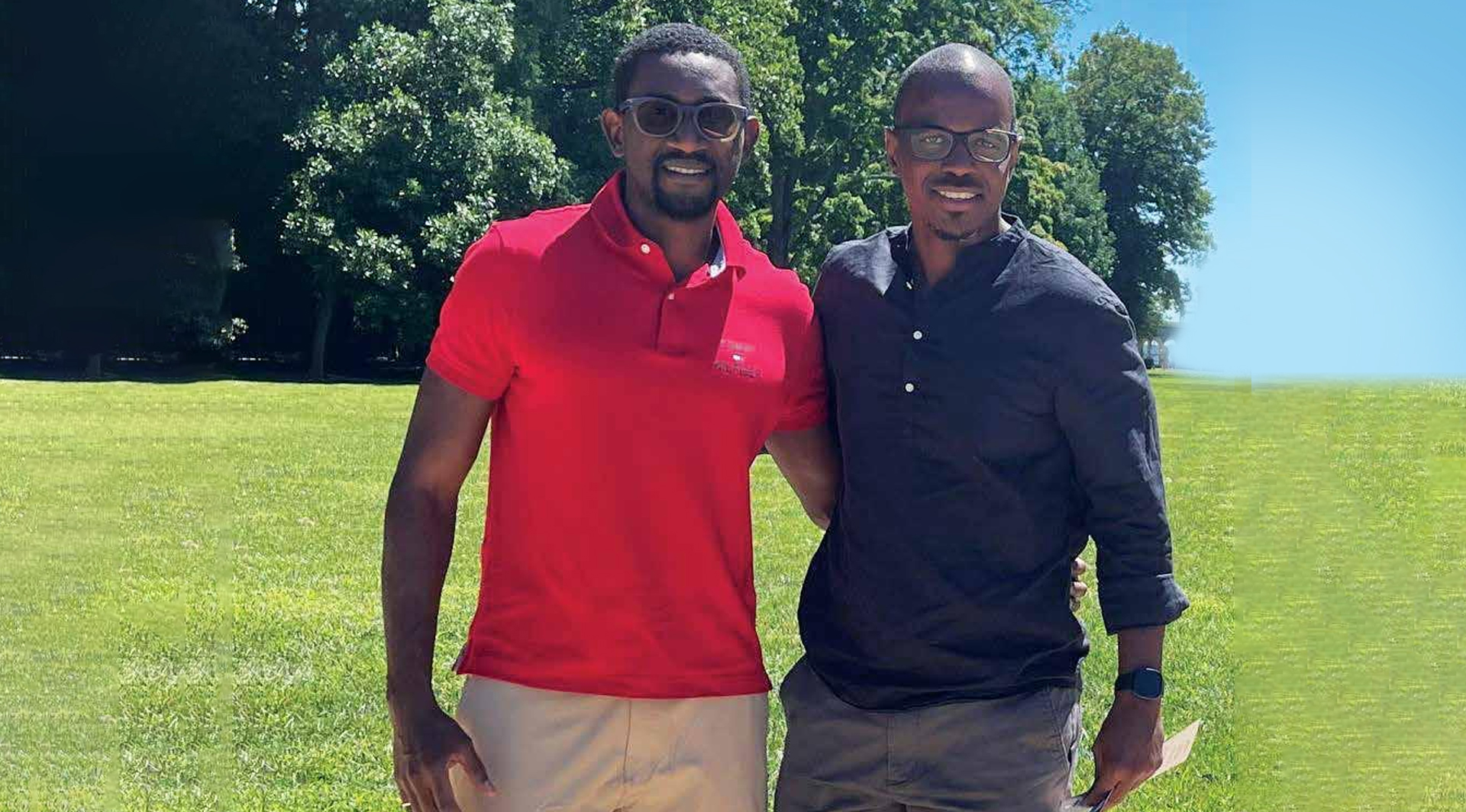
When asked what he would do if he were not building Cauridor, Barry’s answer was brief enough to fit on a business card.
“Probably still building, just tackling a different problem.”
Oumar Rafiou Barry
It is a useful answer from someone whose working life has already accommodated electricity infrastructure, university laboratories and money transfers. The subject changes. The willingness to take a system apart persists.
The app meets the plumbing
The business history starts before the Cauridor name. Barry founded EZ Money Transfer in 2011 and led it until 2013. BNB Transfer followed in 2014, serving Guineans sending money from Canada. Cauridor was spun out in 2022 to work on the infrastructure connecting the different payment channels.
The progression makes sense when followed from the recipient’s end. Offering a way to send money leaves a further task: arranging where and how it can be paid out. Banks, mobile money operators and cash agents already exist, but their existence does not guarantee that a transfer can move conveniently between them.
Cauridor’s answer was to connect those systems. By early 2025, the company said its payment rails business accounted for more than 90 percent of revenue. It reported $500 million in total payment volume for 2024. That figure measures money moving through the network, rather than money the business keeps.
Money processed through Cauridor’s network. Company-reported.
A $3.5 million seed financing round was disclosed in early 2025, with Oui Capital, Rally Cap, BKR Capital and angel investors participating. Barry had previously described being reluctant to raise outside money because the business was profitable. His account puts customers and operating revenue earlier in the story than the fundraising announcement.
It also gives the company’s age some necessary perspective. Cauridor dates to 2022. The practical education behind it had been accumulating for years.
Cash has a seat at this table
The network has room for bank transfers, mobile wallets and cash pickups. On its website in October 2026, Cauridor reported more than 40,000 agents and over 300 million connected mobile wallets. A connected wallet is a reachable payment destination; it does not mean that its owner is an active Cauridor customer.
The mix is revealing. A company working toward more digital payments still needs to deal with cash. Recipients have different accounts, different access and different preferences. A network gains usefulness by accommodating the route a person can actually use.
transfer operator
connects the networks
The MoneyGram relationship illustrates the gradual work involved. It began in 2016 with retail cash pickup in Guinea, Sierra Leone and Liberia. In February 2025, the partners announced an expanded integration for digital payouts to mobile wallets and bank accounts.
Barry emphasized the local support teams helping customers set up their wallets correctly. This is the part of financial technology that rarely makes a glamorous diagram: someone needs help, and someone else has to know how to provide it.
The company’s name carries an older monetary reference. Cauri refers to cowrie shells; d’or evokes gold in French. Currency has changed its appearance considerably. The need for a recipient to recognize and use its value has proved more durable.
A larger network, the same receiving end
In April 2026, Cauridor appointed Awa Koné as chief operating officer. She had spent more than five years at Flutterwave and previously worked at Swiss Re. The appointment came as Cauridor sought to deepen its existing markets and prepare for entry into the Democratic Republic of the Congo.
For Barry, expansion brings a different leadership task from starting a remittance service. A bigger network needs executives who can manage operations across borders. The founder’s knowledge of the original problem must be accompanied by people able to keep many versions of its solution working.
On May 11, 2026, Proparco announced a $2 million investment as part of Cauridor’s Series A financing, alongside participation from Flourish Ventures and LoftyInc Capital. That brought disclosed funding to date to $13 million. The announcement described a round still being completed, with a target of closing by the end of 2026.
The intended uses were specific: strengthen engineering, operations and commercial teams, and expand in West and Central Africa. Cauridor also received the Africa CEO Forum’s 2026 Disrupter of the Year award. Recognition had caught up with a business built around a fairly uncelebrated activity: making other people’s transfers work.
By August, its operating executives had completed a three-week tour of Senegal, Mali, Togo and Benin, holding 23 partner meetings. The itinerary supplies a practical picture of expansion. Connections have to be negotiated between organizations as well as written into software.
Expansion also changes what a founder has to notice. The early business could begin with a familiar corridor and a family’s experience. A regional network introduces more organizations, more receiving channels and more opportunities for a small problem to interrupt a transfer. The original inconvenience remains a useful test of whether the added complexity is doing its job.
Barry’s career offers several measures of progress: degrees, a research award, companies founded, money processed. The opening measure remains the most understandable. Someone has sent money home. How far does the person receiving it still have to go?