A friend of Ori Faran had a mortgage that seemed to be taking care of itself. Payments left the bank account automatically. The arrangement worked for ten years. Then the authorization expired. In year eleven, the friend discovered a missed payment through a credit-monitoring service. A routine that had required no thought suddenly demanded considerable attention.
Faran recounted the episode in 2024 while arguing for proactive customer care. The friend had liked his bank and recommended it to others. A process buried inside that relationship had quietly changed, leaving the customer to discover the consequences. Faran’s point was practical: an organization can anticipate a problem and help someone act before the problem becomes a complaint.
It is a useful way into his career. Faran works on the unglamorous stretch between wanting something done and getting it done. A payment. A document. A question about an account. These are small errands with a remarkable talent for acquiring departments. His company, Callvu, has spent years trying to shorten their itineraries.
A screen hiding in plain sight
Faran originally trained as an electrical engineer. He later described discovering that he enjoyed the business side of work, with customer service becoming a particular interest. Before Callvu, his career included engineering and professional-services work at Cosmocom and Enghouse Interactive. He knew the machinery behind the recorded voice that answers before a person does.
In a 2024 conversation with Jordi Torras, he returned to the observation behind the business: phones were acquiring larger screens. A customer calling a company was holding a display, yet the interaction could still proceed as an audio menu. The device offered another way to explain a choice. Why leave the screen unemployed?
There is a design choice in that observation. The customer has already chosen to make a call. Visual help can meet that person during the call instead of requiring a separate expedition through a website. The useful question becomes where the explanation belongs. On a screen, several choices can stay visible while someone decides.
Callvu began in 2012, with Faran, Doron Rotsztein and Roee Halfon as co-founders. Its early proposition joined a telephone conversation to information a caller could see. Instructions and pictures could arrive on the smartphone while assistance continued. The familiar call gained a visual companion; the customer gained something more dependable than remembering the third option in a spoken list.
An unusually large credit card
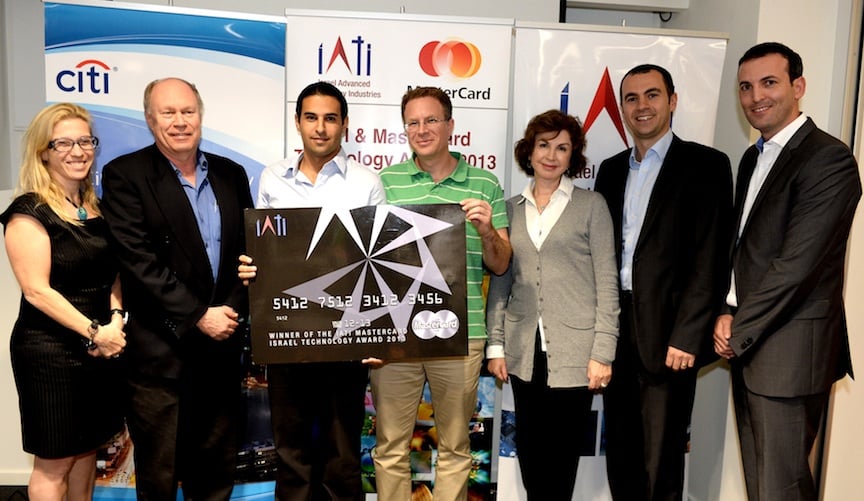
By late 2013, that idea had earned Callvu the MasterCard Israel Technology Award. The company received a $25,000 prize and entry into Citi’s financial-technology accelerator in Tel Aviv. It had competed against more than 45 startups. For a young business working on service calls, payment-industry attention opened a useful door.
The award photograph has the happy absurdity of startup ceremonies: seven people, several institutional banners, and a credit card large enough to require its own luggage allowance. Faran stands third from the left, beside fellow co-founder Rotsztein. The picture records a specific early achievement, before the subsequent funding rounds and broader product vocabulary.
What had caught attention was easy to explain. A person asking for help could hear an answer and see it. There was no need for a grand theory of human behavior to appreciate the convenience. Anyone who has tried to follow spoken instructions while staring at an unrelated screen can supply the demonstration.
Three friends, fewer instructions
Faran’s account of building the business contains a quieter success. In a 2018 interview, he said he had started Callvu with two friends and that they remained friends while working together. The founding relationship had survived the transition from an idea to an operating company. He credited the people around him when asked about his own success.
His stated management preference fits that answer. Set a goal, then allow managers to decide how to reach it. That gives colleagues room to exercise the judgment for which they were hired. Asked for the best advice he had received, he offered seven words: “Listening is more powerful than speaking.”
Those words make a particularly apt motto for someone selling improvements to telephone service. They also suggest a useful reading of his professional interests. The customer has something to accomplish; the manager has something to accomplish. In both cases, extra instructions can become an obstacle. Faran’s public account of leadership favors clear purposes and room to act.
“Listening is more powerful than speaking.”
Ori Faran · on the best advice he received, 2018
The experiment reaches a Romanian bank
Banca Transilvania gives that philosophy an observable setting. The bank began working with Callvu in 2019, introducing BT Visual Help that year and BT Visual Call Center in 2022. The collaboration joined the bank’s service operation to visual tools customers could use themselves. It developed over years, rather than arriving as one theatrical switch.
In July 2024, the bank reported that customers handled more than half of Contact Center & Customer Care requests through the interactive self-service systems. Almost three million visual sessions had been initiated during the first six months of the year. Those figures describe this bank’s implementation during a defined period, rather than a promise about every Callvu customer.
The tasks were ordinary and consequential: obtaining an account statement, checking information, changing a card limit or blocking a card. Human help remained accessible by phone or live chat. A visual session could lead to an answer, an action or a colleague. Faran welcomed the uptake as evidence that efficient service mattered to loyalty.
Oana Ilaș, the bank’s deputy CEO for retail banking, described a gradual start with standard information, including balances and transactions. In a separate July 2024 account, the bank reported that more than 200,000 statements had been obtained directly through BT Visual Help. A document arriving without a conversation is a small event. Repeat it at that scale and a service operation begins to look different.
visual sessions initiated by Banca Transilvania customers
A company outgrows the call
As the business expanded, its tools moved beyond the original telephone setting. In August 2021, under the trading name FICX, the company announced an $8 million Series B round. NAventures, National Bank of Canada’s corporate venture arm, and Prytek were lead investors; Liberty Global Ventures also participated.
The funding announcement described a platform for building customer workflows without writing code. Those workflows could appear on websites, in apps and chat, through contact centers, or in stores. The same announcement identified Michael Oiknine as FICX’s CEO. Today, Callvu’s own management page names Faran chief executive and co-founder, with Oiknine CEO for North America.
The 2021 platform also connected those customer-facing workflows to existing enterprise technology through connectors and APIs. A completed form could become information a business could use. For Faran’s wider story, the expansion matters because it keeps the focus on finishing the errand. Showing the customer a choice is an opening step; carrying the result through the organization is part of the same job.
The changing name and expanding remit trace a business moving into a broader problem: helping a customer complete a process across existing systems. That involves more than making an attractive screen. Information has to reach the organization’s records and the next step has to work. A tidy front door is welcome; someone still has to organize the rooms behind it.
The doctorate, and the impatient guest
In 2023, Faran earned a doctorate in Management and Business Administration from the Swiss Management Center, formerly SMC University. Callvu describes his specialization as customer engagement. His earlier education includes a bachelor’s degree at Bar-Ilan University and an MBA at Tel Aviv University. His career has carried an engineering problem into the study of how organizations serve people.
His writing shows how widely he applies that question. In a February 2024 essay about hospitality, he considered a tension familiar to hotels: attentive service matters, while many guests prefer completing simple tasks independently. A business traveler retrieving a folio for expenses may value a quick digital route. Another guest may need an employee’s time and judgment.
That is a useful distinction for understanding Faran’s work. A service experience can include both personal attention and an efficient way to avoid needing it. Screen-sharing and easier access to customer information can support employees, while self-service can handle a routine request. The hotel does not have to greet every administrative task with a conversation. Sometimes the considerate gesture is to hand over the receipt.
Give the customer back the afternoon
Artificial intelligence adds another set of choices. In his conversation with Torras, Faran discussed combining conventional selections with AI, removing irrelevant form questions and filling information automatically where possible. He emphasized accuracy and reliability alongside adoption. The ambition remained recognizable from the early visual call: use what the technology can do to reduce what the customer must do.
His 2024 essays repeatedly returned to that test. He wrote about making people comfortable with AI in customer service, asked whether customers wanted a company’s chatbot, and later addressed effortlessness. These are questions about reception and usefulness. A tool earns its place through the experience someone has while trying to finish a task.
There is continuity here without much ceremony. Faran began among the systems that make callers wait, co-founded a company to put the screen to work, and kept broadening the ways a task could be completed. The friends, the bank deployments and the doctorate belong to the same professional story. So does the mortgage anecdote: a reminder that a functioning system can still surprise the person who depends on it.
His original observation remains agreeably modest. The caller already has a screen. Use it well. Then let the caller get on with the afternoon.