A city can run short of water while perfectly good water escapes beneath its streets. That is an awkward place to begin a story about progress. Before anyone builds another reservoir, there is a more pedestrian question: where is the water already in the system going?
In Campinas, Brazil, that question brought together Microsoft, the local utility SANASA and Orbia’s building infrastructure business, Wavin. Their project uses flow meters, pressure sensors and software to help find losses. The interesting part is the combination: a technology company with a water commitment, a utility with pipes to manage and an industrial supplier that understands what happens underground.
- Five businesses, one practical theme: moving water, information and essential materials.
- Customers buy outcomes: irrigated crops, functioning networks and dependable industrial inputs.
- The constraint is execution: instruments need operators, and growth plans need paying demand.
The water was already there
Orbia announced the Microsoft collaboration in September 2024. The Campinas work operates under a ten-year agreement. Wavin’s Water Network Management service combines TaKaDu’s cloud analytics with a São Paulo control room staffed by water engineers. They monitor patterns that can reveal leaks, bursts, faulty equipment and telemetry problems, helping SANASA decide where to intervene.
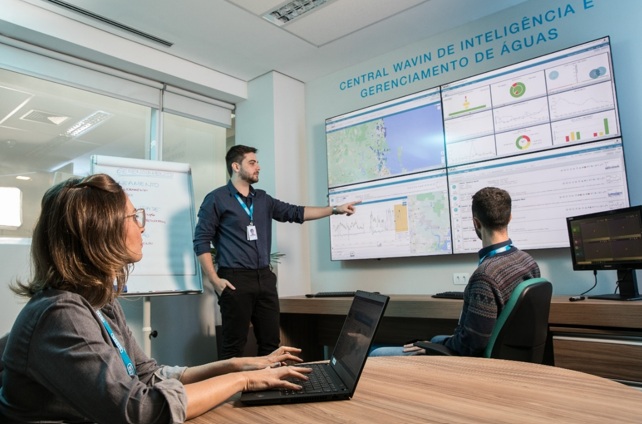
For July 2024 through June 2025, Orbia reported more than 370,000 cubic meters of volumetric water benefit. Its second-year target was 622,000; its longer-term ambition exceeded 2.5 million annually. Those last two numbers are targets. Keeping them separate from the measured first year is essential to understanding the project.
The practical lesson follows from the machinery: detection has to end in action. Sensors can identify a suspicious pattern; somebody still has to investigate and repair the pipe. For a utility considering the approach, reliable instrumentation, repair crews and sustained operating funds belong in the same conversation as the software.
A company assembled around the bottleneck
Orbia began far from cloud dashboards. In 1953, Mexican and American investors founded Cables Mexicanos to supply steel wire ropes. Its later history is a sequence of acquisitions and changes in direction: chemicals, polymers, water systems, connectivity and irrigation. The group previously known as Mexichem adopted the Orbia name in 2019.
The purchases made the strategy tangible. Wavin arrived in 2012. Dura-Line followed in 2014 for $630 million. In 2018, Mexichem completed its purchase of 80% of Netafim. The deal valued Netafim at $1.895 billion; the transaction proposal estimated roughly $1.5 billion for the acquired shares and associated loans. These capabilities came with substantial price tags.
Today, five business groups connect the portfolio. Vestolit and Alphagary make polymer resins and compounds. Wavin supplies building and water infrastructure. Netafim handles precision agriculture. Dura-Line makes pathways for communications networks. Fluor & Energy Materials supplies fluorine-based products for applications including refrigeration, medicine and batteries.
Polymer compoundsMaterials for pipes, cables and devices
Driplines + controlsWater and nutrients delivered to crops
Conduit + microductsProtected pathways for fiber networks
Some connections are literal: Polymer Solutions supplies Orbia’s downstream businesses as well as outside customers. Others are commercial. A farmer, a broadband contractor and an inhaler manufacturer need different expertise, but each depends on a physical system working reliably. Orbia’s market position rests on materials knowledge, manufacturing and application support across those systems.
The customer is buying Tuesday morning
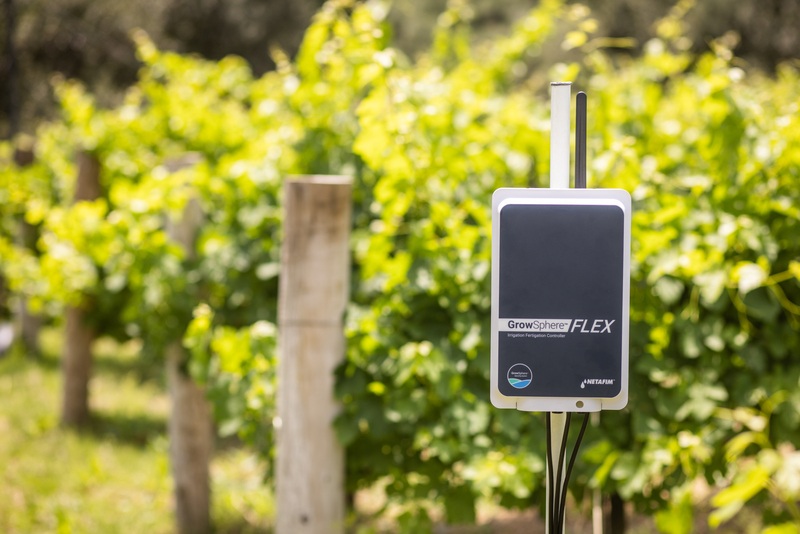
Consider irrigation. A grower needs to decide what a particular crop needs in particular soil under changing weather. Netafim supplies drippers, filters, valves, design and agronomic support. GrowSphere adds digital control of irrigation and fertigation, connecting sensors, controllers, cloud tools and the person making decisions.
In August 2026, Netafim introduced GrowSphere FLEX for smallholders and mid-sized farmers. The company said the broader GrowSphere portfolio already served thousands of users across more than 100,000 hectares. FLEX extends that product family through a phased rollout. Its appeal is practical control: monitoring field conditions and managing water and nutrients remotely.
Netafim competes with irrigation specialists including Rivulis, Jain Irrigation, Irritec and Toro. Orbia’s breadth is distinctive, but breadth alone does not settle a purchasing decision. Farmers still need appropriate system design, support and workable economics. Telecom operators need installation performance. Utilities need repairs they can execute. Each business earns its place locally.
The business model reflects that variety. Orbia sells materials, components and engineered systems to businesses and institutions, alongside project and technical services. It is a manufacturer with digital capabilities and specialist support. A customer generally approaches the relevant operating business rather than buying a single, all-purpose Orbia product.
Ambition has a capital budget
The limits became visible in 2024. Orbia paused a PVC capacity expansion, then announced an extension of up to two years for investment in its PVDF battery-materials joint venture. In August, it cut planned annual capital spending to $525 million for 2024 and $450 million for each of 2025 and 2026, citing challenging markets and balance-sheet discipline.
That sequence matters. Long-term needs do not guarantee immediate orders. Construction cycles and investment timing can interrupt an industrial growth plan before its underlying application disappears. The revised budgets show management responding to those conditions. They also show why a compelling end market cannot justify every project on its original schedule.
“To advance life around the world.”
Orbia’s stated purpose
In 2025, Orbia reported $7.619 billion in sales, $405 million in capital expenditure and a $359 million consolidated net loss. Revenue scale and shareholder profitability tell different stories. More recently, its July 2026 release reported second-quarter revenue of $2.352 billion and EBITDA of $467 million, both higher year on year.
Orbia’s stated values include responsibility, bravery and diversity. A useful way to judge that language is through observable work: the company reported over $70 million in 2025 research and development spending and 90% of manufacturing sites achieving zero waste to landfill. Its most instructive habit remains simpler: locate the loss, connect the tools to people who can act, and measure what actually changes.