The germ of Orange Biomed was not a gadget. It was a traffic problem happening at microscopic scale. Red blood cells are soft enough to bend through vessels narrower than themselves. As hemoglobin becomes glycated - the slow sugar-binding process reflected in an A1C score - the cells become stiffer. Unghyeon Ko, then a Duke University researcher in cell mechanics, wondered whether those physical changes could be measured fast enough to tell a person something useful about diabetes.
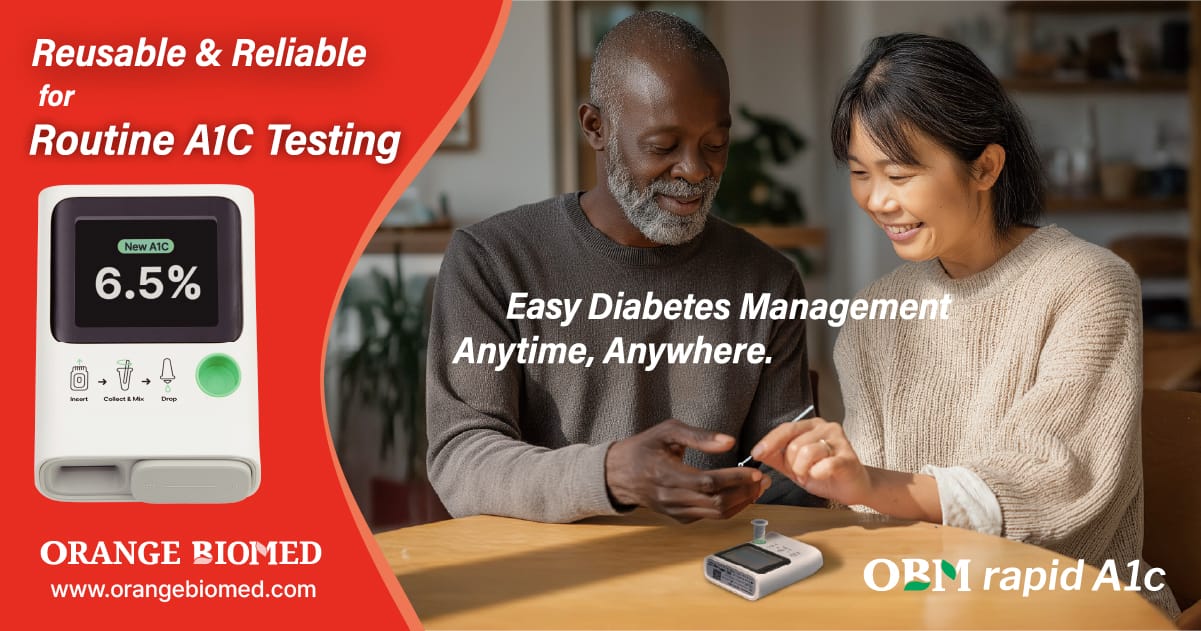
The conventional move would have been to miniaturize the chemistry already used in laboratories. Ko and business-school classmate Yeaseul Park took the stranger route. Their team built tiny channels that mimic capillaries, pushed hundreds and later thousands of cells through them, and used the cells' movement to estimate A1C. Orange Biomed was incorporated in 2021. Its flagship device, OBM rapid A1c, is now a 0.2-pound reader intended to produce a result in five minutes from 5 microliters of finger-stick blood.
A failed test became the brief
Park once ordered a mail-in blood test to understand the alternative. It required about 300 microliters. She could not collect enough blood to finish it. The failure was mundane and therefore valuable: the customer could understand the instructions and still lose. Orange Biomed's answer was not a better envelope. It was a test that asks for one drop and keeps the sample in the room.
That experience also clarified the market. Park has contrasted an A1C test costing less than $8 in South Korea with a bill that can reach $200 for an uninsured person in the United States. Orange Biomed chose the U.S. not because “global expansion” looked good on a slide, but because the access problem was unusually visible. Its intended users include people monitoring diabetes or prediabetes at home, their families, small clinics, pharmacies and public-health centers that do not own a central-lab analyzer.
“Our focus was to create a guided device that makes it as simple as possible for older age groups.”
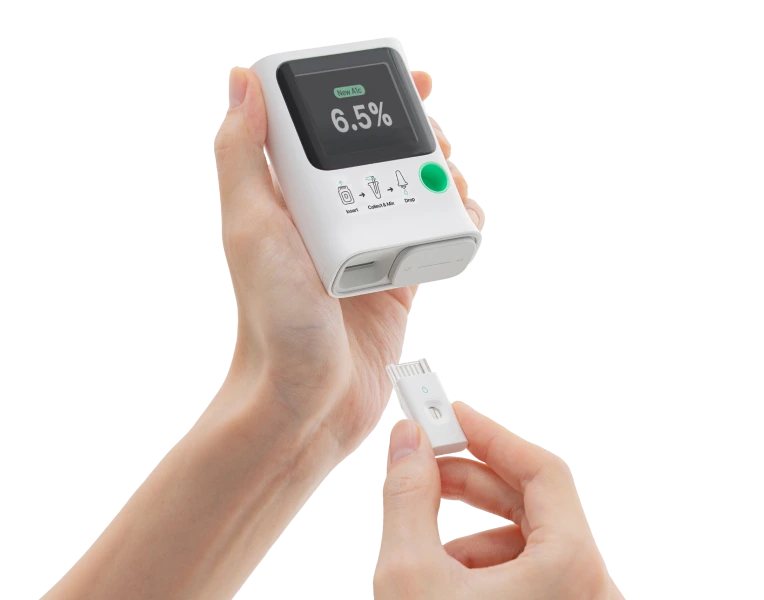
The team originally considered smartphone functions and extra information. Then it removed them. More features made the device harder to use, particularly for older adults. The resulting meter has essentially one power button and a guided sequence: insert the cartridge, collect and dilute the blood, add the drop, wait. Its choreography borrows from two objects people already know - the blood glucose meter and the COVID self-test. The core science is unfamiliar; the behavior is deliberately boring.
What it changes - and what it does not
A1C is different from the glucose number on a continuous monitor or finger-stick meter. Glucose is a snapshot. A1C reflects longer-term exposure, which is why clinicians commonly use it to diagnose diabetes and monitor treatment. Orange Biomed is not trying to replace daily glucose tracking. It is trying to make the slower-moving score easier to check without scheduling a lab visit.
The physical method creates several claimed advantages. With no antibody or other protein reagent in the cartridge, the test does not need cold storage and can sit at room temperature for 24 months. The reader is designed not to require recalibration. The company also says measuring cell mechanics avoids interference from hemoglobin variants that can distort some conventional A1C methods, an issue with consequences for patients of African, Asian and Mediterranean ancestry.
Those claims deserve the right amount of skepticism. Orange Biomed publishes preliminary internal performance showing a coefficient of variation below 2 percent and a strong correlation with a standard comparator. It has worked with Seoul Asan Medical Center and presented research at diabetes and laboratory-medicine conferences. But preliminary data, conference demonstrations and awards are not the same as a cleared consumer device tested across messy real homes. Broad U.S. availability depends on regulatory review, clinical validation and reliable production.
The meter is cheap only in theory - for now
Orange Biomed has said its prototype could approach HPLC-grade accuracy at a fraction of the capital cost. The comparison is seductive: a hospital HPLC analyzer can cost more than $75,000, while smaller benchtop devices can run above $3,000. Yet there is no public retail price for OBM rapid A1c. The company's comparison pages mark its meter and disposable pricing “TBA,” and the shop currently behaves as a waitlist.
The intended model is easy to read. A household buys a reusable meter, then an annual pack of four disposable tests. A professional buyer gets a meter and purchases kits in packs of 20. It is the familiar razor-and-blades structure, except the blades are regulated diagnostic cartridges. That can produce recurring revenue, but only if the installed meter remains accurate, the cartridges manufacture consistently and payers or consumers accept the price.
Funding has bought Orange Biomed time to answer those questions. The company reported more than KRW 3 billion across seed and Pre-A financing by 2022, then raised roughly KRW 3 billion in a December 2024 Series A1 round. By August 2025, it said cumulative investment had reached KRW 10.1 billion. It has earned ISO 9001 certification, a Korean Hospital Association innovation award and, in 2025, global GMP certification intended to support scaled production. None substitutes for sales, but each removes a different reason a medical device can die.
The conditions where this does not work
The play breaks if independent trials cannot reproduce the accuracy claims, if the algorithm drifts across patient groups, if manufacturing variation clogs the microchannels, if regulation delays launch, or if the final cartridge price is too high for routine use. It also will not replace real-time glucose monitoring: A1C answers a different clinical question.
A five-person founding team with a narrow first shot
Orange Biomed's founding roster looks built for the unphotogenic middle of medtech. Park runs the company and business. Ko, a mechanical engineer and former Duke postdoctoral researcher, leads technology. Eunyoung Park runs research and clinical work. Seungjin Kang brings device development, firmware and mechanical engineering. Luke Jo oversees U.S. operations after experience around American medical institutions. The broader team adds semiconductor manufacturing and quality expertise.

The platform could theoretically travel farther. Ko has discussed complete blood counts, circulating tumor-cell detection and even filtration applications. Resisting that menu may be as important as inventing it. The near-term company is not a universal blood laboratory. It is an A1C company pursuing two regulatory paths - an over-the-counter home system and a professional point-of-care product - with the public goal of U.S. clearance in 2026.
Around the device, Orange Biomed has begun building a market before it can ship at scale. It demonstrated at ADA, the Diabetes Technology Meeting, MEDICA and CES. Its M.A.P. Your Health campaign convened more than 18 health and community organizations for a Chicago event in 2025. That work is partly mission, partly education and partly distribution research. A diagnostic is more useful when people know why and when to take it.
The bit worth stealing
Orange Biomed's best lessons are not “start a microfluidics company.” They are choices a less scientific business can copy. The company found a new signal before polishing the interface, watched a founder fail as a customer, chose a geography where the pain was measurable and removed features until the behavior felt familiar.
- Change the measured variable. If every competitor is shrinking the same chemistry, look for a physical proxy with better operating constraints.
- Turn failure into a number. “Mail-in is hard” became 300 microliters versus 5. A sharp metric makes a sharper product brief.
- Keep the novelty in one place. Orange Biomed put novelty in the sensor and familiarity in the user flow.
- Design logistics with the product. Room-temperature storage and shelf life matter as much as a clever demo when clinics are far away.
- Name the gate. The next win is not another award. It is reproducible evidence, clearance, scaled manufacturing and a price people will pay.
The wager is now plain. If red-cell mechanics can survive independent scrutiny and factory repetition, Orange Biomed may have found a useful place between the central lab, the mailer and the disposable home kit. If it cannot, the five-minute demo remains a smart piece of science. Medical hardware is rude that way: the invention gets you into the race; evidence, operations and economics decide whether you finish.