The striking thing about Yeaseul Park's company may be the mismatch in scale. Orange Biomed is working to compress an elaborate laboratory process into an object small enough for a hand. Yet every inch removed from the machine seems to add another mile to the founder's route: research, patents, clinical studies, manufacturing, fundraising, regulation, and the delicate matter of persuading people that simple-looking hardware can be serious hardware.
Park lives in Durham, North Carolina, but her operating map reaches from the United States to South Korea. She is the co-founder and CEO, the person charged with turning a technical proposition into a company that can cross those borders. The title sounds neat. The work is a crowded desk where science, capital, institutions, and human behavior keep borrowing one another's pens.
Chapter one
A useful collision at Duke
The story starts in 2019. Park arrived at Duke University's Fuqua School of Business for an MBA, studying finance alongside management science and technology management. On the same campus, Unghyeon Ko was doing postdoctoral work in biomedical engineering. Their meeting paired two different kinds of fluency: Ko understood the mechanics of microfluidics and single-cell analysis; Park understood how technology might be financed, positioned, and carried into a market.
That pairing mattered more in 2020, when ordinary in-person routines became difficult. The pair focused on a familiar measurement that was still tethered to professional settings and asked whether the center of gravity could move. Their answer was Orange Biomed, created in 2021 with a wider founding team. Its proposed device would analyze individual red blood cells through a microfluidic channel and deliver a result in about five minutes.
The founding anecdote is tidy only in retrospect. Campus meeting, global disruption, company. But it contains a useful piece of founder arithmetic: a painful constraint plus complementary skills can produce a specific question. Park did not need to become the engineer in the room. She needed to make the engineering legible to every other room.
“Taking any health tech innovation to market requires building and leveraging a global multi-player ecosystem.”Yeaseul Park, speaking about the work around the product
The object
Small enough to misunderstand
Compact hardware invites a charming illusion: if the object is small, perhaps the job is small too. Orange Biomed's work argues the reverse. A device designed for ordinary settings must absorb duties once distributed across equipment, trained operators, maintenance schedules, and controlled environments. Ease at the surface requires rigor underneath. The product must conceal complexity without concealing evidence.
By 2022, the company said it had completed a portable prototype. The following years brought patent filings and registrations, clinical research with Asan Medical Center, appearances at industry gatherings, and conversations with institutions in the United States. Each item addressed a different doubt. Can the mechanism work? Can it be protected? Can it perform consistently? Can a company make and distribute it? Will the relevant gatekeepers allow it into the market?
Park's public language stays anchored to accessibility and affordability. Those words can become conference wallpaper, but the company's design choices give them a physical shape: a minimal sample, a guided process, portable hardware, no protein reagents, and less dependence on laboratory infrastructure. The proposed convenience is designed, not sprinkled on at the end.
The operator
Translation as a company function
Park's route to the CEO seat includes Yonsei University, startup competitions, the Duke MBA, and a stint on FuturePlay's strategy planning team. Her public career profile describes a broad brief at Orange Biomed: fundraising, recruiting, business development, and management strategy. This is the sort of list that appears banal until one remembers that every line contains a different professional language.
An investor asks about market size and risk. A research partner asks about methods and evidence. A prospective hire asks whether the company can become a career rather than an experiment. A regulator asks for documentation. A future customer wants the thing to be clear. Park's function is partly to keep those conversations from becoming separate companies.
The cross-border operator's five clocks
- The research clock moves when evidence is ready.
- The regulatory clock moves when documentation is complete.
- The capital clock moves before the runway disappears.
- The market clock moves when need and timing finally meet.
- The team clock moves every morning, regardless of the other four.
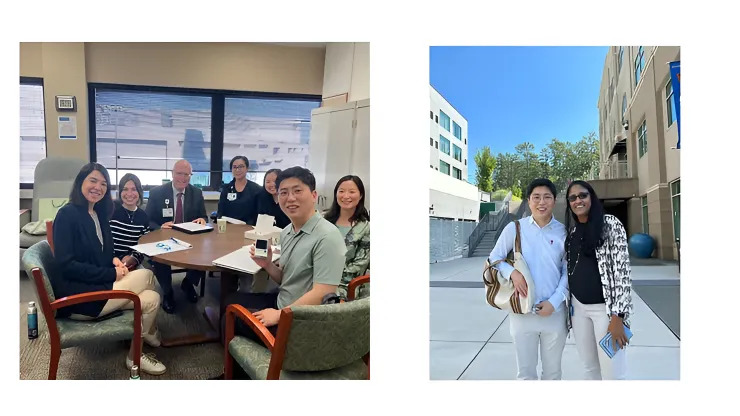
Her connection to Duke also outlasted graduation. A classmate's 2021 photograph catches Park in cap and gown with a group holding a Duke banner, a pleasingly ordinary souvenir from a period that would soon be described through company milestones. Park and Ko later met Duke professor Shyni Varghese again during a U.S. tour. Networks are often discussed as nouns. In a young company they are verbs: people introduce, advise, test, question, and open doors.
Proof, slowly
The milestones do not arrive in order
Recognition came before commercialization. Forbes Korea included Park in its 2023 30 Under 30 Social Impact list. Orange Biomed received the Korean Hospital Association's KHF Innovation Award in September 2024. In December, the company announced a Series A1 round of roughly KRW 3 billion, taking reported cumulative investment above KRW 8 billion at the time. In 2025, Fortune Korea included Orange Biomed among 40 emerging South Korean healthcare innovations.
Awards are bright punctuation; regulatory hardware is mostly paragraphs. Park has continued to present the company at gatherings including MEDICA, CES, the Diabetes Technology Meeting, and American Diabetes Association events. Orange Biomed has also hosted public campaign programming and built relationships with community organizations. Such appearances do more than decorate a press page. They let a small company discover which explanation survives contact with different audiences.
The 2024 financing bought the company more of the resource that hardware consumes with astonishing appetite: time. Funds were earmarked for commercialization and U.S. regulatory preparation. Public statements later described 2026 as the target year for U.S. clearance work. A target is not a result, but it reveals the operating horizon. Park is playing a game measured in submissions, studies, and manufacturing readiness, while the public measures startups in announcements.
“I hope that the portable HbA1c monitor, our first product, will form a successful foundation in the market.”Yeaseul Park on the ambition beyond one device
What builders can steal
Make one sentence travel
The transferable lesson in Park's story is not a microfluidic trick. It is the discipline of carrying one clear proposition through wildly different settings. The wording may change, but the center holds: take a complicated measurement and make it easier to access. That thought can guide an engineering tradeoff, a partnership meeting, a funding pitch, a conference talk, or the sequence on a tiny screen.
Founders working across disciplines often lose energy translating the company afresh for every audience. Park's public case suggests a better method. Keep the mission stable and let the evidence accumulate around it. One room cares about cost. Another cares about accuracy. Another cares about usability. The founder's job is to show how those are views of the same object.
There is also a quieter lesson in her timeline. Park had been entering startup competitions years before Orange Biomed. She won first prize at a Global Startup Weekend in 2015 and received recognition in a Yonsei competition in 2014. She volunteered as an academic tutor and mentor for a decade. These details do not prove a personality, but they show repeated practice in explaining, organizing, and staying with work long enough for it to become useful.
The long middle
A household object must first survive the institution
Orange Biomed still sits in the demanding distance between prototype and ordinary use. That middle can be awkward for storytelling. The founding spark has passed. The finished product has not yet become a familiar object. What remains is evidence, systems, and patience. Park's task is to keep a team and its partners moving while refusing the temptation to treat anticipation as completion.
That restraint is especially important in medical devices, where trust cannot be improvised. The company must earn permission from institutions before it can ask for a place in anyone's routine. In this business, credibility is a product feature with a very long manufacturing cycle.
The image at the center of Park's work remains appealingly modest: a small device, guided steps, a quick result. Its modesty is the achievement being attempted. The technology should feel less like a laboratory has entered the room and more like the room has acquired one useful object. If Orange Biomed succeeds, the complexity will still exist. Park and her team will simply have carried it out of sight, where good systems tend to live.