A pair of scissors is an unlikely place to begin a story about an artificial intelligence company. It is also a useful place to begin with Xin Xie. In his early engineering research, the familiar opening-and-closing geometry became a mechanism small enough to belong in a microfabricated device. A slight movement in one direction could become a larger movement in another. The trick was in the arrangement.
Years later, Xie would become cofounder and CEO of Xellar Biosystems, bringing experimental hardware, automation and computational analysis into the same business. The vocabulary had grown considerably. Yet those earlier devices offer a pleasingly concrete introduction to his work. Before the company presentations and financing announcements, there were hinges. A hinge has the advantage of being fairly immune to a good sales pitch. It either moves as intended or requires another afternoon.
A doctorate measured in movement
Xie studied electrical engineering at Shanghai Jiao Tong University from 2006 to 2010. His subsequent education took him to the United States, and in 2017 he earned his doctorate in electrical engineering at Northeastern University. Carol Livermore was his adviser. The subject of his dissertation was high-performance micro actuators for tactile displays: devices designed to communicate information through physical movement.
That description carries an engaging reversal. We usually ask a display to show us something. Xie's research concerned arrangements that could make information physically perceptible. It required electrical engineering to cooperate with mechanics, materials and fabrication. The device had to occupy little space while still producing useful displacement and force. A beautiful drawing could propose the answer; manufacturing and measurement would decide whether it survived.
In December 2015, Xie and fellow Northeastern doctoral student Chenye Yang gave oral presentations on actuator research at PowerMEMS in Boston. It was an early public marker of a career being built through working mechanisms. The conference title concerned power generation, energy conversion and microsystems. Xie's contribution sat at the small, tangible end of that world, where the movement itself was the result to be demonstrated.
His dissertation followed several generations of designs. There were changes in hinge construction, geometry and assembly. That progression is more revealing than a single triumphant prototype. It shows the work between an idea and a usable object: keep the useful principle, find where the construction gets awkward, and return with a different way to build it. Even at a miniature scale, engineering contains quite a lot of rearranging the furniture.
- 2017The doctorateElectrical engineering, Northeastern
- 2018The folded structurePostdoctoral research, ApreX team
- 2021 / 22The companyXellar founded; CEO role begins
The hinge earns its place
A 2016 paper by Xie and Livermore examined a pivot-hinged motion amplifier made with multiple layers of SU-8, a material used in microfabrication. An actuator moved within a plane; the attached mechanism translated that motion out of the plane and amplified it. A self-aligned assembly approach addressed a fabrication difficulty in producing the layered structure. The construction method belonged to the invention as much as the finished shape.
This is a useful detail for understanding the engineer who later became a founder. A mechanism has to do its job, but somebody must also be able to make it. Assembly is where promising designs can acquire unfortunate personalities. Xie's paper put the method of building the thing directly in its title. The practical inconvenience was part of the scientific question.
The work also invites a less theatrical reading of innovation. A change in how two parts meet can matter as much as a wholly unfamiliar component. The scissors were recognizable. The scale, hinges and fabrication were where the difficult work lived. Following Xie's early papers means paying attention to those interfaces, rather than waiting for a single moment when everything suddenly became futuristic.
Then came the fold
By February 2018, Xie was a postdoctoral researcher in Livermore's laboratory and part of the research team behind ApreX Biotech, a Northeastern spinoff. That team also included Yu Shrike Zhang and biomedical engineer Rui Sun. Its approach used origami to turn patterned, two-dimensional surfaces into three-dimensional structures. Folding supplied an alternative route through a manufacturing problem.
The collaboration included insights from origami artist Robert Lang. Northeastern's IDEA accelerator and Alpha Fund provided support for the spinoff. Here was a notably varied cast: university researchers, an artist with expertise in folding, and organizations helping research find a commercial path. Xie was already working in the territory between an academic result and an object someone else might eventually use.
The pleasure of this episode is its literalness. Origami was a construction technique. The fold gave a flat starting material a three-dimensional arrangement. Rather than asking the reader to admire an abstract convergence of disciplines, it offers something imaginable: a surface, a pattern and a sequence of movements. The old paper crane had acquired a rather demanding laboratory appointment.
Xie later appeared as first author on an origami microfluidics paper published online in November 2021 and in a 2022 journal issue. Its coauthors included Lang, mathematician Roger Alperin, Livermore and Zhang. The fabrication used laser-cut polyimide tape and nanoporous membranes, folded into a stack of adjacent flow chambers. In that work, geometry again provided a way to organize a complicated physical system.
A company requires a different kind of assembly
Xie's career also took him into industry at TransMedics, where he worked in biomedical and systems engineering. His subsequent move into entrepreneurship came at the end of 2021, when he cofounded Xellar. Public professional records place the start of his CEO role in January 2022. The dates sit on either side of a new year; the larger change was from engineering within an established organization to helping build a new one.
Founding changes the size of the object being assembled. A team needs complementary skills. Research needs a route to customers. Customers need a reason to trust the work. None of those responsibilities fits neatly inside a circuit diagram. They are nevertheless connected to the question that ran through the earlier devices: how do separate parts work together well enough to produce something useful?
Haiqing Bai, a former Harvard colleague, became one of Xie's fellow founders. Xie's account of their early discussions emphasized an ambition to establish a methodology that could earn international recognition. The proposed relationship extended beyond collaborating on one research project. It involved building an organization around a way of working, with the added demands of repeatability, commercial use and scrutiny outside their own laboratory.
That distinction gives the company story its human stakes. A paper has a set of authors and a publication date. A company keeps acquiring obligations after the announcement. Each new partner brings a different timetable and a different test of usefulness. The founder's job includes keeping those expectations attached to work the team can actually deliver.
From a pilot to a working relationship
In a 2026 interview, Xie described customers beginning with individual projects before moving toward longer relationships after evaluating the work. His account acknowledged concerns about data credibility and the complexity of internal validation. It is a decidedly practical description of selling unfamiliar technology: first, let someone establish whether it belongs in their own workflow.
There is a useful business lesson in that sequence, although it comes without much glamour. The buyer's first question may concern the work required to adopt a new method. An impressive demonstration and a purchasing decision occupy different parts of the calendar. Xie's description makes room for that gap. A pilot gives both sides something concrete to examine before discussing a broader commitment.
His geographical story widened as well. In 2024, Xellar began building its presence in Shanghai. Its operations connected the Boston research environment in which the company began with a growing Chinese network. For a founder, expanding the map also expands the practical business of coordination: laboratories, collaborators and customers must remain connected even when they inhabit different institutions and time zones.
The company’s Shanghai development places Xie's education in an interesting perspective. Shanghai Jiao Tong was part of his route into engineering; Boston was where much of his research career developed. The later business drew on connections in both places. The itinerary doubled back, with a company now accompanying the engineer.
“Capital operations are a means, not an end.”
Xin Xie / translated from Chinese
Fifty million dollars, and more work to do
On June 29, 2026, Xellar announced that it had closed $50 million in Series A and A+ financing. The announced plans included expanding laboratory automation, imaging, computational analysis and the company's experimental infrastructure. The number belonged to the business. It was financing for future work, with the execution still ahead.
Series A + A+ financing
For Xie, the announcement made the management challenge more visible. Hardware, software and experimental teams have different working rhythms. Bringing them together asks for decisions about priorities as well as technical compatibility. His public framing of the business places the generation of useful data alongside its interpretation. In that arrangement, the physical experiment keeps a seat at the table beside the model.
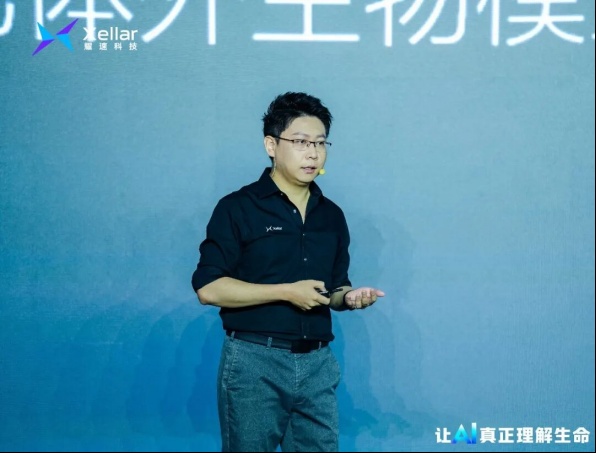
On August 27, 2026, he presented the DeepInsight AI platform at a Shanghai launch event that also introduced Xellar Intelligence branding. Announced agreements included Tencent Cloud, MoleculeMind and BioMap. The occasion extended the story from building individual devices to organizing a broader set of computational and experimental capabilities. A launch supplies a date and a name; the subsequent work has to make the connections hold.
A miniature scissor mechanism and a company operating across borders belong to very different scales. Xie's career puts them in the same narrative without requiring a miraculous conversion between the two. There were studies, collaborators, an industry role and a decision to found a business. The fold remains the most appealing image along the way: a modest change in arrangement that makes room for another dimension. Simple to picture. Considerably harder to get right.
Keep following the folds
- Xellar Biosystems
- Xin Xie on LinkedIn
- Northeastern’s 2017 doctoral research report
- The 2015 PowerMEMS presentations
- Xie and Livermore’s 2016 motion-amplifier paper
- The Northeastern origami and ApreX story
- The origami fabrication collaboration
- The 2024 founder biography
- Xie on customer pilots and commercialization
- Xellar’s Shanghai expansion
- The June 2026 financing announcement
- The August 2026 platform launch