Sonar is an unusual way to begin an Austin startup story. The city is landlocked, for one thing. Yet Nick Arab was working on sonar development there before a software opening at Luminex gave him a route into another industry. He had graduated from the University of Texas in 2002 and wanted to stay near friends and family. Geography was a preference. The work could change.
It did. Arab moved through software and hardware, eventually leading Luminex’s Advanced Technology Group. In 2016, he co-founded Pattern Bioscience with Ross Johnson and Bryan Gammon. The electrical engineer had become a chief executive. In the leadership change announced in January 2025, he became Pattern’s chief technology officer, while Carey-Ann Burnham became CEO.
That sequence makes an interesting career shape: engineer, founder, executive, technology chief. The titles move around. The technical work keeps its place. To understand Arab’s story, it helps to look below the company announcements, where a seemingly modest object can contain a formidable amount of engineering.
A familiar collaborator, before the company existed
Arab’s training was in electrical engineering at UT Austin. At Luminex, his responsibilities grew to include leadership of advanced technology, and he twice received the company’s Top Inventor award. This was a career built inside an existing organization before it became a story about starting one. He had already worked across disciplines by the time Pattern began.
Ross Johnson brought a complementary background. A senior mechanical engineer at Luminex, Johnson specialized in droplet microfluidics, the movement and division of very small quantities of liquid. His own Top Inventor recognition included a 2014 award shared with Arab. Their collaboration therefore preceded the business they would build together. The partnership had a technical history before it had a company name.
A Luminex patent application published in September 2016 lists Arab, Johnson, Arnold Estrada and Daniel Fine as inventors of a method for forming droplets. Its drawings describe channels, nozzles and changes in height. The subject sounds almost domestic until the dimensions enter the conversation. A staircase is easy to picture. Making liquid behave predictably around microscopic steps is a less forgiving assignment.
For Arab and Johnson, the later co-founder relationship had this tangible foundation: shared inventions, different engineering specialties, and experience working on the same physical problems. The paperwork is less picturesque than a garage. It also tells us rather more about what they could build together.
- 2002UT Austin
Electrical engineering - LuminexSoftware, hardware
Advanced technology - 2016Pattern
Co-founder & CEO - 2025Pattern
Founder & CTO
Small enough to make the details unavoidable
Consider one of Pattern’s inventions: a vacuum-loaded chip that generates droplets. Arab is named alongside Johnson, David Bussian and Jon Isom on the patent granted in May 2022. The device has channels, ports and a test volume. Gas is removed before liquid enters; a subsequent change in pressure brings the liquid into the chip.
The engineering addresses several unglamorous problems at once. Droplets need consistent dimensions. Their arrangement matters. Manufacturing methods constrain the shapes that can be made accurately. Pressure affects seals and how fluid travels. Each item is small enough to disappear in a business presentation, and substantial enough to occupy an inventor’s attention.
The patent describes ways to make the droplet-forming geometry less dependent on precisely manufactured ramps. That opens up more manufacturing options. It is a useful example of invention that reaches beyond an isolated clever mechanism: the design considers how the object will actually be made. An elegant drawing still has to survive its introduction to a factory.
Reading this part of Arab’s work as engineering offers a different measure of progress. The visible object may remain a chip. What changes is how reliably it can be loaded, how consistently it forms droplets, and how readily its design can be manufactured. Small differences can require a great deal of work.
The camera has a job, too
Fluid handling is only part of Arab’s inventive record. An earlier Luminex patent family names him with Matthew Fisher on image normalization. Its history reaches back to a June 2012 priority filing. The work concerns processing images and making measurements more consistent, placing it in a different technical corner from channels and liquid flow.
That breadth matters to this portrait. Calling Arab an electrical engineer identifies his degree; it leaves room for a career involving optics, image processing and physical devices. His name appears beside collaborators whose specialties enter at different stages. A system can demand several kinds of expertise before it produces anything a user can see.
A Pattern patent granted in October 2024 connects some of those pieces. Arab, Johnson, Jonathan Isom and Bussian are named on an apparatus for contactless loading and imaging of microfluidic chips. The described equipment combines a vacuum chamber, a light source and an optical sensor. Loading and looking become parts of the same apparatus.
These inventions make the everyday verb “build” feel properly crowded. There is the chip, the pressure system, the illumination and the image. Then there is the relationship among them. The career running through those components is more revealing than any single job title.
Channels, ports and controlled pressure.
Illumination and optical sensing.
Precision tooling, molding and assembly.
An editorial overview of the engineering themes in Arab’s patents and Pattern’s manufacturing collaboration.
Twenty ingredients. One stubborn piece of hardware.
Manufacturing gives this story a particularly concrete number: 20. Pattern’s consumable required 20 different dry reagents on a chip, along with tight fabrication tolerances and a storage solution that could scale. The assignment also called for a partner able to respond rapidly as designs changed. Precision and flexibility had to share the same production plan.
Pattern worked with thinXXS on tooling, injection molding and assembly. Together, they developed a customized reagent plug, with joint intellectual property and a design intended for automated manufacturing. Those details give the collaboration a shape: the partner was involved in developing how the consumable would work and how it would be produced.
Arab described earlier partners struggling with Pattern’s design requirements. He credited the thinXXS collaboration with saving time and resources. The assessment is restrained, which suits the subject. A production problem can consume both without producing a particularly theatrical scene. The relief is in getting the object made.
“Our collaboration saved valuable time and resources.”
Nick Arab · on working with thinXXS
For a founder whose earlier work crossed software and hardware, this is a recognizable extension of the job. The product’s promise has to fit into a manufacturing process. Costs, tolerances and assembly become part of the design conversation. Even the smallest component arrives with quite a long list of demands.
A manufacturing constraint in Pattern’s collaboration with thinXXS. A small object with a crowded agenda.
A company needs more than an inventor
While Arab was CEO, Pattern’s financing and leadership expanded. The company announced a $28.7 million Series C in April 2023, led by Illumina Ventures and Omnimed Capital, with participation from AMR Action Fund and Daleshaw. The round brought its reported funding total at that time to $68 million. These were company resources, funding the next stages of work.
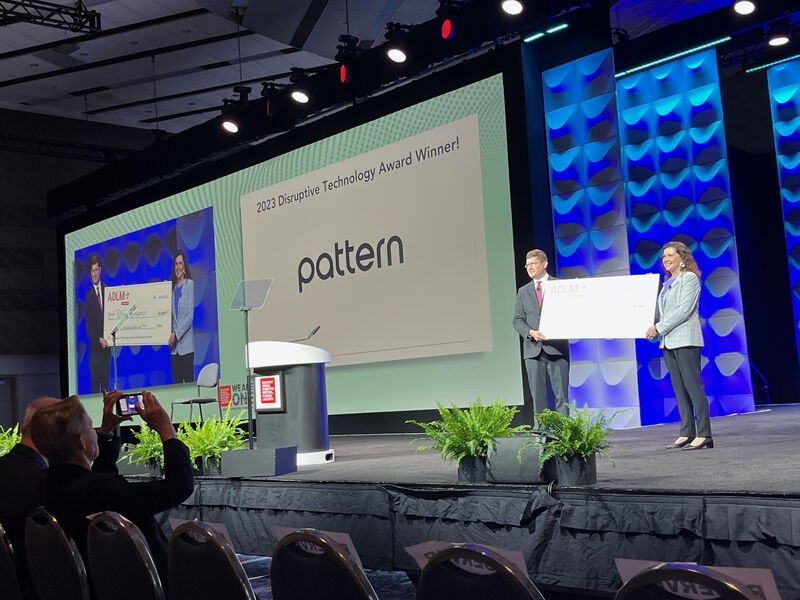
That July, Pattern won the ADLM Disruptive Technology Award at the AACC Annual Scientific Meeting. The award belonged to the company and its team. For Arab’s career, it marked public recognition during the years he was responsible for the business as well as the founding idea. Engineering had acquired a wider audience.
In October 2023, Pattern added Tim Skansi as chief financial officer and Travis Davies as vice president of operations. Arab emphasized their experience and the company’s preparation for its next stage. Those appointments put finance and operations alongside the technical work. Building the organization had become a distinct part of building the product.
The distinction helps explain why a founder’s responsibilities can change even when the underlying ambition continues. A company needs people who can manage production, money and execution, as well as people who can develop inventions. Arab’s tenure as CEO included assembling more of that range around the original team.
A different title, the same company
The leadership announcement on January 9, 2025 made the next division of work explicit. Burnham became CEO after joining Pattern in 2022. Arab moved to CTO, with a stated focus on advancing the technology. Chairman Patrick Balthrop credited Arab’s vision and leadership while explaining the company’s choice of its next chief executive.
Arab, in turn, welcomed Burnham’s combination of expertise and operational ability. He described his own ambition in terms of helping the technology reach its potential. The announced arrangement kept both people in leadership, with different responsibilities. A founder could continue developing what he had started while another executive led the organization.
By November 2025, Pattern had announced a further $43 million Series D, led by AMR Action Fund, Illumina Ventures and Omnimed Capital. Burnham was the CEO quoted in that financing announcement. Arab remained the founder and technology chief. The business had continued beyond the moment when its founder’s title changed.
There is a satisfying scale to this career. Arab chose to stay near the people he knew in Austin, then worked across disciplines, companies and increasingly intricate devices. The objects grew smaller while the organization grew more complicated. His latest title puts the technology directly in his remit. Somewhere inside the larger business, the channels, light sources and stubborn little chips still require attention.