The awkward thing about an antibiotic is that it can arrive before its instructions. A critically ill patient with suspected pneumonia needs treatment now. The laboratory may need two to four days to identify the bacteria and establish which drugs can stop them. Medicine has learned to act in that interval. Pattern Bioscience is trying to make the interval smaller.
- Isolate living bacteria in droplets; measure their response to antibiotics.
- Start with pneumonia specimens, where several organisms can share one sample.
- Prove agreement with reference tests before turning a promising system into a clinical product.
A very small room with a very important guest
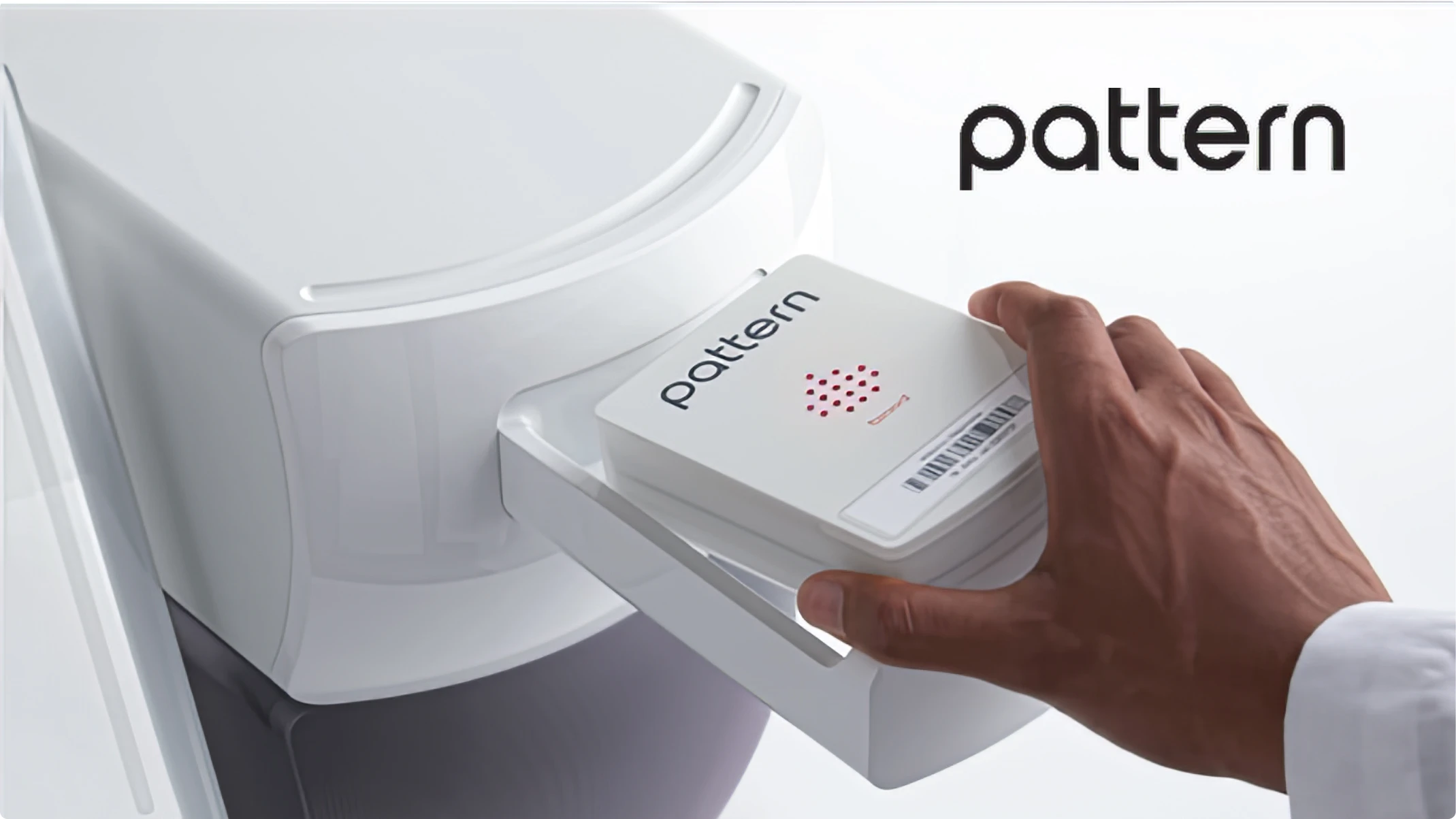
Pattern’s Digital Culture technology separates individual bacterial cells into picoliter-scale droplets. Fluorescent signals track their metabolic activity over time. Machine learning groups and identifies the resulting patterns. Expose those cells to antibiotics, and changes in the patterns provide evidence of susceptibility. Identification and drug response emerge from the same single-cell approach.
The attraction is practical. Conventional workflows grow bacteria before interpreting them. Pattern wants to observe the living cells directly from the specimen, bypassing those time-consuming culture steps. It combines microfluidics, assay chemistry, optical measurements and data science. The software has a physical subject: a bacterium getting on with its day, or having that day interrupted by a drug.
● ● ●
Signals shown are illustrative, not clinical results.
Calling this “culture-free” does not mean biology has been replaced by a computer. It means the instrument is designed to measure a response without waiting for conventional colonies. The distinction matters because the company’s competitive argument rests on what it measures, as well as how soon it measures it.
The question a gene leaves behind
Molecular diagnostics can identify pathogens and genetic markers associated with resistance. Pattern’s wager is that a clinician also needs evidence about what an antibiotic will actually do to the organism. In a May 2025 investor interview, CEO Carey-Ann Burnham described the remaining question:
“But you’re still left with an open question, ‘what can you use?’”Carey-Ann Burnham / May 2025
Phenotypic testing asks that question experimentally. Its value is the observed response, rather than dependence on a list of resistance genes. That does not make every molecular test obsolete. It gives Pattern a specific job within clinical microbiology: supplying treatment guidance that a pathogen’s name alone cannot provide.
Nor is rapid susceptibility testing an empty market. BioMérieux’s VITEK REVEAL reports average results in 5.5 to six hours from a positive blood culture. Pattern’s initial focus is direct respiratory specimens. Those starting points differ. Comparing the advertised hours without comparing the specimen is rather like timing a journey after one traveller has already reached the station.

The lung refuses to be tidy
A respiratory specimen can contain multiple kinds of bacteria. Finding one does not automatically establish that it is causing the infection. Pattern is developing simultaneous identification, quantification and susceptibility testing to help interpret that mixture. Separating cells allows their responses to be examined without treating the whole sample as one undifferentiated organism.
This is an exacting place to begin. The pneumonia panel targets critically ill patients with suspected pneumonia, using lower respiratory specimens. A test still depends on what was collected: if the relevant organism never reaches the cartridge, a clever instrument cannot summon it. Appropriate collection and clinical interpretation remain part of the diagnostic job.
An engineer meets a clinical question
Nick Arab had spent a decade in diagnostics when the delay began to look intolerable. CARB-X’s history traces his interest in antimicrobial resistance to a 2014 conference in Lisbon. He co-founded the company in 2016 with Ross Johnson and Bryan Gammon. Arab and Johnson brought experience from Luminex; Johnson’s specialty is droplet microfluidics. The company initially operated as Klaris Diagnostics.
Its stated mission is earlier information for targeted antimicrobial treatment. Its public values include ambition without ego, honesty and independence. Those principles suit the assignment: engineers, microbiologists and data scientists have to make one answer together.
The factory gets a vote
Pattern’s engineering problem extends beyond recognizing signals. Manufacturing partner thinXXS describes tight chip tolerances and 20 different dry reagents per chip. Its customer case study reports precision tooling, molding and assembly, plus a jointly developed reagent plug. Nick Arab’s account says previous partners struggled with the design criteria. The obstacle was tangible, and expensive in time.
The useful lesson for other builders is an inference from that work: define the decision, then follow every dependency back to the factory. Pattern’s droplets need repeatable hardware as much as capable algorithms. A prototype that produces a beautiful signal once is a different proposition from a consumable that a laboratory can trust repeatedly.
Capital buys the chance to prove it
Pattern announced a $28.7 million Series C in April 2023 and won that year’s ADLM Disruptive Technology Award. In November 2024, a BARDA cost-share contract supplied a $22.5 million base award, with optional phases potentially taking the contract to $40.9 million. These amounts fund development; they are not the price of running a patient’s test.
The November 2025 Series D added $43 million, led by AMR Action Fund, Illumina Ventures and Omnimed Capital, to support the U.S. trial and regulatory submission. Leadership had changed earlier that year: Burnham became CEO, and founder Nick Arab moved to CTO. The board connected the transition to clinical validation and preparation for market entry.
samples enrolled toward approximately 2,000 planned
The study’s primary endpoint is agreement with reference methods for identification and susceptibility. It includes prospective specimens alongside contrived and challenge samples. Enrollment is progress, not a performance verdict. The distinction keeps the company’s ambition attached to something measurable.
The answer must leave the laboratory
The intended customers are hospital and clinical microbiology laboratories. Physicians, pharmacists and stewardship teams would use the results. The system-and-cartridge architecture points toward an instrument business with a menu of assays. In July 2026, Pattern hired David Barreca to build its U.S. sales organization as it approached submission and launch.
September brought Breakthrough Device Designation for its urine panel, following the pneumonia designation in 2021. Designation facilitates development and review; it is not clearance. The expanding menu makes commercial sense, but the essential ambition remains narrower: get a useful answer to the person choosing treatment while there is still time for that answer to matter.