Before Will Mayo had a company, he had a collection of cassettes. His father, a director of television commercials, traveled for work and sent recorded bedtime stories home to New York. There were sound effects. There was a familiar voice. There was an audience of one, receiving a production made expressly for him. A small domestic arrangement had solved a rather consequential problem: how to be present when you were somewhere else.
Years later, Mayo would build a business around carrying stories across a similar distance. SpokenLayer gave written articles a voice and a route into a listener’s day. Eventually, its founder handed over the chief executive’s chair and took responsibility for strategy. More recently, he has been making wooden bathing vessels in Austin. The distance between internet audio and a barrel looks considerable. Follow the work, though, and the connecting thread becomes easier to see: he keeps thinking about how something feels to the person using it.
The engineer had a music problem
At Lehigh University, Mayo studied electrical engineering alongside product design, graduating in 2008. His computer engineering master’s followed in 2010, with ergonomics also part of his studies. Those subjects offer a useful introduction to his interests. An object has to function; somebody also has to live with it. A technically correct answer can still be an awkward thing to use.
Music supplied a practical testing ground. He sang with the university’s Choir and Men’s Glee Club, and his master’s work concerned entering and editing musical notation across touchscreens and the web. Think of the fiddly journey from a musical thought to a score that somebody else can work on. His thesis tackled that journey through software. A musician’s impatience and an engineer’s appetite for a system could occupy the same desk.
His early company, AUDIOis, developed SoundPipe, a cloud platform for recording and sharing audio. The audio publishing business emerged from this period of experimentation. The order matters: Mayo was working on sound before smart speakers became a household proposition. He had a set of interests and tools, then kept looking for a useful arrangement of them.
His previous work had included designing server processor internals at Intel and building visualization and analysis technologies for traders at Goldman Sachs. Those are specific, demanding assignments. They also make the eventual move toward spoken stories more interesting. Here was someone who had worked deep inside computing systems and on a trading floor, choosing to spend his attention on what came out of a pair of headphones.
A pair of headphones was the opening
SpokenLayer publicly launched at TechCrunch Disrupt in May 2012. The proposal was easy to understand: let people hear material they would otherwise have to read. Making that proposition into a dependable publishing service required rather more than a record button. News arrives continuously. A recording has to arrive while the story still matters.
By 2014, Mayo was describing a workflow in which a newly published article traveled to actors and voice artists, returned as recorded audio, and appeared in a player alongside the text. He put the turnaround at 15 to 20 minutes. TIME and Smithsonian were among the outlets using the service. The production schedule had to respect the habits of a newsroom, where yesterday’s urgency can become today’s recycling.
There had already been an adjustment in the business. SpokenLayer began as a consumer app and relaunched as a service for businesses at the beginning of 2014. The listener still got an audio story. The customer relationship changed. A publisher could add another way to experience its own work, inside a publishing operation it already understood.
The distinction carried a practical advantage. Publishers had reporting, writers and archives. Asking them to create a separate stream of original programming meant asking for another production operation. Giving an existing article an audio edition offered a smaller first step. Mayo was proposing another use for work that had already been commissioned, edited and published. The headphones were waiting; the editorial investment had already been made.
“It’s time to listen, because we’re too busy to read.”
Will Mayo, Matter Demo Day, 2013
A good story still needs a good performance
Mayo’s pitch had room for editorial judgment. A written piece does not become compelling audio simply because somebody has said every word aloud. A dense visual explanation, for instance, asks different things of its audience than a first-person narrative. The transformation involves deciding what belongs in the listener’s ear and what depends on a page.
In a 2016 interview with Nathan Latka, Mayo discussed that selection problem alongside the commercial one. He described a business with publisher payments, advertising and sponsorship, and work for clients outside media. He also talked about choosing suitable material. There is a useful lack of romance in those details. A voice business needs an editorial ear and somebody watching the invoice.
The underlying production challenge had been there early. Mayo described combining synthetic speech with human recordings, using demand to help decide where people should spend their recording time. A web-sized supply of text could overwhelm a finite pool of readers. Meanwhile, listeners had different tolerances for the rough edges of computer-generated speech. His proposed arrangement gave the two methods different jobs.
That is an engineer’s way of framing a creative business: identify the constraints, then distribute the work. It leaves plenty of room for performance. A reading has timing, emphasis and character. Anyone who has heard a joke delivered with the stress on the wrong word knows how much can go astray between text and sound. Getting the words right is merely the beginning of getting the story across.
article→Voice
production→Listening
platforms→Ads &
sponsors
The founder changes chairs
In July 2019, Andy Lipset became SpokenLayer’s chief executive. Lipset came from Pandora and brought experience in digital audio advertising. Mayo became chief strategy officer, with a brief covering product vision, innovation and global partnerships. He would also be the executive contact for strategic relationships across distribution, media, agencies, platforms and investment.
For a founder, a change of title can carry more narrative weight than a new client logo. The company had grown around Mayo’s ideas and persistence. Now the responsibilities were being divided. Lipset would oversee operations, including sales, marketing, publisher operations, technology and finance. Mayo would concentrate on the business’s future direction and the relationships needed to get there.
The two already knew each other. In announcing the appointment, Lipset said their acquaintance went back almost eight years. Mayo welcomed the opportunity to work together. The arrangement put an audio advertising operator at the center of a company whose recordings needed a commercial life as well as an audience. It was a fairly concrete answer to the question every publishing experiment eventually encounters: who pays for the next installment?
Mayo had been considering the fit between advertising and listening, too. A sponsored daily market briefing could make sense for a bank; an intrusive spot during a request for an account balance would be a different experience. The distinction suggests a useful instinct. An advertising opportunity has to survive contact with what the listener was actually trying to do.
Then the material became wood
Today, Mayo’s public professional profile places him in Austin and associates him with Nordsprings. The company makes thermal bathing systems, combining wooden vessels with circulation and temperature control. It is physical work with physical consequences: dimensions, joints, surfaces, weight. A barrel has a wonderfully direct way of expressing an engineering disagreement. Water finds it.
Nordsprings describes a workshop practice that brings together thermally modified wood, handcut stone and stainless steel. The pieces are assembled and refined by hand. The aspiration is durability and coherence across an entire system, rather than a collection of attractive parts. This is familiar territory for someone whose education joined electronics to product design and ergonomics. The materials have changed; the attention to use is recognizable.
The origins of this business reach back to New York as well. Mayo remembers looking up at the city’s wooden rooftop water towers and imagining swimming inside them. A family trip to Europe in 2000 introduced him to bathing traditions that stayed with him. When he introduced Nordsprings publicly, he connected the venture to those memories and to a wish to build something functional and beautiful.
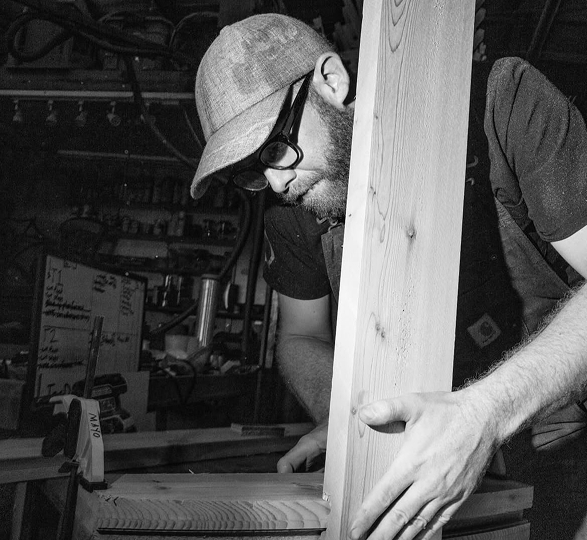
His childhood image is pleasingly specific. Plenty of children see a water tower. Mayo saw a possible place to climb into. An everyday piece of infrastructure became a design question. Years later, he was working with wood, steel and stone to give that question a form. The workshop photograph supplies its own explanation: a pair of hands, a wooden component, and a founder close enough to inspect the join.
What the tape and the barrel share
There is a temptation to tidy a career into one straight line. Mayo’s has involved processors, trading tools, music software, narrated articles and wooden vessels. The changes deserve to retain some of their oddness. A life with this many materials would lose something if every turn were presented as inevitable.
Still, a recurring concern is visible. His father made a recording for a particular listener. His music software addressed the act of getting a score into a usable form. SpokenLayer gave publishers a way to meet people during moments when a screen was inconvenient. Nordsprings puts that attention into objects people can touch. In each case, the experience depends on the relationship between the thing made and the person receiving it.
In a 2016 interview, asked what he would tell his younger self, Mayo offered a modest piece of advice: “Just keep trying and you’ll figure it out.” It fits a career that has required changes of product, customer and material. The cassette collection began with a father trying to reach his child. The subsequent work keeps returning to the practical question hidden inside that gesture: how do you make something arrive well?