An elevator has a peculiar relationship with applause. Deliver someone to the right floor, open the doors, and the audience disappears. The machine has done precisely what everyone expected. In that small, uneventful departure lies the business Judy Marks has spent the latter part of her career running: a product whose daily success is measured by how little attention it demands.
Long before she became chair, chief executive and president of Otis Worldwide, Marks learned about expectations at a more accessible height. Her father co-owned a small department store outside Philadelphia. She worked behind the counter. Customers could tell you directly whether you had been useful. A corporate strategy had very little distance to travel before meeting its verdict.
That experience keeps turning up in her account of her career. Engineering supplied the tools. Retail supplied a question that could survive changes of employer, country and technology: had the customer actually received what they needed? At Otis, answering it means thinking about the years after installation, when the ribbon has been cut and somebody still has to turn up.
A department store education
Marks grew up in Pennsylvania and went to Lehigh University to study electrical engineering. She completed the degree in three years, graduating in 1984. By her own account, she arrived somewhat introverted. Volunteering for campus activities and task forces helped her become more confident. The ability to speak up was something she developed through participation, rather than a personality she brought fully assembled.
She was one of fewer than ten women among more than 130 electrical engineering majors. Most of her teachers were men, too. She later described learning to use her voice to bring people together and agree on objectives. The experience made being the only woman in a room familiar. It also gave her a lasting interest in who gets invited into that room.
Her argument for bringing more women into engineering is practical: a broader pool of people produces more approaches to difficult problems. Her advice to students extends beyond their coursework. Join activities. Reflect. Have fun. For someone who graduated at that pace, the recommendation to enjoy university life has a pleasing absence of stopwatch.
“Believe in yourself, work hard, and pay it forward.”
Judy Marks · Lehigh reflections, 2021
The engineer learns the whole business
IBM hired Marks as a systems engineer in 1984. She moved through engineering management, program management, business development and marketing. These jobs widened her field of view from whether a system worked to whether an organization could deliver it. Her early career also followed a changing corporate map: IBM Federal Systems passed through Loral before becoming part of Lockheed Martin.
By March 2001, she was president of Lockheed Martin’s Distribution Technologies business in Owego, New York. The work included automation and recognition systems for postal operators, including the United States Postal Service and Britain’s Royal Mail. The customer might be a national institution, but the practical challenge remained recognizable: moving a great many things to the correct destination.
In 2005, she moved into leadership of Transportation and Security Solutions, becoming its president that October. Air traffic management and government information systems added further dimensions to her experience. A career often summarized by four employer names contained a substantial apprenticeship in delivering complicated systems to demanding customers.
Siemens recruited her in 2011 to lead its new United States federal business. She subsequently became chief executive of Siemens USA and also Dresser-Rand, a Siemens business. At a Senate commerce hearing in 2017, she represented an industrial company concerned with manufacturing, exports and technical skills. By the time Otis recruited her that year, she had worked across both government contracting and industrial technology.
A working life in five stops
- 1984IBM
Systems engineer - 2001Lockheed Martin
Business president - 2011Siemens
Federal business - 2017Otis
President - 2020Otis
Independent company
A company that lives between visits
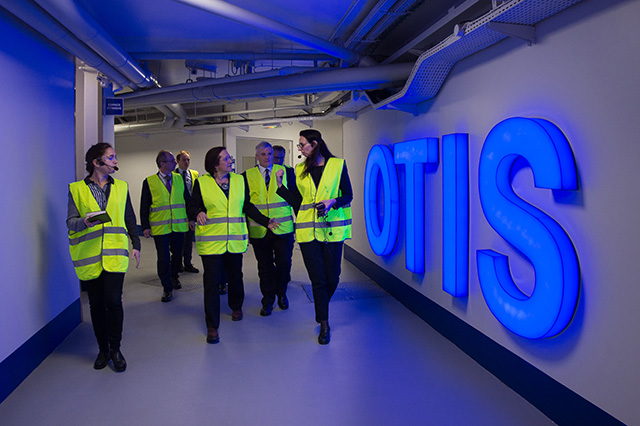
Marks joined Otis as president in October 2017. The chief executive title followed in June 2019. In April 2020, she led its separation from United Technologies and return to the New York Stock Exchange as an independent company. She became chair in February 2022. Taking responsibility for a subsidiary had become the task of establishing the habits of a standalone public business.
An elevator company has two clocks running at once. One measures the construction schedule: manufacture, install, commission. The other keeps going for decades. Doors need attention. Controls age. Owners want better performance from equipment already inside a building. The company selling the original machine has an opportunity to earn the next visit, and the visit after that.
That longer relationship became central to Otis under Marks. By the end of 2025, its maintenance portfolio covered approximately 2.5 million units. Portfolio growth had been 4 percent for four consecutive years. These are company figures, describing the reach of a business whose connection with a customer can continue long after the original sale.
Her store-counter experience makes this an unusually personal industrial strategy. The customer in the modern version might be a condominium association president, someone Marks has said she hears from directly. A building owner’s problem can still travel to the person at the top. The diagram of the organization may be elaborate; the complaint rarely is.
The next floor is already built
New skyscrapers make convenient pictures. Existing buildings make a substantial market. Otis reported that its modernization and refurbishment orders rose 26 percent in 2025, while the corresponding backlog grew 30 percent at constant currency. New equipment faced a more difficult environment, particularly in China. The contrast helps explain why servicing what already exists commands so much attention.
Modernization means finding ways to improve equipment within the constraints of a building that people already use. Otis introduced phased Arise MOD packages in Europe, the Middle East and Africa during 2025. Its annual report described a regional opportunity in which, in many countries, more than half of elevators were at least 25 years old. The elevator may be familiar to its passengers and overdue for a different set of controls.
Marks’s engineering background fits another part of this work: using information from equipment to improve maintenance. Connected elevators supply data that can help teams anticipate problems. Dispatching systems organize passenger traffic. These are practical applications of computing in a setting where a successful innovation might be experienced simply as a shorter wait.
In her 2018 discussion of engineering leadership, she emphasized that mechanics increasingly needed digital skills alongside mechanical ones. The transformation therefore reaches the people carrying tools, as well as the people writing software. Teaching a workforce how to use new equipment is part of introducing it. An algorithm still has to be useful to someone on a job.
Otis at year-end 2025
Year-over-year growth. Backlog at constant currency. Bars share a 0-30% scale. Figures: Otis 2025 annual report.
When the spreadsheet says stop
Marks has described an earlier assignment running a struggling, equally owned joint venture. She believed she could turn it around. The underlying business case proved unsound, and the venture closed. In recounting it, she emphasized the consequences for employees and customers. Confidence in her ability to repair the business had outrun an objective reading of its prospects.
The episode puts some useful grit into a career of promotions. She learned to stay objective even when asked to deliver a recovery. There are occasions when accepting responsibility means acknowledging that the intended outcome is no longer feasible. An engineer’s confidence that problems can be solved needs company from a manager’s willingness to examine the assumptions.
Her public advice about leadership repeatedly returns to decisions, communication and continued learning. She distinguishes directing work from getting a team willing to pursue an objective. In a 2025 interview, she said she would advise her younger self to take risks sooner, understand the risks, and learn when something goes wrong. Experience had made her more willing to stretch, rather than more interested in a quiet corner.
“I am an engineer by background, and a technologist by choice.”
Judy Marks · The Future of Work, 2018
The people who come after
Lehigh remained part of her life after graduation. She served on the engineering college’s Dean’s Advisory Council from 2006 to 2016, supported efforts to widen participation in technical fields, and returned to speak to students. Her daughter, Sasha, earned a civil engineering degree there in 2013. The family connection gives the university dates a significance beyond an executive biography.
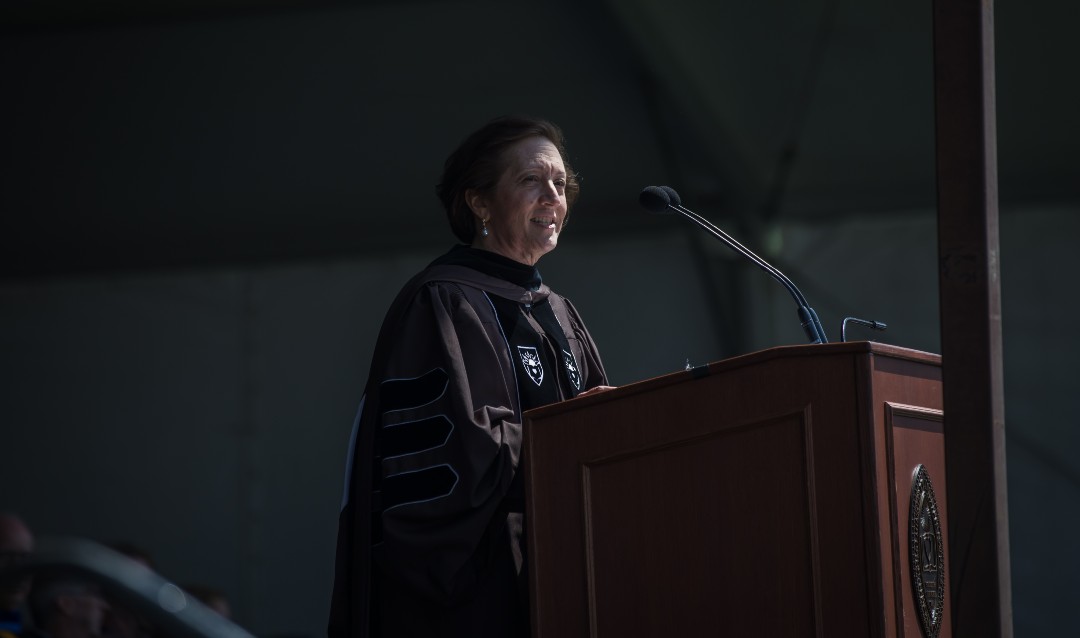
In 2022, Marks returned as commencement speaker. Her daughter was in the audience. The advice covered admitting gaps in knowledge, working with other people, accepting change and being accountable. She also asked graduates to think about generations: those who made their opportunities possible, their own responsibilities, and the people who would follow.
The honors have followed, including a 2021 Distinguished Leadership Award from the Committee for Economic Development and Lehigh’s 2022 Distinguished Alumni Award for Excellence in Industry. She also serves on Caterpillar’s board. Yet the intergenerational thread gives the record a more intimate scale. Having benefited from people who offered her difficult assignments, she argues for creating opportunities for others.
Preparing the handoff
On September 15, 2026, Otis announced that Marks would retire as chair, chief executive and president when her successor is appointed, expected in the first half of 2027. Independent directors are overseeing a search that includes internal and external candidates. If the appointment comes before July 31, 2027, she is to remain a senior adviser until that date.
The transition comes with work still on the desk. In April 2026, Marks discussed pressure on service profits, including investments in field staffing and sales capabilities, and the effects of portfolio mix. The service model requires execution customer by customer. An expanding installed base does not relieve the company of the obligation to deliver the next repair well.
Her tenure can be read through the separation, the service portfolio and the expansion of modernization. It can also be read through an older habit: keeping the person buying the service in view. The department store has become a global industrial business. The person waiting for an answer is still there, on the other side of the counter.