An artificial intelligence model can write a sonnet. It remains remarkably poor at delivering its own electrical equipment. Somewhere between the promise of a new data center and the moment its servers come alive, someone must arrange the power, connections, components and services. This is the territory John Engel has spent years assembling at Wesco. The glamorous end of technology gets the applause. His end has to arrive.
On January 13, 2020, Wesco and Anixter announced a merger agreement valued at approximately $4.5 billion, including assumed debt. The price commanded attention. The more revealing detail was the intended fit: electrical distribution meeting communications and security, with customers able to buy more of what they needed from the combined business. Engel was committing his company to a much larger operating task.
By June 22, the merger was complete. Wesco’s capabilities in industrial, construction and utility markets had joined Anixter’s strengths in communications, security, and wire and cable. The combined businesses had generated more than $17 billion in pro forma 2019 revenue. There was now an impressive collection of parts. Getting them to work together would be Engel’s particular examination.
An engineer before the corner office
Engel’s formal preparation began with mechanical engineering at Villanova University and continued with an MBA at the University of Rochester. The combination makes a useful introduction to his career: understand the machinery, then understand the business that owns it. His subsequent appointments took him through companies where engineering, manufacturing and commercial decisions had to share the same room.
From 1985 to 1994, he held positions at General Electric. A vice president and general manager role at AlliedSignal followed from 1994 to 1999. He then served as a senior vice president and executive vice president at PerkinElmer between 1999 and 2002, before becoming a senior vice president and general manager at Gateway in 2003 and 2004. Different businesses, repeated responsibility for making operations deliver.
In July 2004, Engel joined Wesco as senior vice president and chief operating officer. His remit included marketing, sales, operations and supply chain activities. This was an unusually broad view of the company’s daily life. A promise made by a salesperson eventually becomes an instruction somewhere else; Engel had responsibility across much of that journey. He joined its board in 2008.
The succession announcement came in May 2009. Engel would become president and CEO on September 1, succeeding Roy Haley, who would remain executive chairman during the transition. It was a planned handover in an unsettled economy. Engel received the chief executive’s job during the Great Recession, a time when even a carefully prepared appointment came with an uninvited examination in uncertainty.
- 2004Joins as COO
- 2009Becomes CEO
- 2011Adds chairmanship
- 2020Combines with Anixter
A larger company is a longer to-do list
In May 2011, Engel added the chairmanship as Haley retired from the board. The progression matters because Engel’s Wesco story is one of accumulated responsibility. He had spent years in the operating role before taking charge, then inherited the board leadership through the established succession plan. By the 2020 Anixter agreement, he had worked inside Wesco for more than a decade.
The January 2020 agreement also displaced Anixter’s earlier deal with Clayton, Dubilier & Rice. Wesco’s proposal offered cash, common stock and preferred stock. The companies expected more than $200 million in annual run-rate cost synergies by the end of the third year. A merger announcement is allowed to be elegant. Its implementation must survive considerably less elegant matters: overlapping work, branch networks, purchasing, systems and incentives.
At completion, Engel described the combination as an opportunity to sell more solutions to more customers in more locations. That was a practical ambition. A wider catalogue only earns its keep when someone can recognize a customer’s additional need and supply it. Otherwise, size becomes an expensive filing cabinet. Wesco had bought capabilities; it still had to make them available across the business.
The difficult arithmetic of belonging
Engel’s explanation of the integration places unusual weight on participation. Employees were asked to respond to proposed values, mission and vision. Leadership and organizational choices became part of building a new company. He also described a specific incentive program for genuine additional cross-sales. The interesting detail is the pairing: ask people to help shape the organization, then reward the behavior the new organization needs.
That gives his talk about culture a concrete edge. A combined workforce needs to know whose experience counts, what changes, and how success will be recognized. Bringing sales teams into a common structure was one answer. Paying for incremental business was another. Engel’s account makes the integration sound less like declaring a winner between two companies and more like giving their people useful work to do together.
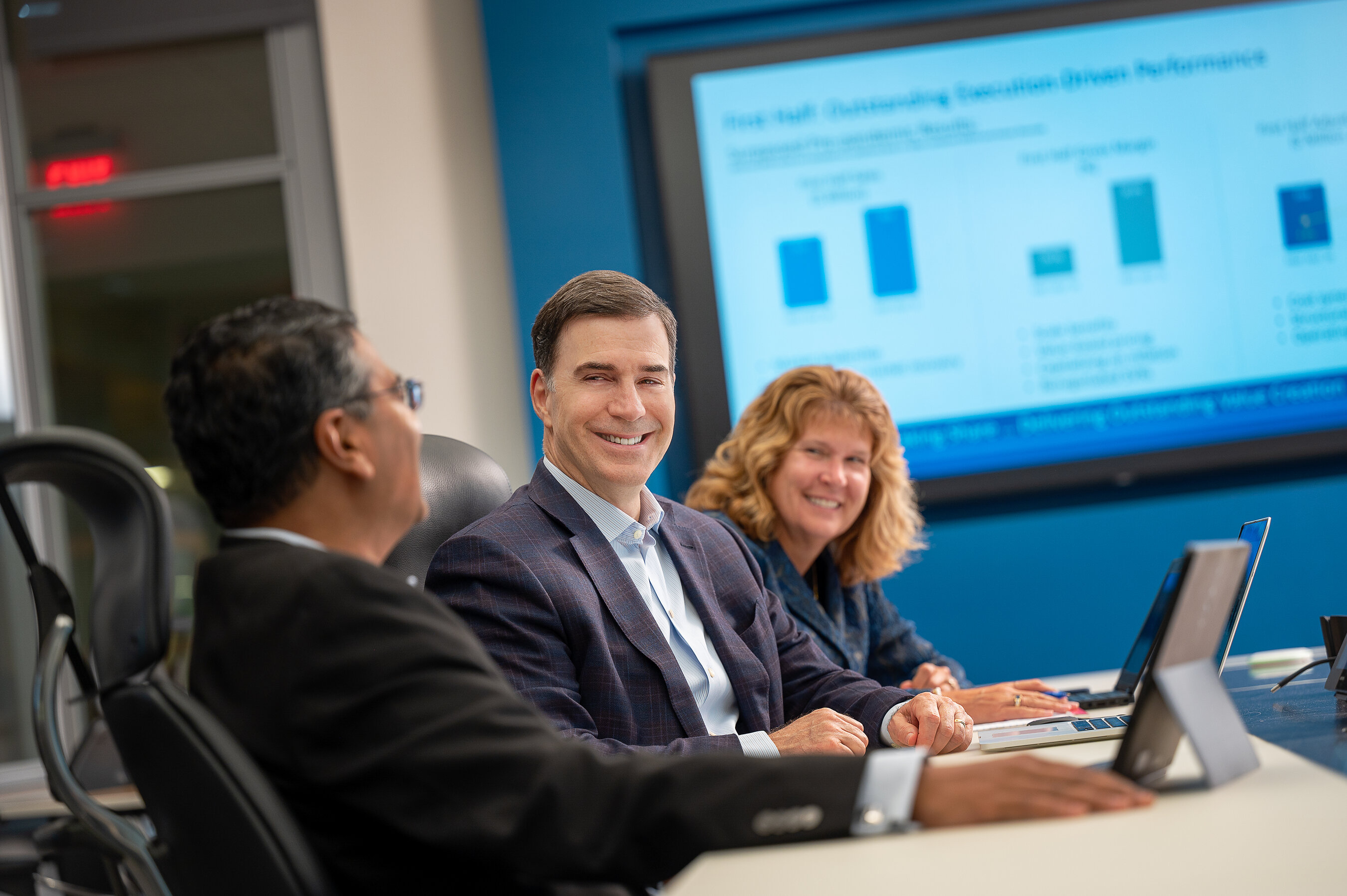
“Talent is my top priority,” Engel has said. It is a short sentence carrying a large obligation for a business spread across branches, facilities and countries. The company’s early career programs offer experience, education and exposure; its veterans program recognizes skills developed in service. These are specific ways a supply chain business can widen the pool of people capable of running it.
“Talent is my top priority.”
John Engel
The promises began to acquire numbers
The first year gave shareholders something more substantial than a new organization chart. Wesco reported $586 million in free cash flow for 2020 and said that its three-year integration plan had delivered synergies above the initial targets within the first six months. Those were early results, with the longer integration still ahead. Cash was especially useful evidence for a company that had just completed a large transaction.
By August 2021, the company raised its expected cost synergy benefit from $250 million to $300 million by the end of 2023. It also increased the assumed cumulative sales benefit from cross-selling from 1 percent to 3 percent over that period. The revisions show how the transaction was being judged: savings on one side, additional customer business on the other. Engel needed both columns to improve.
When Wesco reported its 2023 results, it declared the three-year Anixter integration complete. Sales had risen 30 percent and adjusted EBITDA 89 percent against the standalone companies’ 2019 performance. Total shareholder return from the June 2020 closing through the end of 2023 was 353 percent, compared with 62 percent for the S&P 500. That defined period is essential to the comparison; it describes the integration chapter, rather than a promise about the next one.
What $100 became
A bell, then more work
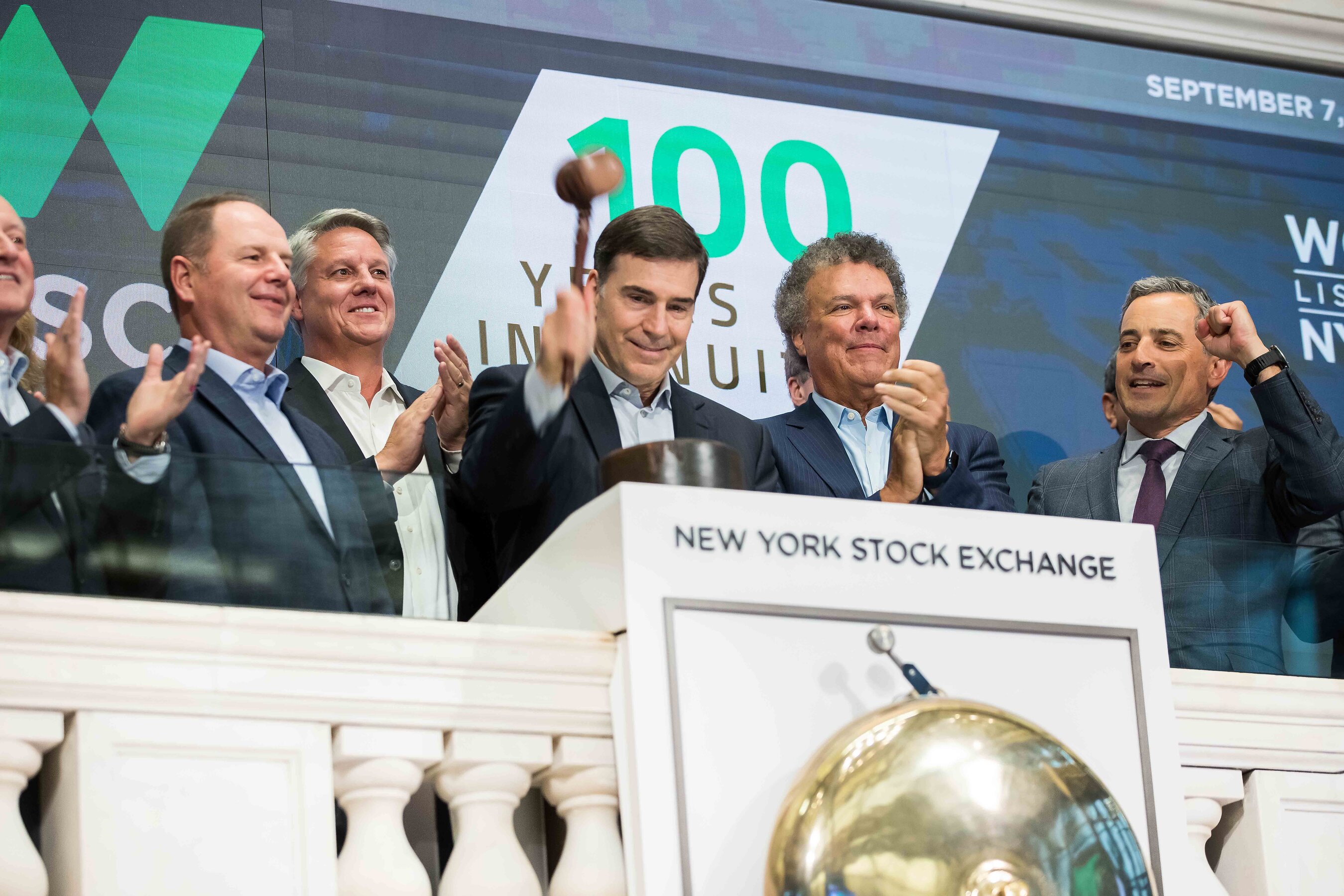
On September 7, 2022, Engel joined executives and guests at the New York Stock Exchange to ring the closing bell for Wesco’s centennial. There are few more public ways for a distributor to mark an anniversary. The photographs supply a pleasant contrast to the everyday business of fulfilling orders: for once, the equipment everybody was watching was a bell.
That same autumn brought another addition. Wesco completed its purchase of Rahi Systems on November 1 for $217 million. Rahi brought services supporting the full lifecycle of data center solutions and joined the Communications and Security Solutions business. Engel was adding expertise around the products, extending what the company could do for customers beyond getting an item through a warehouse.
In December 2024, Wesco announced completion of its purchase of Ascent, a provider of data center facility management services. Its capabilities included site operations, critical systems repairs and advanced liquid cooling. The acquisition moved the story further into the working life of a data center. A facility has needs after construction and commissioning, too. Maintenance is rarely invited to the unveiling, although the unveiling would have a short afterlife without it.
The digital economy has a delivery address
The business Engel now leads operates in about 50 countries, with roughly 21,000 employees and more than 700 sites. Wesco’s reported 2025 sales were $23.5 billion. This is the physical scale behind his language about technology. An improvement in information has to be useful across a network of people, suppliers and customers, rather than merely look persuasive on a screen.
In July 2026, Wesco reported second-quarter sales of $6.7 billion, up 13 percent from a year earlier. Data center sales reached $1.5 billion, up approximately 45 percent. The company also disclosed a multi-year Grid Services award from a hyperscale data center customer. For Engel, that contract connected two parts of his portfolio: the enormous appetite for computing and the power infrastructure required to support it.
Wesco sales to data center customers, up approximately 45% from a year earlier.
His July sustainability letter placed supply chain resilience, grid modernization, automation and building intelligence within the same operating agenda. He described using data and analytics to improve efficiency and reduce waste, alongside employee development and community work. The connection is practical: running a sprawling distribution network requires decisions about resources as well as revenue. Efficiency has a physical footprint when products and people move through actual buildings.
By September, in a conversation with Ayna CEO Gaurav Batra, Engel was stressing the order of operations for artificial intelligence: get the data right first. He discussed customers, suppliers and transactions as an asset, with information brought together in a data lake. He also described reshoring as a long-term industrial realignment. These are ambitions with a long timetable, consistent with an executive whose defining transaction took years to integrate.
There is a recognizable operating temperament in those choices: acquisition followed by integration, customer opportunity followed by sales incentives, artificial intelligence preceded by attention to the data it will consume. Engel’s public career offers plenty of scale, but its most revealing details are the mechanisms. He keeps returning to the work between an intention and a result. Even the future, in this business, needs somebody to organize the delivery.