In 1991, a FedEx interview became available because someone else was leaving. Raj Subramaniam’s roommate had decided to return to India and turned down the appointment. Subramaniam, still looking for work, asked for the telephone number and called back. The vacancy was for an interview, which is a modest sort of opening. He took it seriously.
He joined as an associate marketing analyst. Thirty-one years later, he became the second chief executive in FedEx history, succeeding Frederick W. Smith. Between those two events sits the more interesting story: how someone trained to understand chemical processes learned to run a company whose business depends on things arriving somewhere else.
The telephone call is a good beginning because it resists the polished logic of the executive biography. There was an opening, a recession and a graduate who wanted a job. The eventual destination would have made an ambitious answer to an interview question. First, he needed to get the interview.
A small apartment, then a wider map
Subramaniam grew up in Thiruvananthapuram, the Kerala city also known as Trivandrum. He attended Loyola School. At 15, he moved to Mumbai, exchanging a comfortable home for a 200-square-foot apartment in a much bigger city. He later described the move as an early education in adapting to unfamiliar circumstances.
His account of IIT Bombay places particular emphasis on the habits he acquired there: logical thinking, analysis and strategy. He graduated in chemical engineering in 1987. These are useful distinctions. A qualification identifies a subject studied; habits determine what someone can do when the subject changes. His career would eventually require both an engineer’s attention to systems and a marketer’s attention to the person buying the service.
A scholarship brought him to Syracuse University. He completed a master’s in chemical engineering in 1989, but his time there had room for another undertaking: he helped form a cricket club and became its captain. There is something pleasing about this footnote. An academic record can make a young person sound like a sequence of examinations. Here was someone also organizing a game.
He subsequently earned an MBA at the University of Texas at Austin. The sequence gave him two engineering degrees before a business qualification. It also made his eventual first job in marketing less of a departure than it might appear. A delivery promise needs someone to understand the machinery behind it. A beautifully expressed promise that misses the connection is still a late package.

One employer, several working lives
FedEx hired him into its international division in Memphis. His education soon found an application across departmental lines. He has described recognizing that network design could use his combination of engineering and business training. Marketing a transportation service involved understanding how the transportation actually worked.
His career then moved through Asia, Canada and the United States. He became president of FedEx Express Canada in 2003, later held the corporation’s chief marketing and communications role, and briefly led FedEx Express before becoming the parent company’s president and chief operating officer in 2019. He joined the corporate board in 2020.
Read quickly, that sounds like the usual procession of longer titles. Geography makes it more revealing. A network seen from one market is only part of a network. International assignments put different customers, operating conditions and trading relationships into the picture. An executive can spend decades at one employer and still have to learn several versions of the business.
By 2020, the questions reaching his desk included how to accommodate the habits of online shoppers. FedEx was expanding residential delivery across the week, making returns easier through retail locations and giving service providers route-planning technology. The consumer’s request was straightforward: bring the thing, make the timing understandable, and make sending it back tolerable. Delivering that simplicity required considerable organization behind the scenes.
- 1991Associate marketing analyst
- 2003President, FedEx Express Canada
- 2019President & COO, FedEx Corporation
- 2022President & CEO, FedEx Corporation
Four appointments across a 31-year apprenticeship.
The founder’s chair comes with homework
On June 1, 2022, Subramaniam succeeded Smith as chief executive. Smith remained executive chairman at the time. The change was unusually legible: the first CEO was handing over to the second. There was no long line of predecessors to make succession feel routine.
The call announcing the succession had arrived ahead of schedule. Smith telephoned about half an hour before the appointed time, an example of what Subramaniam jokingly called “FedEx time.” He wanted to tell the board he was ready to pass the baton. Even the conversation about becoming chief executive had a delivery standard. The detail gives the handover a human scale: two people on a telephone, discussing a change that would reach far beyond either of them.
Subramaniam had also talked with Microsoft’s Satya Nadella about what it means to lead a company associated so closely with its founder. The idea they discussed was re-founding: respecting the institution while interpreting it for another chapter. It is an attractive phrase. The practical version involves deciding which inherited arrangements still earn their place.
Familiarity is useful in that work, but it creates its own difficulty. An insider knows why something exists. That knowledge can explain a complication so well that the complication starts to seem inevitable. The successor’s task includes distinguishing a founding principle from an operating arrangement that once served it. Customers generally have little sentimental attachment to an organization chart.
Subramaniam’s first years made that distinction concrete. In April 2023, FedEx announced plans to bring Express, Ground, Services and other operating companies into a single organization. The stated purpose was a more integrated air-and-ground network and a simpler customer experience. In June 2024, Ground and Services merged into Federal Express.
“We are building a simplified experience for our customers”
Raj Subramaniam · April 2023
The promise sounds small until one considers the scale of the plumbing. Integrating operations means changing how assets, responsibilities and information fit together. The customer sees a pickup or a delivery. Within the company, making that encounter easier can require rearranging relationships built over years. The organizational work is largely invisible when it succeeds.
Teaching the network to read its own signals
In January 2024, Subramaniam announced fdx at the National Retail Federation’s Big Show. FedEx described a commerce platform reaching across the customer journey: attracting demand, improving conversion, organizing fulfillment and handling returns. The announcement put a digital proposition beside the familiar physical one.
This is a useful place to slow down the language. A shipment leaves information behind as it moves. For a retailer, decisions about where to fulfill an order or how to manage a return affect the delivery experience before a driver reaches the address. A company carrying the parcel has a particular view of those decisions and their consequences.
Subramaniam’s ambition is to turn that view into something customers can use. The hard question is practical: does the information help a business make a better decision? A prediction must prove useful outside the presentation that introduced it. The delivery address supplies a rather unforgiving test of whether the technology has helped.
In a 2026 conversation with David Rubenstein, he discussed artificial intelligence, data analytics and autonomous trucking alongside his own journey from Kerala. Those subjects fit the career. An engineering graduate who moved into business now leads an organization trying to connect its accumulated operating knowledge with new ways of using information.
Bring operations together
Ground + Services → Federal Express
Give Freight its own company
FedEx Freight → independent public listing
A simplified diagram of the corporate changes, not a map of delivery routes.
Knowing when to join, and when to separate
On June 1, 2026, FedEx completed the separation of FedEx Freight. The less-than-truckload business became an independent public company, trading on the New York Stock Exchange as FDXF. Subramaniam remained president and CEO of FedEx Corporation.
Placed beside the earlier merger, the separation gives his tenure an interesting shape. Some operations were brought together; another business received its own public listing. There is no single organizational verb that solves every problem. A successor has to make choices about boundaries as well as efficiency within them.
The company’s fiscal 2026 results supplied one measure of the continuing overhaul: FedEx said it exceeded its goal of $1 billion in transformation-related cost savings during the year. That is a company-reported result, with a specific period attached. It measures part of the work. Customers experience the outcome through reliability, useful information and the handling of the next shipment.
The borders beyond Memphis
Subramaniam’s responsibilities extend into organizations concerned with the trading relationships his company serves. He chairs the U.S.-China Business Council, serves as vice chair of the U.S.-India Strategic Partnership Forum and sits on Procter & Gamble’s board. His biography runs between countries; his public roles concern the connections between them.
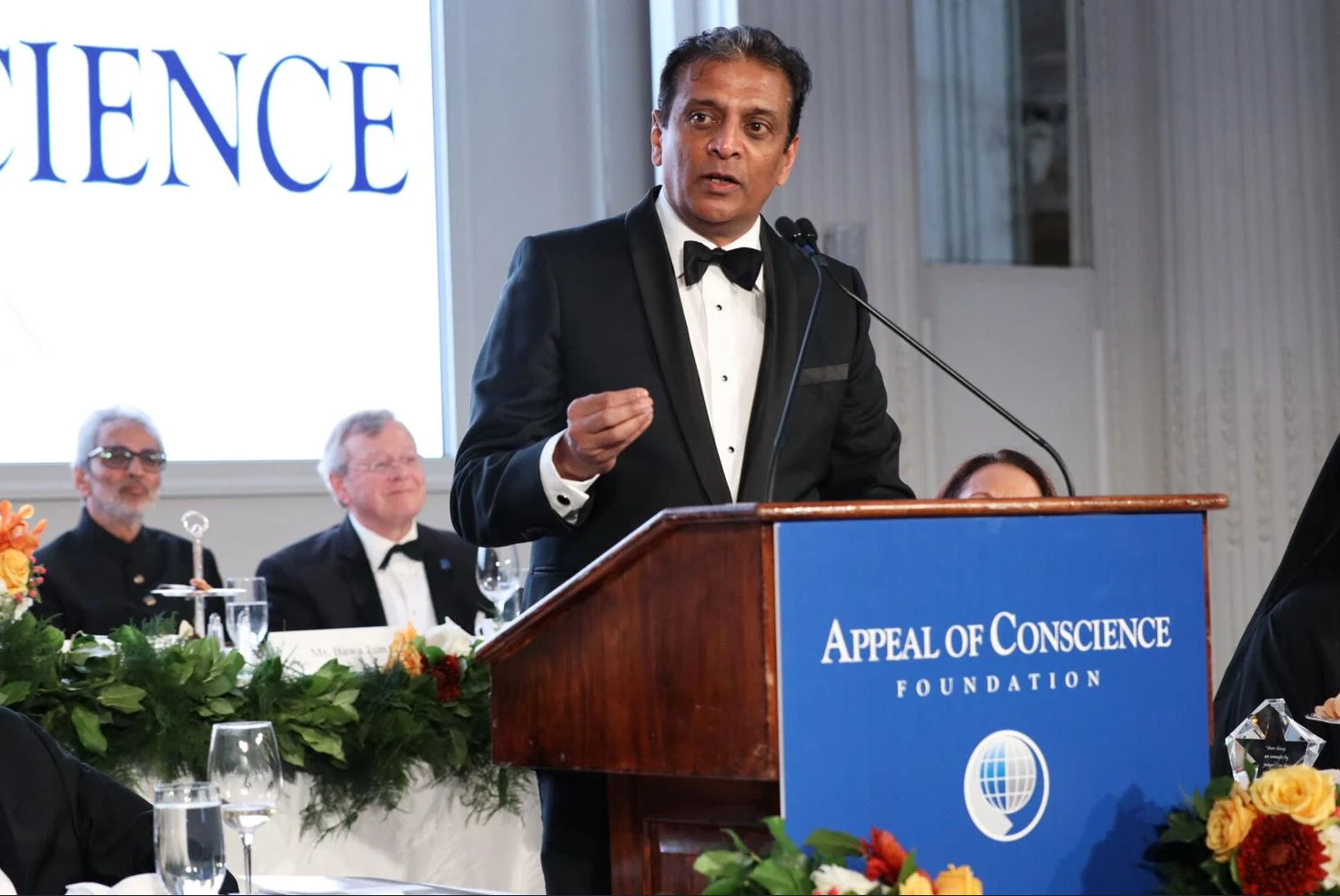
In 2023, he received the Pravasi Bharatiya Samman, an Indian honor for members of the diaspora. In September 2026, the Appeal of Conscience Foundation recognized him at its annual gala. His remarks there linked international commerce with cooperation between communities. The aspiration is consistent with the work, though moving goods and bringing people closer remain different kinds of achievement.
The biography can be read as a succession of arrivals: Mumbai, Syracuse, Austin, Memphis, the CEO’s office. Each arrival also created another problem to understand. Engineering gave him a way to examine systems. International assignments gave him different places from which to examine the same company. Succession gave him responsibility for deciding what should change.
The early telephone call remains a fitting detail. He did not invent the opening. He recognized it and acted. Decades later, running FedEx asks for a more complicated version of that judgment: seeing where an established route still works, where it needs a new connection, and when it is time to call back.