The useful detail in Bill Hunter's account of the smart knee is not that the idea arrived in a flash. It is that the knee was big enough. Canary Medical needed room for a battery, a transmitter and sensors. In the middle of the 2010s, those parts would not disappear into a coronary stent. A knee implant, by contrast, offered real estate. So the opening application was not a grand declaration that orthopedics would conquer digital health. It was a decision made inside a physical constraint.
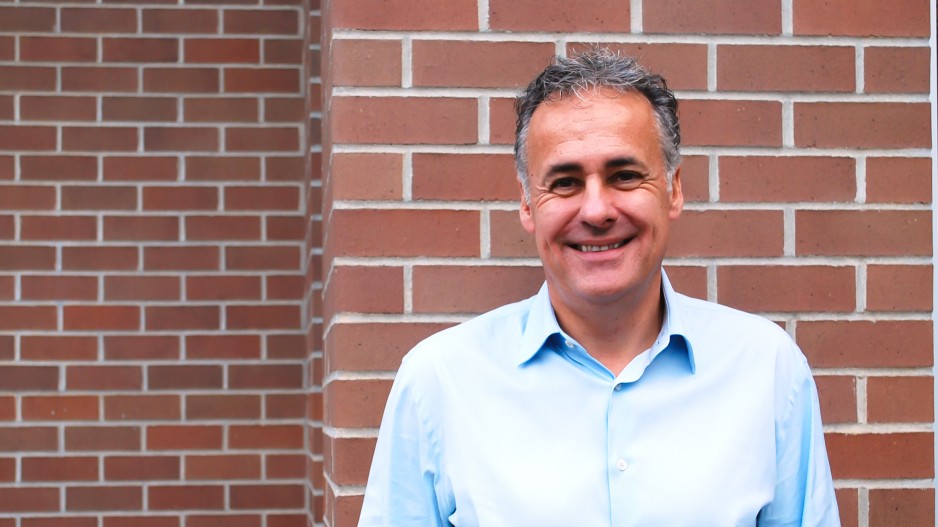
That is a fitting entry into Hunter's career. For more than three decades, the Vancouver physician-founder has worked where ambitious concepts meet stubborn objects: a coated wire inside an artery, a power budget measured in years, a signal without enough context, an invention waiting on regulation and payment. He speaks about the future, but his stories keep returning to what fits, what lasts and what someone can actually use.
Hunter's recurring move is combination. At Angiotech Pharmaceuticals, the company he helped start while studying medicine at the University of British Columbia, the combination was drugs plus devices. At Canary, it is implants plus sensors, wireless communication and software. Neither half was novel in isolation. The work was making the halves cooperate inside a regulated product.
A company hiding in a research question
In the early 1990s, Hunter was a third-year medical student giving a talk about using small amounts of cancer drugs to control unwanted growth by non-cancerous cells. Interventional radiologist Lindsay Machan heard the presentation and suggested putting the idea together with the devices used in minimally invasive procedures. Machan did not expect the student to return a couple of months later with a business proposal. Hunter did. With Machan and graduate supervisor Larry Arsenault, he founded Angiotech in 1992.
The pairing helped create a way to coat stents with paclitaxel. A bare stent could reopen an artery, yet the intervention itself could provoke tissue growth that narrowed it again. The coated device released a drug intended to suppress that response. The technology moved through a partnership with Boston Scientific into the TAXUS drug-eluting coronary stent. Angiotech grew into a public company with a market value that passed $2 billion, and Hunter moved from clinical work into the company full time.
A polished biography can make this sound like an escalator. Hunter describes switchbacks. He has written about 2004 as the last easy year he remembers as a healthcare CEO: revenue rising, shares moving, acquisition ideas arriving every week. Then concerns around late stent thrombosis, the 2008 debt crisis and the strain of corporate obligations changed the temperature. Later, at Correvio Pharma, an FDA rejection became another sharp turn. The line between effort and result refused to behave.
“The business of healthcare is nonlinear, not fair and unpredictable.”Bill Hunter, reflecting on two decades as a healthcare CEO
The candor is part of Hunter's operating voice. He does not treat adversity as a decorative chapter added after success. It is the environment. In healthcare, years of work can look flat before a regulatory decision, a reimbursement code, a partner or a clinical pattern changes the slope. The lesson is less romantic than “never give up.” It is to understand the kind of curve you are managing.
Correvio showed the other side of that management. Hunter did not arrive with a single invention to shepherd. He built a direct sales organization in Europe, added an international distribution network, licensed more products and completed an acquisition that brought a complementary medicine into the portfolio. Company accounts credit that operating stretch with increasing Correvio's valuation more than fivefold. It was portfolio work rather than laboratory theater: assemble the channels, widen the offering, and make several pieces support one another. That chapter matters because Canary would also demand more than a clever device. It would need hardware, software, connectivity, partnerships, clinical evidence and a route to payment to advance together.
The implant that reports back
Hunter founded Canary Medical in 2012 around a blunt observation: enormous amounts of medical hardware are placed inside people, and almost none of it reports what happens next. Consumer electronics had made sensing and wireless communication ordinary. Pacemakers had shown that implanted electronics could operate reliably for long periods. His question was whether those capabilities could become a reusable layer inside other devices.
Canary's canturio tibial extension became the sensing component inside Persona IQ, developed with Zimmer Biomet. It attaches to the stem of a knee implant and measures motion from inside the body. The system records metrics such as steps, walking speed, cadence, stride and range of motion. A base station relays the data on a schedule. In August 2021, the FDA granted De Novo classification for Canary's implantable post-surgical kinematic measurement knee device, clearing the way for marketing in the United States.
The engineering story is a study in rationing. An implanted battery cannot be treated like a phone plugged in every night. Hunter has explained that continuous real-time transmission would consume power quickly. The device therefore spends much of the day sampling at lower resolution, briefly switches to a much higher rate for detailed gait measurements, and transmits once daily. Yesterday's useful record beats today's dead battery.
A day inside the data budget
This is also why “smart” is an imprecise label. The implant does not become useful merely because it can count. At the start, Canary had streams of movement and no deep population context. A step count could be accurate and still leave the important question unanswered: is this pattern expected for a person at this point in recovery?
“Engineering made it possible, data science has made it meaningful.”Bill Hunter on moving from collection to context
As the dataset grew, the company could build comparative recovery curves and begin separating typical patterns from unusual ones. Hunter said in 2023 that Canary had collected more than a billion data points and the equivalent of a millennium of monitoring. A later interview put the gait dataset above two billion points. The numbers matter because they turn isolated observations into distributions, and distributions can give a clinician context at a glance.
The founder as translator
Hunter's public explanations have an unusually mechanical quality for a physician. He reaches for systems that people already understand. His rebuilt 1973 Triumph TR6, nicknamed the “TR-Fix,” becomes a model of reactive maintenance: listen for a rattle, find the smoke, open the hood. A modern car, dense with sensors and diagnostics, becomes the comparison for connected medicine. Formula 1 supplies the extreme case, with hundreds of sensors turning a race into a live stream of machine behavior.
Baseball is the other grammar. Hunter coached his sons and youth teams for years, follows the Toronto Blue Jays and has written about the game's lessons for business. Baseball makes room for variance. A good process can produce a bad afternoon. A long season resists a single scoreboard. That perspective fits a field in which company value, scientific merit and commercial timing can move on different clocks.
The personal notes are not incidental. Hunter credits two early board mentors, physician and medtech leader Glen Nelson and pharmaceutical executive Hank McKinnell, with shaping him in his late twenties. He has also written that his mother's example formed his ideas about grit and corporate obligation. In his telling, a healthcare company owes something to employees, its community and the quality of what it brings into the world, not only to the arithmetic in a quarterly report.
From a clever object to a connected system
The ambition has expanded beyond one joint. Canary has discussed sensors for hips, shoulders and spinal applications, along with smaller devices for cardiovascular monitoring. In 2024, the company announced FDA Breakthrough Device designation for its canturio lc spine application, following designations for knee, hip and shoulder programs. In 2025, Hunter also became chairman of Tensive, extending his board work into another implant-focused company.
Yet the larger bet is not a catalog of instrumented objects. It is a common data layer. Hunter imagines major devices becoming connected, then using continuous records to help distinguish normal from abnormal patterns and, eventually, to recognize changes earlier. In a 2026 interview, he described a progression from monitoring to diagnosis, prediction and more active management. The aspiration is broad. The route remains sequential: first capture a reliable signal, then understand it, then decide what action it can support.
That sequence may be Hunter's most portable idea. Founders are often encouraged to tell the biggest version of a story. His career argues for keeping the smallest constraint in view at the same time. The future of the implant may be continuous intelligence. The first product still needed enough room for a battery.
Keep going