The most revealing moment in Canary Medical's history came after its big technical victory. The Vancouver company and Zimmer Biomet had won FDA authorization for Persona IQ, a knee replacement with Canary's motion sensors, memory, transmitter and battery sealed inside its tibial stem extension. It could count steps, measure walking speed and estimate range of motion from inside the body. It did not need charging. It did not need a patient to remember a wristband. It worked - and the data arrived without a user manual for reality.
Was 900 steps on day five reassuring? Was a certain range of motion on day 12 ordinary, poor or excellent? Canary did not yet have enough implanted patients, or a full year of recovery histories, to answer confidently. CEO Bill Hunter later described the first year and a quarter as a period of getting the company's bearings. The hardware was reporting facts. The company still had to manufacture meaning.
“When we first started collecting data there was no context.”Bill Hunter, CEO, on Persona IQ's early launch
A knee that phones home
Canary was founded in 2013 by a group that reads like a deliberately awkward dinner party: surgeons, experienced medical-device builders and connected-device specialists. Their premise was that implants should stop being mute pieces of metal and plastic. A device already sitting at the site of treatment ought to report how that site is behaving.
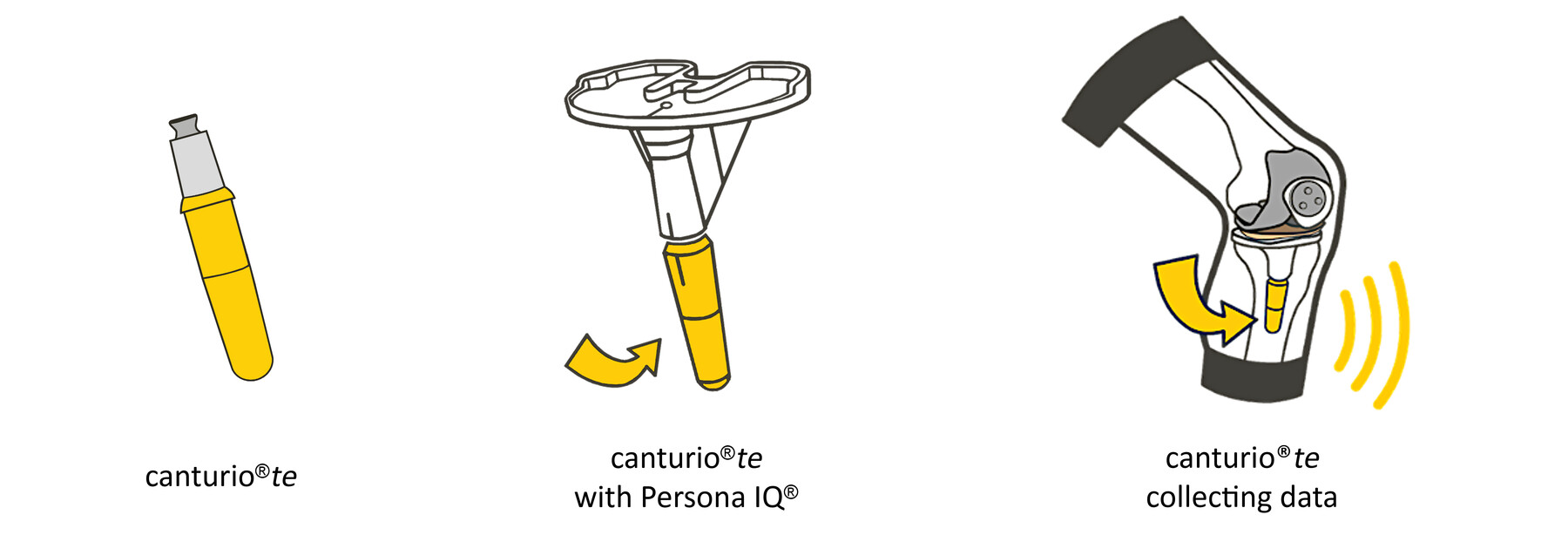
The company's first commercial expression is Canturio. Attached to Zimmer Biomet's Persona knee system, the sensor extension creates Persona IQ. During recovery, it captures qualified steps, distance, cadence, stride length, walking speed and two measures of motion. A base station at home queries the implant and sends the readings into a protected cloud system. Clinicians view the results through dashboards connected to Zimmer Biomet's broader digital-care ecosystem.
One ordinary walk, five technical handoffs
That last box is the business. A measurement alone does not schedule physical therapy, reassure a worried patient or decide whether an office visit can become a virtual check-in. Canary learned that the surgeon chooses the implant, but nurses and care coordinators often turn its output into care. The company consequently expanded from sensing into Recovery Curves, sorting tools, clinical dashboards and practice-management support for remote monitoring.
The cold start inside a human joint
Consumer software can solve a cold start by giving away an app and observing clicks. Canary had to wait for surgery, healing and time. A knee replacement can take a year to recover. The company needed enough patients at enough stages to establish what typical looked like, then divide those histories by useful cohorts such as age, sex and weeks since surgery.
By the beginning of the second quarter of 2023, Hunter said Canary had sufficient experience to begin offering clinical context. Recovery Curves could show whether a patient's walking speed sat above the 90th percentile, slid below the 25th, or returned toward the pack. A practice could scan for people falling behind instead of opening every record. That is a modest interface improvement with a large operational purpose: attention is scarce, especially after the patient leaves the operating room.
For a high-performing patient, that visibility can support virtual-first follow-up. For someone whose activity or motion deteriorates, it can prompt an earlier call, visit or therapy review. The important regulatory footnote is blunt: Canary's current materials warn that the kinematic data have not been demonstrated by the FDA to provide clinical benefit and are not intended by themselves for clinical decision-making. The dashboard is an adjunct, not an oracle.
Who pays for a clever stem?
The buyer map is crowded. Zimmer Biomet distributes the knee. Hospitals and surgery centers acquire implants. Surgeons select patients and components. Care teams monitor recovery. Payers reimburse procedures and, in some settings, remote monitoring. Patients supply both the gait and the patience. Canary sits in the middle as a B2B2C supplier of the sensor, data pipe, analytics and workflow support.
A 2023 reimbursement guide put the hospital cost of the Canturio extension and home base station at $1,654 - $1,309 for the implant component and $345 for the station. Medicare's inpatient new-technology add-on could reach $850.85 for one knee under applicable conditions. That did not make every case profitable automatically. It gave hospitals a bridge while reimbursement calculations learned about a product too new to be baked into standard payments.
90-day median healthcare cost
Retrospective matched-claims analysis published in 2025. Association is not proof that the implant caused the difference.
In that observational study, smart-implant recipients also had fewer emergency-department visits and hospital admissions within 90 days than matched recipients of traditional knees. The result is interesting, not dispositive. The groups still differed in several baseline characteristics, pharmacy costs were absent, and claims analyses cannot reproduce a randomized trial. The copyable lesson is not “add a sensor and save 39 percent.” It is “price the full workflow, measure utilization and design evidence around the payer's actual question.”
Partner for the metal, own the signal

Canary did not build a replacement for Zimmer Biomet. It built the part Zimmer lacked. The partnership put Canary's technology inside an established implant family with manufacturing, regulatory infrastructure, sales relationships and global distribution. Zimmer gained a differentiated “smart” option; Canary avoided assembling an orthopedic empire before proving its sensor.
This is the strategy worth stealing. Start with an incumbent product whose installed workflow already has a missing data layer. Make the add-on structurally useful, but make the accumulating dataset increasingly valuable. Use the incumbent's channel while retaining expertise in sensing, telemetry and interpretation. The arrangement also creates dependence: Canary's orthopedic scale is tied to Zimmer's launch cadence, surgeon education, compatible anatomy and commercial priorities.
The company's competitive alternative is less a rival smart knee than the familiar bundle of a conventional implant, periodic clinic appointments, patient questionnaires and optional wearables. Wearables are easy to upgrade and remove. They are also easy to forget, misplace or wear inconsistently. An implant is passive and location-specific, but it demands surgery, long validation, cybersecurity discipline and a battery designed for a one-shot installation.
What failed first?
Meaning failed before mechanics: the first data arrived without enough history to label it normal or abnormal. Later, in 2025, process control produced a more literal stumble. Canary recalled 106 smaller Canturio Smart Extensions distributed in Indiana because they were incorrectly labeled. The FDA classified it as a Class II recall and attributed the cause to process change control. Public records did not describe this action as a sensor, telemetry or battery failure.
The platform test begins after the knee
Canary's ambition extends to hips, shoulders and spine. Its Canturio Lumbar Cartridge received FDA Breakthrough Device designation in 2024 and is intended to track motion related to lumbar fusion and possible instability. Breakthrough status speeds interaction with the regulator; it is not market authorization. The distinction matters because every anatomy creates a new evidence problem. A cadence benchmark does not tell a surgeon whether two vertebrae have fused.
The company has also tested an acoustic implant for congestive heart failure. A two-person feasibility trial in Paraguay showed that the sensor could detect mitral-regurgitation sound signals compared with normal acoustic signals. Two patients can answer “can it hear?” They cannot answer whether routine monitoring improves medication management, prevents admission or deserves reimbursement. Canary has crossed the first bridge, not the river.
Conditions for failure are therefore easy to list. The model does not work where a strategic partner cannot integrate the sensor without compromising the implant. It struggles when clinics lack staff to monitor data, when alerts create more work than they prevent, when reimbursement disappears, when patients cannot support the home connection, or when evidence never links measurements to better decisions. A permanent sensor also has to earn trust on privacy and security for longer than most phones survive.
The useful idea hiding in the hardware
Canary's story is often told as a tiny-electronics trick. The stronger interpretation is organizational. The company assembled implant engineers, surgeons, regulatory veterans, data scientists and workflow operators around a product whose value changes with time. On day one, it is a sensor. After thousands of recoveries, it becomes a comparison engine. Once practices reorganize around it, it can become infrastructure.
Founders in less regulated markets can copy the sequence without copying the knee: attach to a trusted distribution channel, automate data collection, tolerate the cold start, convert raw events into peer benchmarks, and build the human follow-up loop before claiming the dashboard changes outcomes. Canary's most honest line is also its most useful. It is not “presto.” It is years of waiting until each number has something credible to stand beside.