A heart does not arrange its irregularities around office hours. That is the awkward premise behind Preventice Solutions: the information a physician needs may arrive while the patient is somewhere else. Its BodyGuardian monitors travel with that patient. But the more interesting invention is the arrangement behind the patch - software, technicians, reports, and a route back into the medical practice.
- BodyGuardian records ECG data outside the clinic under a physician’s prescription.
- Preventice joined its technology with eCardio’s monitoring operations in 2014.
- Boston Scientific acquired the business in 2021; today it is Boston Scientific Cardiac Diagnostics.
Programming for food
The beginning was rather less glamorous than a medical-device acquisition. Jon Otterstatter and three fellow entrepreneurs started the original Preventice business in Rochester, Minnesota, in 2007. Their experience came from enterprise software. They financed the operation partly by selling technical services while pursuing their healthcare ambitions.
“It’s what we call programming for food.”
Jon Otterstatter, on the early business, 2011
The phrase is useful because it restores the unromantic work to an origin story. Before there was a wearable product, there were bills. Before there was clinical credibility, there had to be people who understood clinical problems. Mayo Clinic became central to that second task.
Preventice licensed technology for BodyGuardian from Mayo and developed the system with its physicians, nurses, engineers, and technical staff. The company initially worked on mobile health applications; a device that could collect physiological information gave that software a different job. The FDA issued BodyGuardian’s first 510(k) clearance in August 2012. Clinical expertise had become something a patient could wear.
A sensor acquires a service
A cleared device still needs a way into a practice. In September 2014, Preventice combined with Houston-based eCardio Diagnostics. The pairing supplied a national sales force and established monitoring centers. Corporate operations would be managed from Houston, while research and product development stayed in Rochester.
That division of labor explains the company better than a list of technologies. Preventice brought the software and sensor; eCardio brought an organization that already served physicians. The combined business could develop a product, deliver it, monitor its output, and return a report. Its expertise crossed the boundary between writing code and running a diagnostic service.

The patch has four jobs
BodyGuardian’s proposition is unusually practical: support short-term Holter monitoring, longer Holter studies, cardiac event monitoring, and mobile cardiac telemetry through one platform. These are different ways to gather and deliver ECG evidence. A physician chooses the appropriate approach; telemetry adds near-real-time transmission to the monitoring center.
The MINI and MINI PLUS portfolio combines small sensors with different configurations and wear options. Waterproofing and adhesive flexibility have a mundane purpose with serious consequences: the patient has to keep wearing the thing. The current MINI EL specification lists up to 16 days of battery operation in Holter mode, compared with up to seven in telemetry mode. The mode matters.
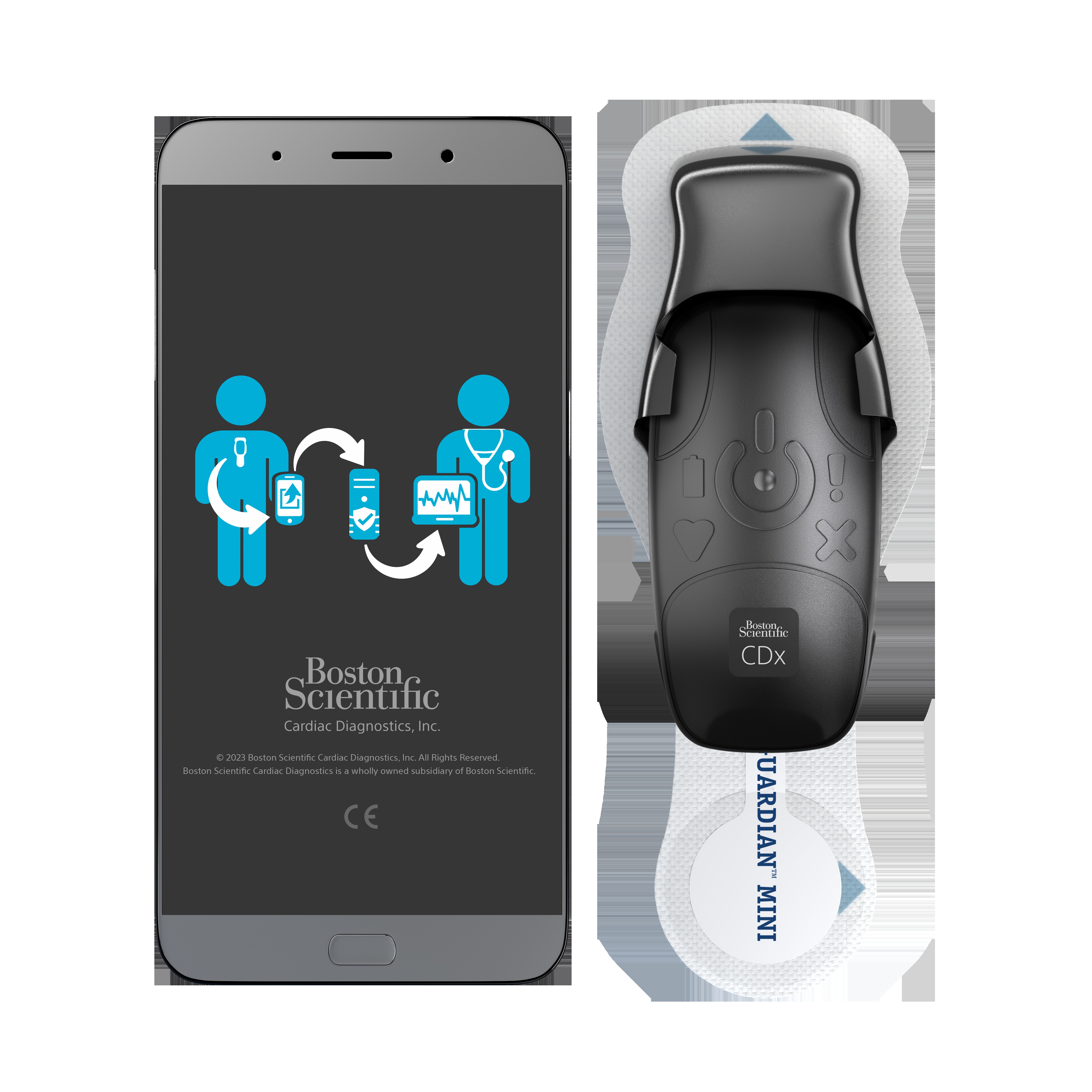
On the software side, BeatLogic analyzes beats and rhythms using specialized deep-learning models. Cardiac technicians review the data; physicians interpret the results. Portals and electronic medical record integrations handle enrollment and delivery. The current business reports more than 1,300 sites with live EMR integration. That is where an impressive recording becomes usable work.
- 01EnrollPractice / EMR
- 02RecordWearable ECG
- 03ReviewAI + technicians
- 04InterpretPhysician
Who owns the report - and the bill?
The customer is usually a physician practice, hospital, or health network; the wearer is the patient. The economics reflect both. In the current split-bill model, Boston Scientific Cardiac Diagnostics supplies monitoring services, retains the equipment, and cleans devices. Physicians review and interpret reports. A purchased-service model lets the facility manage patient billing while buying monitoring, support, and reporting.
PatientCare was described in 2020 as a cloud subscription platform. Yet calling the whole enterprise SaaS leaves out most of the furniture: reusable equipment, monitoring staff, payer arrangements, patient support. Patient responsibility depends on insurance and the service prescribed. Benefits quotes and financial assistance sit beside the product instructions. Reimbursement is part of getting the product used.
Alternatives include iRhythm’s Zio service and Philips’ MCOT offering. Both also combine devices with analysis and reporting. AI with human review is therefore no exclusive advantage. BodyGuardian’s distinction lies in its combination of monitoring modes, wear options, and workflow choices. A practice must compare the configuration it needs, rather than award a trophy to a generic “heart monitor.”
The long route to $925 million
Boston Scientific became an investor and commercial partner in 2015. Five years later, Preventice raised a $137 million Series B led by Vivo Capital. The announced priorities included expanding the sales force, improving technology, and developing clinical evidence. Those priorities suggest a company scaling the machinery around its invention.
Series B funding
July 2020
Upfront acquisition price
Announced January 2021
Preventice recorded $158 million in 2020 net sales, roughly 30 percent above the previous year. Boston Scientific agreed to buy it in January 2021, and closed the acquisition on March 1. The upfront headline was $925 million, with up to $300 million more tied to commercial milestones. The buyer already owned about 22 percent. This was the purchase of a business it had watched closely.
The service continues under its new name. In a feature updated in July 2026, Boston Scientific says BeatLogic processes more than three billion heartbeats daily. That is a manufacturer-reported workload, rather than a measure of better patient outcomes. It does, however, explain the division of labor: software sorts an enormous stream, and people remain responsible for the clinical decision.
The useful thing to copy
The lesson for another founder is to map the entire journey from measurement to decision. Find who supplies the missing service, who reviews the output, and how it enters the customer’s routine. Preventice’s partnerships made those responsibilities concrete. A sensor without that journey would leave a great deal of work for its buyer.
The boundaries remain concrete, too. Telemetry needs the prescribed setup and connectivity; usable recordings depend on proper wear. BodyGuardian does not provide a diagnosis and is contraindicated for patients needing attended in-hospital monitoring of life-threatening arrhythmias. The physician remains responsible for interpretation. The patch extends observation into ordinary life. The service gives that observation somewhere useful to go.